Apple Crisp for One (or Two)

Very easy, very tasty.

One of the great things about living near Wenatchee, Washington’s “Apple Capital,” is the wide availability of fresh-picked apples each autumn. Not only am I able to buy local apples direct from packing companies like Stemilt’s Bountiful Fruit store in North Wenatchee (which ships, by the way), but I can often get out in an orchard and pick the less marketable fruit left behind. Indeed, just last week, after dropping off some passengers for a meeting at an orchard, I walked through an organic gala apple block and picked a half dozen apples that were just too small to pick. (I get cherries and pears like this, too.)

I was invited to dinner at a friend’s house the other day and told my host I’d bring apple crisp. I wanted to make just enough for him and his three guests. So I found a recipe that was easily scalable. It came out great with those galas. So good that I made myself a single serving of hot apple crisp the next day for breakfast.

Here’s my scalable recipe. This will serve one or two.

Ingredients:

  • 1 medium or large apple. I used gala.
  • 2 tablespoons raisins (optional). I didn’t use them. I really don’t care much for raisins, but they do go good in apple crisp.
  • 2 teaspoons sugar. I use raw cane sugar.
  • 1/4 teaspoon cinnamon
  • Pinch of salt (optional).
  • 2 tablespoons light brown sugar. Packed, of course.
  • 2 tablespoons oatmeal. Do not use instant oatmeal. Ever. (Ick.)
  • 1 tablespoon flour
  • 1 tablespoon cold butter. I used frozen butter cut into small pieces.
  • Additional butter to butter pan.

Instructions:

  1. Preheat oven to 350°F.
  2. Butter a small baking dish and set aside.
  3. Cut up the apple and place it in a small bowl. You can cut it however you like; keep in mind that the smaller the pieces, the faster they’ll cook.
  4. Add raisins (if you’re including them), sugar, cinnamon, and salt (if you’re including it). Toss to coat apples with sugar and cinnamon.
  5. Place apple mixture in the prepared baking dish.
  6. Mix together brown sugar, oatmeal, flour, and butter pieces. Using your fingers, blend until the butter is in very small pieces and well mixed in. This could take about 2 minutes.
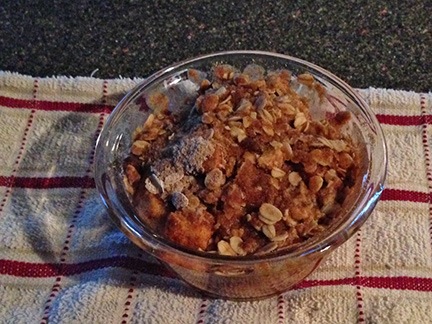
  7. Apple Crisp for OneSprinkle the topping over the apples.
  8. Bake until apple is tender, 30 to 40 minutes, depending on the size of the apple pieces. (If you used a glass baking dish, you should see the apples bubbling in their juices.)
  9. Cool for at least 15 minutes before eating.

This is amazingly delicious with coffee for breakfast or with vanilla ice cream for dessert.

The Life, Death, and Life of the O-Grill

A portable BBQ grill I really like.

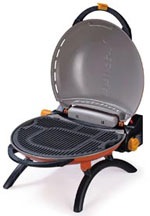
_images_ogrill_open.jpgThe Iroda O-Grill.

Back in May 2010, the first season I drove my “mobile mansion” north for my summer job, I stopped along the way to pick up a portable gas grill. I stopped at the Camping World in Junction City, OR — now apparently closed — for the night and shopped before they closed for the day. I wound up with an Iroda O-Grill: a small clamshell style grill with 225 square inches of grilling space that used a propane cylinder for fuel.

I soon grew to love the grill. It was easy to set up and store, easy to clean, easy to use, and easy to find fuel for. I’d fire it up, let it run on highest temperature for 5 minutes, and clean it with a wire brush. Then I’d turn it down to its lowest setting and grill whatever I liked: steak, fish, vegetables — even tofu. You had to cook on its lowest setting; the darn thing put out so much heat with the lid closed that anything higher than that would cook much too quickly.

I used it all that summer and the next. When I brought the RV back to Arizona for the winter of 2010/11, I even brought the grill home to my house. It was a hell of a lot easier to use than the big Jennaire grill my wasband had bought for the patio — a grill I never seemed to be able to light properly. The darn thing always started on the first button push. Always.

The summer of 2013 was summer #4 for the grill. Although it was just starting to show its age — mostly from the time spent outdoors at the Quincy golf course RV park where it was sprinkled on every night by the irrigation system — but was running perfectly well. That is until it caught fire while grilling up some brats.

The fire was hot and fierce. Water from my poor man’s hot tub nearby extinguished it. With a few twists, the gas can was removed and the danger was over.

Burned Grill   Burned Table
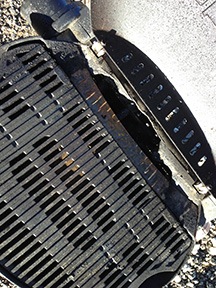
Death of the O-Grill (and the table it sat on).

But my O-Gill had so obviously grilled its last brat. The back of the grill surface was melted off and one of the legs was melted sideways so it didn’t even sit level anymore. Even the folding table it had been sitting on was pretty much destroyed.

I immediately looked for a replacement. Yeah, I know it had caught fire, but it had given me four solid seasons of grilling before that. I liked it. It was worth replacing.

A search online brought up more than just shopping results. It brought up the recall notice. From the notice:

Hazard: The regulator on the grill can leak gas which can ignite, posing a fire and burn hazard to consumers.
Incidents/Injuries: Uni-O has received 10 reports of grills catching fire. No injuries or property damage have been reported.
Description: This recall involves Iroda O-Grill models 1000 and 3000 produced before 2010. Some were also sold under the Tailgate Gear brand. Both models are lightweight, portable, clamshell-type propane grills with steel bodies, cast iron cooking surfaces, retractable legs and a handle. They can be used with either 1-pound propane cylinders or 20-pound propane tanks. The grills come in orange, red, green, blue, silver and black and have the words “O-Grill” stamped on the metal grill cover. Recalled O-Grills do not have ventilation slots in the regulator cover where the propane bottle screws in. Grills with ventilation slots in the regulator cover are not subject to the recall.

Oops.

The notice was more than 18 months old, but I figured that a replacement would be a heck of a lot cheaper than a new grill (which was now selling for $40 more). So I made the necessary phone calls. Eventually, I spoke with a very nice man who asked me some questions about the grill and promised to send me a new one. He even asked what color I wanted. (I picked red.) All he asked is that I send back the old grill in the new grill’s shipping box.

Done and done.

My New O-GrillMy new O-Grill looks a lot like my old one, but it’s red instead of orange.

The new grill, which arrived just yesterday, looks a lot like the old one, although there is a difference in the grill design. This one has a sort of barrier between the grill and the area behind it, near the cover hinge. It works pretty much the same, although I have to admit it doesn’t fire up on the first button push every time. (Not yet, anyway.)

I do recommend this grill. It’s great for camping or tailgating. Very portable and very easy to use. It makes a good complement to my Traeger by providing a quick and efficient way to sear the BBQ sauce on the ribs I’m always smoking.

Cheese: The Cheesemaking Class

I get to see — and participate in — the cheesemaking process.

There’s a cheese maker that comes to Wenatchee Valley Farmer’s Market held each Wednesday and Saturday at Pybus Market: Alpine Lakes Sheep Cheese. As you might imagine, I stopped at their booth tasted some cheese, and bought some. It was very good. I don’t know how I missed it, but my friend didn’t: a rack card that advertised a hands on cheese making class. I went back to the booth and talked to Katha (pronounced with a long a like Kate). The class was five hours long and cost $80. It wasn’t held regularly, like the rack card suggested, but if I could get at least three people to go, she’d do a class.

I immediately thought of my meetup groups and decided to suggest it to the Wenatchee Social and Outdoor Adventure Group. They’re really not big on “adventure” (despite the name) and I thought this might interest them. But I was quite aware that the price tag would likely turn more than a few people off. Still, I got one person to RSVP yes for the August 10 date.

Then I sprained my foot. I wasn’t sure if I could stand for five hours. And I’d failed to get three people.

But Katha assured me that if I was able to attend with my companion, she was willing to do the class with just two of us. So on that Saturday morning, I met with Jill and we carpooled up to Peshastin in my truck. We arrived at 10 AM.

Alpine Lakes has an excellent cheese making kitchen in a converted garage. It has all the things they need to keep the equipment clean and sterile, several cheese making vats in different sizes, draining trays on wheels to capture the whey, and a “cheese cave.” At least a dozen refrigerators line one wall. A set of sinks and dish draining boards make all-important sanitation easy.

Katha was prepared to make four kinds of cheeses: a soft fresh cheese (like cream cheese), a soft ripened cheese (like brie), a hard cheese, and ricotta. She’d already put various quantities of milk into pots or vats and was heating them. The milk was all fresh sheep’s milk from that morning’s milking. The quantities varied from 2 gallons for the fresh cheese to 20 gallons (I think) for the hard cheese.

She explained that each type of cheese used a different culture and required a different temperature. Some cheeses required a very specific temperature while others could be made within a range of temperatures. She let us measure out the powered cultures that came in a foil envelope stored in the freezer and sprinkle them over the milk surfaces. After waiting a short while, we used large skimmer ladles to draw the moistened culture down into the warm milk. After a certain amount of waiting time, we added liquid rennet diluted in a small amount of cool water. Again, we drew the rennet down into the milk, blending it well.

While we waited for the milk mixture to coagulate, Katha kept us busy. We visited her cheese cave — a room off the side of the kitchen with controlled temperature and humidity where cheese is left to ripen. The room was full of shelves where cheeses in various states of the aging process sat waiting for their time to come.

Katha pulled out a tray full of soft-ripened cheese and set it on a worktable. She showed us how the white rind on these cheese is actually a fuzzy white mold that gets more rind-like as the fuzz is pressed down onto the cheese when it’s wrapped. She put us to work wrapping the cheeses.

At around 11 AM, three more women showed up. Katha had been expecting them — they were last-minute participants. She caught them up on what they missed. Soon we were all taking turns wrapping cheese and coating hard cheese in wax.

Katha also pulled out some cheeses for us to taste. I think this was the best part. We tasted the cheeses she usually sells at the market and elsewhere, as well as a few new cheeses and even two cheeses she called “mistakes.” I liked the mistakes a lot — especially the blue-veined one. There was so much about this that I found odd — most of all that if you make cheese, you can’t immediately taste it to know how it came out. Some cheeses need weeks or months to ripen. These “mistakes” were good examples. She knew that she’d done something wrong — or at least something she hadn’t intended to do — but she wouldn’t know whether it would result in an edible cheese for months. I wondered how many other “mistakes” sat on shelves in her cheese cave.

Once the milk had coagulated, it was time to test it for a “clean break” — an indication that there were good, solid curds. Katha demonstrated and each of us tested one of the cheeses. We worked in shifts to cut the curd — large curd for the soft cheese and very small curd for the hard cheese. She had a huge rounded-tip spatula for curd cutting. The hard cheese, which was in the largest vat, required an extra step: curd cutting by dragging a huge wire whisk through it. This was quite a chore that required a great deal of arm and upper body strength. Who would have thought you could get good exercise making cheese?

Through the course of the morning, we scooped the various cheeses into various molds on the whey draining trays. The whey drained away into 5-gallon buckets beneath the trays. Katha told us that she feeds it to her pigs.

Ricotta for Breakfast
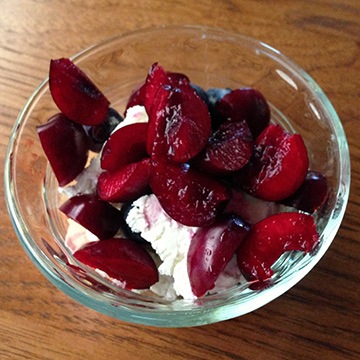
I enjoyed the fresh ricotta cheese for breakfast with fresh fruit.

She also uses it to make ricotta cheese, which is what we did next. She heated about 5 gallons of whey in the now-empty medium sized vat. The whey had to be heated to at least 200 degrees — but could not be heated beyond boiling because it would boil over and make a horrendous mess. It also had to be stirred the whole time. We watched it closely. When it reached the proper temperature, she turned off the heat and added a small amount of vinegar. Small curds immediately began to form. She poured off the contents of the vat into a relatively small cheese bag, letting the whey drain through onto a draining table. After draining and squeezing she had about a quart of ricotta, which she split among the five of us in small plastic containers. I ate it over the next two days with fresh cherries and blueberries from the orchard where I was living along with a small amount of honey from my bees. Amazingly delicious!

Katha took my classmates out to the field to visit with the sheep. Because of my sprained foot, I stayed behind, resting on a chair and munching on cheese.

There was more to the class but I honestly can’t remember the details. I waited too long to write it up. And for some reason I didn’t take any pictures! But I do remember paying an extra $20 at the end so I could take home a bunch of cheese — including those “mistakes” which likely won’t be for sale anywhere.

I’m extremely interested in cheesemaking and, since taking this course, have tried twice to make cheese. My first attempt was probably a success — but I won’t know for sure for another two weeks! My second attempt was a disaster, with a failure of the milk mixture to coagulate properly; I did get a lot of ricotta-like cheese to eat, though. I think my main problem right now is the size of my kitchen (tiny) and my inability to maintain proper “room temperature.” (Remember, I’m currently living in an RV and I detest listening to the constant hum of an air conditioner during the day or heater during the night.)

But I’m very glad I took this course. It taught me a lot about the basic steps of this complex process and what I should expect when I get things right. I recommend a hands-on course like this to anyone interested in making cheese.

Adventures in Cheese-Making

There’s a whole world to explore.

I started making homemade cheese in September 2013 and have been blogging about it periodically. If you’re interested in reading the other posts in this series, follow the Adventures in Cheese-Making tag. Keep in mind that the most recent posts always appear first on this blog.

I love cheese. I mean, who doesn’t?

I love just about any kind of cheese, but I especially love the soft mellow kind like bries. I like cheese that has a secret flavor you can taste only when you let it rise to room temperature before eating and eat it either alone or with a plain cracker. The hint of nuts or earthiness that lingers on your tongue after the cheese has been swallowed.

CheesemongerThere’s an excellent cheese shop not far from where I live: The Cheesemonger in Leavenworth. It — and the smoked meat house called Cured — is the only reason I go to that tourist town. I go early in the day, before the crowds arrive. I prefer taking my motorcycle, since there’s always motorcycle parking right outside Cured. I descend into the basement shop, make my way past the milling tourists nibbling on samples of cheddar and swiss, and find one of the many helpful counter people. Then I place my order, rattling off the names of the cheeses I like best: triple cream brie, morbier, butter cheese, and whatever blue-veined cheese behind the glass catches my eye. I whisper the secret password to get my local discount on checkout, leave a tip, and climb back out into the sunlight while the same milling tourists stand uncertain on how to proceed. In and out in a flash.

If you’re in the area and like cheese — again, who doesn’t? — I highly recommend a visit to this shop.

Anyway, my love of cheese got me interested in making cheese. This interest was fed by my attendance at a cheese-making class I took in early August. Yes, special ingredients and equipment was needed, but it wasn’t difficult to do. And it might be interesting. And heck — the end product was cheese.

It’s not as if this was brand new to me, either. Last autumn, I made yogurt. I’d had a great deal of success with that — so much, in fact, that I made all my own yogurt while I was living in my Arizona house. cheese-making was similar and certainly should be within my capabilities.

Yesterday, I made my first batch of “basic cheese.” Although I won’t be able to taste it for about a month, I also made ricotta cheese from the whey and got to taste that right away.

I realized that my cheese-making adventures were blog-worthy — certainly enough to document for future reference. So if you’re interested at all in making cheese, follow along with me as I take you though my learning process. I’ll write posts in this series as I find time and would certainly love to get comments from other folks exploring home cheese-making.

Me and My Traeger

I enjoy my first rack of ribs, smoked to perfection on my new grill.

Grilling has been a part of my life for the past 30 or so years. I had a grill in Queens (New York), New Jersey, and Arizona. Even when I lived just three months in Yarnell, AZ back in 1995, I bought a little hibachi and used it almost every evening to grill up some meat and vegetables over charcoals for dinner. My old RV had a built-in gas grill and when I got my new RV, the “mobile mansion” back in 2010, I bought a small gas grill to satisfy my craving for grilled food.

I grill year-round, several times a week.

About 10 years ago, I attended a cookout at Prescott’s Love Field airport. My host was cooking on a Traeger Grill. The benefit of the grill was clear: it was fed wood pellets — not gas or charcoal — and it automatically maintained any temperature you set it at. The fact that it was also capable of smoking meat made it something I wanted. Badly.

Time passed. I wasn’t in charge of procuring grills for my home. Someone else was. And he liked gas.

Whatever.

I did have a smoker for a while. I got it from a friend about eight to ten years ago, right before she moved to Colorado. I traded an old bird perch — she has a parrot, too — for it. It was a good-sized traditional smoker with an external firebox and smokestack. It worked well — on the few instances I took the time to use it. Smoking, you see, was all about time — time preparing the wood, time starting the fire, time getting it up to temperature, time checking the temperature, time adding the wood, time checking the temperature, time adding the wood, time checking the temperature — well, you get the idea. When I smoked something, I had to hang around and tend to the smoker. Getting a remote thermometer helped — at least I could monitor the temperature without going outside. But it was still a pain in the butt.

I gave away the smoker. I traded it for a new heating element installed on my hot tub. (Ironically, I gave away the hot tub, too. I traded it for some help moving furniture out of my house last month.)

I’m living in my RV again this summer, prepping to build a custom home on 10 acres of view property in Malaga, WA. That home is going to need a new grill. And this time, I’m in charge.

My Traeger GrillSo I bought the grill I’ve been wanting for the past 10 years. A Traeger.

I bought the “Junior.” It’s the second smallest model and it now comes with the same digital LED thermostat previously available only on the larger, more costly models. Not that the grill was cheap — it wasn’t. But the $50 rebate did help convince me to buy now.

After all, why the hell not?

I bought it at Stan’s Merry Mart in Wenatchee. (I love that store. It’s so funky-weird. Hell, just look at its sign.) Just the day before, a young sales guy had almost talked me into it. I left, thought about it some more, and came back to buy it. They loaded it into the back of my truck with a big bag of mesquite pellets and I drove it back to the Mobile Mansion.

The next day, I assembled it. (If you watch the time-lapse video here, see if you can see the mistake I made and fixed.) But I couldn’t use it that day — I was going to Wenatchee to meet someone new and watch him play softball. Over dinner, I told my new friend about my new grill. I invited him over for the christening celebration: two racks of ribs, smoked. We’d go for a helicopter ride while we waited for the ribs to finish cooking.

And that’s what we did.

Before he came, I prepped the meat by covering it with a mesquite rub. I prepped the Traeger by doing its initial start and seasoning the porcelain grill. Then I turned the thermostat to 250, which brought the cooking chamber up to around 225 — the recommended temperature. I put the ribs on the grill, closed the lid, and went about my business without having to check the temperature or add fuel even once.

Amazing RibsWhen we got back from our flight, the ribs were nearly done. They looked amazing. I made us some salad and corn on the cob, then brushed the smaller of the two racks with BBQ sauce and threw it on my old grill, set to high, to caramelize the sauce onto them.

The finished product was perfect.

What’s next? I’ve been thinking about salmon…