On Words: Helicopter or Chopper?

I fly a helicopter, not a chopper.

When people find out I’m involved with helicopters, they often make comments about choppers. I often get the feeling they’re doing it to make themselves sound knowledgeable or cool. Like they’re in on the industry slang.

But when I hear the word chopper, I think of a ridiculously proportioned, terribly uncomfortable, likely loud motorcycle. Something from Easy Rider. I don’t think of anything that flies.

I don’t use the words helicopter and chopper interchangeably. I fly helicopters. I might see a chopper parked in front of a biker bar or tattoo parlor. I wouldn’t ride one, though. I have two motorcycles I occasionally ride.

I’ve been told that folks who live in San Francisco hate to hear their city referred to as Frisco. I don’t know if it’s true, but I suspect my feelings about the word chopper are similar.

Are you a helicopter pilot or someone who works with helicopters? If so, please do leave a comment letting us know which you prefer. I have to admit that I don’t know any helicopter pilots who call their rides choppers — unless they have two wheels and a kickstand. If you’re one who does, speak up!

A Speck of Red

My helicopter, at the orchard.

Yesterday, after doing some cleanup in my camper, which is now parked at the orchard near my helicopter, I took a drive up the hillside behind the orchard. The road winds up and around, though thousands of acres of fruit trees. When I reached the tall antenna with its scary guy-wires, I spotted a trail from the main road. I parked the truck, grabbed my camera, and went for a tiny hike.

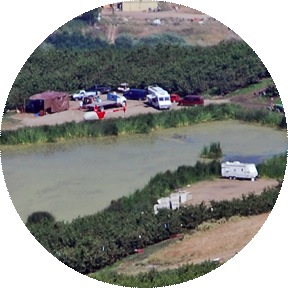
The goal was to shoot the orchard from the hillside behind it. I found a perfect spot and took this photo.

Orchard and Helicopter

CloseupIn the foreground, you can see the orchard’s upper reservoir. Farther down, beyond many cherry trees, is a smaller, algae-covered pond. There’s a parking area on the close side and you can see my trailer parked there. On the far side is a tiny, bright red speck. That’s my helicopter.

To be fair, my helicopter’s cockpit cover is on it, so it’s not fully exposed. I assume it would be a lot easier to see with the cover off. Before I relocate, I’ll pull the cover off, drive back up to this spot, and get a shot. Hopefully, it’ll be a crisper day and I’ll get up there while the light is still good.

In the close-up, you can see the taco truck that arrived not long after I left the orchard. The folks quit working at 10 AM (they start at 5 AM) because of excessive heat. It got up to 107°F in Wenatchee yesterday; I assume it got up to at least 100°F at the orchard some 1500 feet higher in elevation. The guys — mostly Mexican farm workers — were quitting for the day. The grower offers them soda pop and beer at day’s end; I assume they get lunch from the truck.

The helicopter is parked at the edge of the pond with one skid on the gently sloping embankment. A nice easy slope landing site. (And no, it won’t fall into the pond.) There’s a road between it and the shelter (dark reddish). They use the area for staging the cherries — loading them on a flatbed truck for transport up to the chillers and refrigerator truck in the main packing area. I’ll probably get some video footage of the operation later in the week for anyone who is interested. It’s amazing how much work goes into bringing cherries to market. Hard to imagine how anyone can make a profit with prices this year as low as $1/pound.

Not Ready for Solo?

This one is too absurd to pass up without comment.

I was going through the NTSB reports for helicopters today, looking for a specific accident in Arizona that hasn’t yet been listed on NTSB.gov. I did, however find this report that seems to indicate a training problem with a solo student pilot that has 64 hours of helicopter flight time:

According to the pilot, she departed Frederick Municipal Airport (FDK), Frederick, Maryland, about 0745, with an intended destination of Lancaster Airport (LNS), Lancaster, Pennsylvania. The pilot reported that she conducted the cruise portion of the flight at an altitude of 3,000 feet above mean sea level (msl), at an airspeed of approximately 110 knots. After she established communications with the LNS air traffic control tower, and was getting ready to begin her descent to the airport, the pilot noticed that the vertical speed indicator was indicating a descent of approximately 1,000 feet per minute, and that the airspeed was approximately 120 knots. The pilot “raised the collective” pitch control in an effort to reduce or stop the descent, but the helicopter did not respond as the pilot expected, and the descent continued. She determined that she would not be able to reach LNS, and selected a field suitable for a landing. The helicopter landed hard in a soybean field approximately 8 miles west-southwest of LNS. It remained upright, and the engine continued to run after touchdown, until the pilot shut it down using normal shutdown procedures.

The preliminary report goes on to say that when investigators tested the aircraft’s engine, they didn’t find anything wrong with it. It was up to date on all maintenance, the fuel samples were clear, and there was no evidence of a problem.

Is it me or is the problem as simple as what can be gleaned from the above-quoted paragraph? Let’s review:

  • The helicopter was descending at 1000 feet per minute, which is pretty quick, but not nearly as quick as an autorotation or a steep descent from altitude. (I commonly descend at at least 1500 feet per minute when coming off the Weaver Mountains (4500 feet) to Congress (3000 feet) toward Wickenburg (2400 feet).)
  • The helicopter’s airspeed was up to 120 knots from 110 knots. That’s fast, even for an R44. I normally cruise at 110 knots when alone; I have to push pretty hard to get it up to 120 knots without adding power or beginning a descent.
  • The pilot “raised the collective.” Helicopter Flying 101 says that when you pull pitch (raise collective) on a helicopter with a governor or a correlator (or both, as this helicopter has), you’re increasing power.

So the pilot is already zooming through the sky, but she adds power to stop the descent? Doesn’t she understand how the cyclic works? Pull it back to slow down. If you keep your power setting the same, you should also slow your descent rate.

Here’s what I think happened, based on the information provided in the preliminary report and a little research. The pilot was cruising at 3,000 feet. She was “getting ready to begin her descent” to an airport at an elevation of 403 — a required descent of 2600 feet. What she didn’t realize is that she had already begun the descent. Possibly with the airport in sight, she’d pushed the cyclic forward, perhaps to adjust the sight picture of the horizon before her. (This is something I recall doing more than once when I was a new pilot descending from altitude, so I can understand how she might do it, too.) The net result of a forward movement of the cyclic without a power change is to speed up and descend — which is exactly what happened. With a power setting of 18 to 20 inches of manifold pressure, she could easily get into this situation.

Rather than attempt to slow down by pulling the cyclic back, she elected to arrest descent by adding power. This would only make the problem worse if she didn’t add aft cyclic. It was probably a flare near the bottom — perhaps drilled into her by numerous practice autorotations — that slowed her down and enabled her to touch down without slamming any harder into the ground.

What should she have done? As soon as she realized she was going so fast and descending, she should have added aft cyclic. This should both slow her down and reduce her descent rate. It doesn’t matter how much power is available; if the rotors are not stalling, the helicopter will fly. Gentle aft cyclic should enable her to get a better idea of what the problem is — if there is indeed a problem.

But it’s hard to imagine a power problem if there’s no loss of RPM or yawing to the right — neither of which is mentioned as a symptom of the problem. And believe me, if a Robinson has low rotor RPM, you’ll know it — the damn horn starts blaring at 97% RPM; she would have had enough power to fly with RPM as low as 85% (or probably lower).

What do I take away from this? This solo student pilot was not prepared for her solo flight. She evidently did not understand how the controls work together to manage airspeed and climb or descent rates. (This may have something to do with her experience as an airplane pilot.) When she noticed the descent rate and high speed, she possibly panicked and did the first thing that came into her mind: raise the collective to stop the descent. But if she had been properly trained and knew what was going on, she would have reacted properly by simply pulling the cyclic back to slow down and reduce the descent rate.

As a result, a helicopter is destroyed, the NTSB is required to waste time and resources to investigate, and a student pilot, although lucky to be alive, has an accident on her record.

Ash Scattering Woes

Things don’t always go as planned.

I did an ash scattering the other day. Normally, that wouldn’t be a big deal. I’ve done ash scatterings before. (Read about two of them here and here.) But this one didn’t go exactly as planned.

By ash scattering, I mean the aerial scattering of cremains. Cremains is short for cremated remains. That’s what the next of kin get in a baggie and a box when someone is cremated. An ash scattering normally refers to scattering those remains over a large tract of empty land.

My Technique

I should start out by saying that I have ash scattering from a helicopter down to a science. After several trials, I’ve got a technique that works like a charm — for most scatterings, anyway. I get some tissue paper — the kind of paper you might put inside a gift box around a shirt or other item of clothing. I spread it out. The family (or friend) pours the cremains onto the paper. They gather up the corners and sides and twist them at the top to make a kind of paper package of the departed’s remains. This is all done inside, where there’s no chance the wind will foul things up.

Then we climb into the helicopter with the person responsible for scattering the cremains sitting behind me. All doors are on. I start up and fly to the location where the remains will be scattered. I climb to at least 1,000 feet over the target area. Then I bring the helicopter into a high hover — or at least a very slow flight speed.

We close all vents except the one in the ash scatterer’s door. The whole time we’ve been flying, he’s been holding the cremains in its paper package on his lap with the top still twisted closed. He untwists the top and grasps the package by its top. He slips it out through the vent and tosses it gently away from the helicopter.

The package is closed at first, but as it begins its tumbling descent, the wind whips it open. The ashes explode from the paper in a poof and drift away with the wind. The paper also falls to the ground, but since it’s thin, uncoated tissue paper, it’s likely broken down by the elements within a few months or a year.

I like this technique for several reasons:

  • It scatters the ashes with a certain amount of dignity. (One of my clients even bought their own tissue paper. It was printed with a pattern of shoes because the woman who was being scattered had liked shoes.)
  • It prevents the ashes from blowing back into the helicopter when dumped out.
  • It prevents the ashes or their packaging from creating a danger to the helicopter’s tail rotor or other parts.
  • It does an amazing job at scattering the ashes over a wide, open area.

Unfortunately, I didn’t use this technique on Saturday.

Saturday’s Scattering

Saturday’s ash scattering mission was tough for two reasons:

  • The next of kin were the adult children of the two cremated people they wanted to scatter. They were not small people. The lightest one weighed in at 216 pounds. Add me and you have four fatties on board.
  • The ashes were to be scattered over the family orchards, which covered a mere 30 or 40 acres and were surrounded by other farmland and orchards.

Clearly, I’d have to fly lower and use a different technique to scatter the ashes over such a small area. And because we were so heavy, I’d have to drain all but about 15 gallons of fuel out of the helicopter so I had the power I needed to fly low and slow without getting into trouble with the power curve.

We kept it simple. The ash scatterer would sit behind me and dump the two bags of ashes out through his vent. He’d do everything possible to make sure the bag opened on the outside of the helicopter. I made sure he clearly understood what would happen if he let go of the bag and it got into the tail rotor.

I examined both bags of cremains before the flight. The technology has come a long way. The mom’s ashes, created five years ago, were of a sand-like consistency, with very few grains larger than a tiny pebble. The dad’s ashes, created only recently, were powder-like.

We were all in good spirits when we did the flight. I took them out over the target area and made a high reconnoissance as they pointed out the orchard blocks. Apples, pears, and cherries. (Wash your fruit, readers!) The wind was coming from the west at about 7 miles per hour and would really help me deal with the weight I was carrying. I could point into the wind and fly on a diagonal while the scattering was being done behind me. But also to the west was a set of high tension power lines. If I got into a settling with power incident — which I’d have to identify before it became a problem — I’d have to avoid the wires on any kind of escape route. The best thing to do would be to keep moving at a speed above ETL. I’d come in from the northeast for my pass.

With that plan made, the ash scatterer prepared the first bag. I came in over the northeast corner of the first orchard block about 200-300 feet up. On my word, he began dumping ashes out of the helicopter. I could see through the corner of my eye how they streamed behind us. I pointed the helicopter into the wind and flew almost sideways to keep the ashes away from the aircraft as well as I could. I was probably doing about 20 knots ground speed.

The second bag had a small hole in it, which was discovered when the ash scatterer’s sister handed him the bag. (And yes, I still have bits of Mrs. B all over the back seat of the helicopter.) Those remains followed the first. I only had one moment when there was a power issue and I resolved it quickly by picking up speed.

Then we were done.

We made a pass over the family home before returning to the airstrip where I’m based for the summer. I set down on the concrete pad, cooled the engine, and shut down.

Cremains on Helicopter

The white dust you see is the cremated remains of Mr. & Mrs. B.

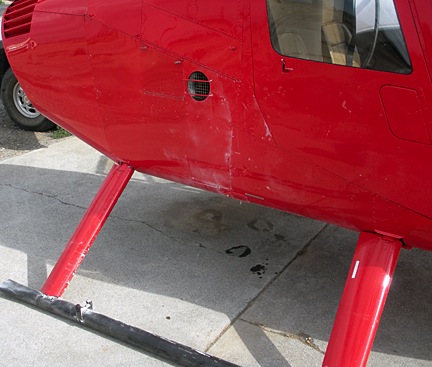
But it wasn’t until we got out of the helicopter that I noticed a fine dusting of Mr. and Mrs. B on the right side of my helicopter.

The family wasn’t the least bit upset about their parents hitching a ride on the side of the helicopter. Or even about bits of mom in the back seat. They were more concerned about cleaning it up for me. But I told them I’d take care of it, after making sure vacuum use wouldn’t bother them.

Then I did a complete walk around of the helicopter, opening up panels to make sure there were no traces of cremains inside any of the compartments. I also looked in the fan scroll area behind the engine. It looked clean, too. The only thing that looked as if it could be a problem was the air inlet behind the right passenger door. As shown in the photo below, it apparently got a heavy dose of dust.

The Extent of the Dusting

I flew the helicopter at least two more hours that day. I gave some rides to a grower’s kids and three hired hands. I flew to Cave B to join the ash scatterers for a celebratory lunch. I flew up the Columbia River as far as Chelan, where I spent the day with a friend, and flew back at high speed along the Waterville Plateau, landing at dusk in 95° heat.

The helicopter flew fine. Cylinder head temperature was up a bit more than average on the last flight of the day, but I figured that was due to my high speed and the hot temperatures. I’d seen it that high before when flying during Arizona summers. It wasn’t anywhere near red line — it was just a bit higher than the tickmark on the gauge where it normally sits.

I’d hoped that Mr. & Mrs. B would get blown off the aircraft, but they didn’t.

Cremains in Air Filter
Cremains sucked into the air intake on the side of the helicopter. The filter will be replaced today.

The air filter had me worried. It would likely need to be replaced. I called my Seattle mechanic on Sunday morning. He proceeded to tell me about all the damage that could be caused by the cremains. Best case scenario: none of it got into the engine. Worst case; it did and was already grinding away at moving engine parts. I was told that symptoms of a problem would include increased oil use and overheating. He promised to overnight the filter for Tuesday delivery.

I went out to the helicopter with a sponge and bucket of clean water and sponged Mr. & Mrs. B off the side of the helicopter. Today, when I go out to change the filter, I’ll bring along a vacuum and inverter so I can vacuum Mrs. B out of the back seat.

And I’ll monitor the helicopter’s operations closely in flight, keeping an eye out for overheating and other indications of a problem.

You can bet that the next time I scatter cremains, I’ll do it with tissue paper and a high altitude drop.

Women Pilots in Another Time

A video.

One of my Twitter friends, keech560, shared a link to this YouTube video. Although I don’t usually embed the videos I like on my blog, this was “a keeper” — a video I want to watch again and remember. It reminds me that women weren’t always accepted in aviation — or many other professions — and gives me an idea of what it must have been like to be the first woman airline pilot.

As you watch this, think about all the fine minds we’ve held back because of gender, race, or other factors. We’re all people; we can all achieve the same dreams — if given the chance.