And I always assumed most helicopter magazine editors-in-chief were helicopter pilots.
Batten down the hatches and prepare for another rant. Not a big one, but one that needs to be shared with my fellow helicopter pilots.
 Yesterday, I got around to reading the February 2010 issue of Rotor & Wing. Rotor & Wing used to be the premier helicopter industry magazine. Somewhere along the way, it turned into a monthly collection of press releases, advertisements, and columns about narrow segments of the helicopter population: North Sea, Military, etc. It improved a bit under the editorial guidance of Ernie Stephens, who added a Helicopter Training column and made some design changes. Now there’s some information of interest to mere mortal commercial operators like me who have absolutely no interest in the politics of the North Sea or unmanned reconnoissance aircraft.
When I read a magazine, I always start with the editor’s page up front. This one, by Editor-in-Chief Joy Finnegan, really stuck in my craw. Titled “Stay Proficient,” it wasn’t about practicing emergency procedures, flying with a CFI, or even staying current with night flight. Instead, it zeroed in on an accident that had been caused by a pilot’s attempt to fly VFR at night into IMC conditions. In other words, a stupid pilot trick.
That didn’t bother me. It’s always good to analyze the mistakes of other pilots and use their situations and decisions as learning tools to avoid the same mistakes in the future. I have done so on several occasions in this blog. (For examples, read “Not Ready for Solo?,” “What if You Crashed a Helicopter and Didn’t Tell Anyone?,” and “Chasing Race Cars Isn’t For Every Pilot.”)
What bothered me were the few revealing statements about her own experience that Ms. Finnegan made, starting with:
I was shocked to learn that many helicopter pilots not only rarely fly IFR, they don’t even bother to keep current.
Hello? Ms. Finnegan? I’d venture to guess that half the helicopter pilots out there — many of which are flying tour, charter, air-taxi, survey, and utility work — don’t even have instrument ratings. I can think of at least a dozen helicopter pilots I know personally who don’t — including me.
She goes on to relate how every flight she did as a commercial airplane pilot was flown IFR, regardless of the weather. She then goes on to make what I consider an insulting statement:
VFR was for amateurs, weekend puddle-jumper jockeys who were out for their $100 hamburger flight.
Nice attitude about your fellow pilots, Ms. Finnegan.
But here’s the paragraph that made me wonder why this woman is Editor-in-Chief of what may still be the best known and most widely read helicopter industry magazine:
But I understand that it’s just the opposite for helicopter operators and that the vast majority of flights conducted in helicopters are VFR. I have also heard that some operators even discourage operations under IFR (again I’m talking flight rules not IMC). This is so very contrary to the way the fixed-wing world works that I had to call around and make sure I understood the situation correctly. After many calls and e-mails, I’m still having difficulty with the concept.
Then why the hell are you editing a helicopter magazine?
I don’t know about the rest of the helicopter pilots out there, but when I turn to a magazine about helicopters and helicopter flight, I want the person responsible for the magazine’s content to be a helicopter pilot. I want that person to know at least what I know about flying helicopters, but preferably more.
And taking two paragraphs to share her own stupid airplane pilot trick — perhaps to show off her ability to follow the instructions of ATC or brag about her coolness in a tough situation — really doesn’t make me feel any better about her experience, capabilities, or connection to the helicopter world.
Instead, I’m left angry by being fed advice by someone who obviously doesn’t have a clue about what helicopter operations are all about.
 If you read about
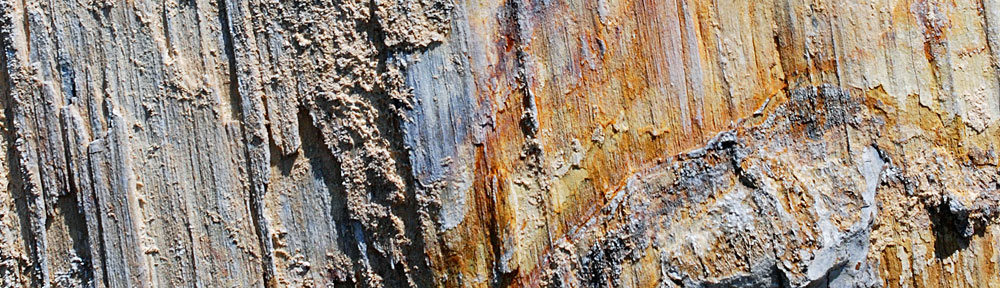
  The course stretches about 30 miles across the open desert east of Parker, zig-zagging on existing dirt roads, including more than a few power line roads. The land out there is mostly old sand dunes like those shown in this photo. (This photo was taken from about 800 feet AGL; the dots are bushes about 3-5 feet tall.) The land here is remote and mostly barren. A bold pilot could fly 50 feet AGL without fear of hitting anything. Except, of course, the power lines.
 Track locations are identified by mile number. There are no visible markers, though — that would make it too easy. Instead, if you’re lucky you have a copy of the course map and have secured it to something so you can consult it in flight. Remember, at least one door is off, so the wind is whipping around the cabin and loose paper is not an option. Although you could put all the mile markers in your GPS, that would make quite a mess. So I just have about 10 points in my GPS and I can use them to home in on the point I need to get to.
 One of the videographers (A) claimed he weighed 260 lbs. I added 10 pounds, as I usually do, for clothes and equipment. I then calculated my weight and balance several ways, hoping he’d choose a back seat location with his 190-lb still photography companion beside him. Earth to video professionals: If you want to do aerial photography from a helicopter, slim down. If you want OGE hovers and aggressive maneuvers, your pilot will need all the performance he can get.
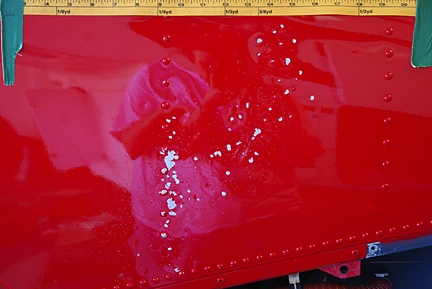
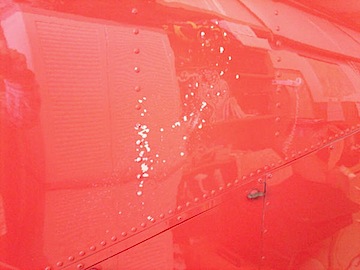 Only one of the videographers (B) had ever worn a harness before. I’d brought mine along and he was very happy to have it. He climbed right in and hooked up. I had to assist the other two with the harness. Tragically, C did not fasten the seatbelt behind him before sitting down and the buckle slipped out of the open door during flight. Dangling there in the slipstream, it did serious damage to the paint on the left side of the helicopter. I can’t imagine how he didn’t see or hear the metal buckle banging, but, as I said earlier, he wasn’t entirely there.
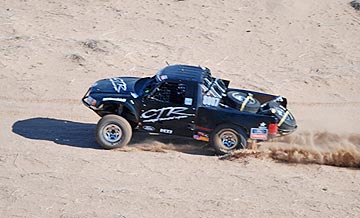 Chase mode. In chase mode, you pair up with the vehicle, putting the photographer(s) in position to shoot. That often means dropping down to 50-100 feet over the desert floor. It almost always means matching the speed of the vehicle you’re chasing. On straight, smooth stretches of road — like one of the power line roads — the vehicle could be going over 100 miles per hour. On roads cutting through lava beds or through canyons or zig-zagging around high tension power line towers, the vehicle could be moving at just 30 miles per hour. The pilot’s job is to keep on the target, always watching out for obstacles and other aircraft, listening to the instructions of the photographer: higher, lower, faster, slower, right, left. It’s tricky when you don’t have brakes or 0-to-60-in-5-seconds acceleration capabilities. I prefer having the photographer sit behind me so I can see the action as well as he can, but that’s not always possible. With two photographers on the left side of the aircraft, I usually can’t see the vehicle — although I can often hear the sound of its engine and passing horn — through my noise canceling headsets and over the sound of the helicopter! — if I’m properly lined up with it. When the photographer has enough footage shot alongside the vehicle, he sometimes asks me to position myself for what I call photo mode.