Sometimes, I REALLY Love My Job

I experience a “magic moment” in the course of doing my summer job.

A little backstory…

Cherry drying (or blowing) is one of those things most folks don’t know about. The short version is this: in the two to three weeks before the cherries are ready to harvest, if they get rained on they can split or rot, making them unmarketable. If a grower loses 50% or more of his crop to splits or other water damage, he won’t bother picking at all and the entire crop is lost.

So to protect the crop from this kind of damage, growers hire helicopter pilots with helicopters to stand by during the period before harvest. When it rains, they call us out to hover low over the trees. Our downwash blows the tree branches and shakes the water off the fruit, “drying” it. It’s tedious work that requires a good bit of concentration to deal with wind and obstructions. And it can be dangerous — in fact, there were three crashes in the area last year, one of which took a young guy’s life.

This is my fifth season doing this kind of work.

It was late afternoon on a day with drifting storm clouds. I was on call for cherry drying and had already gone out once, earlier in the day.

When I wasn’t flying or prepping the helicopter, I’d spent a good part of the day watching the weather radar on my iPad. Various colored blobs were drifting across from the west, after a gradual shift from their southwest to northeast direction earlier in the day. Rain varied in intensity from a light drizzle to torrential downpour. Every time a storm hit or missed an area, there would be another one right behind it to possibly do the same. Sometimes the rain was so intense that the storm would drain itself and the colored blob would fade as it tracked across the screen.

I was only on contract with one orchard: a 30-acre block of mostly very mature trees near the Columbia River. The grower was very careful about his orchard and, during the vital period, normally spent all day just about every day among his trees. Sometimes he’d mow the long strips of grass in the aisles between them. Other times he’d tinker with the tractors and other equipment he needed to care for his crop. Still other times, he worked on his shop, patching insulation, repairing a roof, adding a wall. Smart phones and good cell service — not to mention a good pair of eyes — had made it relatively easy for him to track the weather throughout the day. But he occasionally called or texted me at my base seven air miles away, where I had a better look at the sky and a bigger screen to watch the radar blobs.

I saw the storm coming on radar and confirmed it with a look outside. It was across the river to the west, heading right for the orchard. While there was a chance it might rain itself out before it arrived, I suspected it might not. Already still suited up from my flight a few hours before, I headed back to the helicopter to pull off the blade tie downs and prepare to fly.

Low CloudsThe sky was intensely dark out toward the river and the storm was definitely heading in my direction. But what was even scarier was the low hanging cloud near me that seemed to be swirling gently like something from a Weather Channel tornado special. I watched it for a while, wondering whether the storm was really intense enough to get a tornado going. It didn’t seem to be.

My phone rang. It was my client. “Work your magic,” he said.

It took me a second to comprehend his words. “It didn’t even start raining here,” I said.

“It poured like hell on the orchard,” he told me. “It’s stopped now. Come on out and dry.”

I hung up and moved my truck out of the way. By the time I was hurrying back to the helicopter, big raindrops were falling on me. The swirling cloud was gone.

I started up and began the warm up process. It wasn’t until I was pulling on my helmet that I realized I’d forgotten to take my door off. This could be a problem if the sun came out and it warmed up; the helicopter would become like an oven every time I faced the sun. But the sky was dark and that didn’t seem likely. Ah, little did I know…

By the time I lifted off the pad, the rain was dumping on me. The cockpit bubble was wet with a million drops. I pushed the cyclic forward and accelerated into my climb. The drops ran off the sides, clearing the window enough to see. I turned to the west and flew right into a wall of hard rain.

When I flew at the Grand Canyon back in 2004, we had a sort of mantra for dealing with heavy rain: if you can see through it, you can fly through it. This rain was so intense that I could barely see brightness in the sky beyond it. I was flying at about 200 feet off the ground — just high enough to clear the local power lines but probably not high enough to clear the high-tension power lines I knew were up ahead. The air was remarkably calm, so at least I didn’t have to deal with turbulence. I climbed cautiously, heading west, flying at 110 knots, focused on reaching the orchard quickly.

The sky brightened. The rain lessened. Then I was through the storm, on the other side, flying into what looked like a beautiful day.

A really beautiful day.

Ahead of me, the sun was shining brightly, sending patches of light through broken clouds onto the yellow-green hillsides beyond the Columbia River. Some low-level clouds were floating at my altitude over the river and beyond. Wisps of clouds were wrapping themselves around hilltops like winter scarves around thick necks. The sky had a kind of three-dimensionality I rarely get to see.

And over my right shoulder, back in the dark storm I was passing, was a double rainbow.

There are times that I can only classify as magical — times I wish I could bottle up and save, just so I can open them up to re-experience them when I need a little magic in my life. This was one of those times.

I realized, in a flash of clarity, that I really loved doing what I do.

I call myself a writer, but in all honesty, there’s no way I can express, in words, the feeling I get when I experience one of these moments. I can try to describe what I see. I can try to paint a picture for my reader to see something similar in his own mind as he reads my words. But in truth, there’s no way to share this kind of experience after the fact. It’s a moment in time and space — something that becomes part of me. It’s like a happy little secret I’m forced to bear, unable to share it with anyone else.

It’s moments like these that make my life worth living.

I cleared the big wires, reached the edge of the plateau, and lowered the collective almost to the floor to start a steep descent down to the river. The water was smooth, reflecting the clouds in a magnificent sky. Everything below me looked fresh and clean and wet. I descended at 1200 feet per minute over the river, then pulled the cyclic back gently to slow my airspeed and descent rate. Coming in over the orchardI came in over the orchard in a grand, swooping arc, settling in at the southeast corner in a hover over trees nearly as old as I am.

And then I got down to work, hovering back and forth, up and down the rows of trees, performing the tedious task I was paid to do.

From my seat only a few feet above the treetops, I could clearly see the bright red fruit and the droplets of water clinging to them. I could see my downwash shaking the tree branches all around me. Everything was very wet, but with only one pass, most of that water was shaken and blown down to the ground.

Sunset Cherry Dry

Golden Light

I stole glimpses of the river and sky and cliffs. It was early evening on a Washington day when the sun would set well after 8:30 PM. The sun played peek-a-book with thin strips of clouds. The sunlight illuminated the cliff faces in a golden light.

On the ground out on the road in front of the orchard, my client stood outside his truck, snapping photos with his camera. Inside the front passenger seat, I saw his mom. She waved once but, with both hands fully occupied, I couldn’t wave back. Later, the truck was in the orchard, near the shop building. The photos started arriving on my cell phone, which was docked in a cradle within reach, a while later. I wouldn’t be able to see them until much later.

It took over an hour to do the whole orchard. It always does. It’s a tough dry, with trees of varying ages and heights, a gentle slope, a deep gully, and some nasty wires right at rotor height along one side of the orchard. I spend a lot of time flying sideways so I can keep low on a downhill stretch without getting my tail rotor in the trees behind me. But finally I was done. I did what I think of as my “victory lap,” a fast, low-level flight diagonally across the orchard, gaining speed before pulling the cyclic back to start a steep climb up the cliff face.

At the top of the cliff, thin clouds were thickening, forming a fog layer that would soon be too thick to pass through. I squeezed through a gap in the clouds and pointed the helicopter east, toward my home base.


Note: Many thanks to Patrick, my client, for providing the in-flight photos that appear in this post and on Facebook.

Malaga Springs to Martin Scott by Helicopter

Another nosecam video.

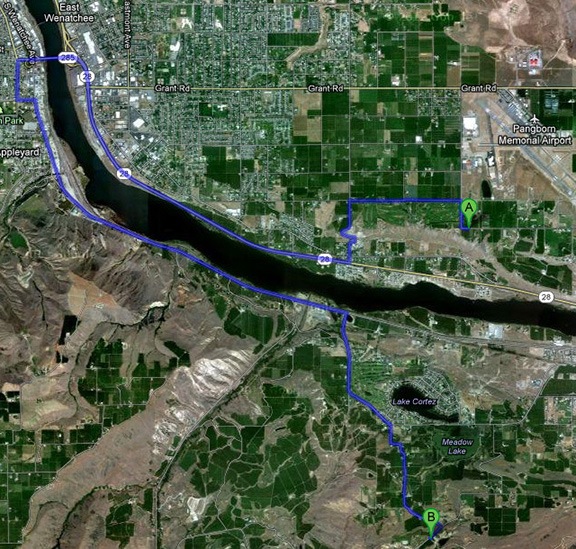
On Saturday, I spent a good portion of the day flying between Martin Scott Winery in East Wenatchee, WA and Malaga Springs Winery in Malaga, WA. I use my helicopter to offer wine-tasting tours for part of the summer season. These are just two of the four (so far) wineries that have suitable landing zones for me and encourage me to bring people there.

As shown in the map below, the two wineries are on opposite sides of the Columbia River. To drive from one to the other, it’s 12.5 miles and will take (according to Google Maps) about 31 minutes. Malaga Springs is a bit tough to find and the last 1.4 miles is on a gravel road. I drove to it just the other day and was convinced I was going the wrong way when I spotted a winery sign that said “Keep the Faith” and encouraged me to continue on my way.

Martin Scott to Malaga Springs

By helicopter, however, it takes less than 2.5 minutes on a direct flight across the river.

Yesterday, I flew nine people from Martin Scott to Malaga Springs and back. For some of those flights, I had my GoPro “nosecam” set up and turned on. Since it’s been so long since I shared a “nosecam” video, I threw one together Saturday night and uploaded it Sunday morning. Here it is:

Interested in a wine-tasting tour by helicopter? Learn more on Flying M Air’s Web site.

Transponders for Dummies

Get the facts straight.

One of the podcasts I listen to on my morning walk is called Stuff You Should Know. Produced by the folks responsible for the How Stuff Works website, Stuff You Should Know is a pretty thorough discussion of a specific topic by two hosts, Josh and Chuck, who base their discussion on a website article and some of their own research. It’s a great way to learn new things when you’re stuck doing something mindless — like walking, driving, flying, etc. So far, I’ve learned about revenge, diamonds, Atlantis, social security numbers, air traffic control (ATC), and bullfighting. You can find its RSS feed here.

The April 24, 2012 episode of the podcast was titled “How Air Traffic Control Works.” It was based on a How Stuff Works article of the same name by Dr. Craig Freudenrich. The article was very detailed; the podcast was based on that article and several other articles on How Stuff Works.

As a pilot, I know quite a bit about air traffic control — but not everything. The article (and podcast) was mostly concerned with ATC as it relates to airliners. After all, that’s how most people interact with aviation. But I’m involved with general aviation (as opposed to airline aviation or military aviation). And, as a helicopter pilot, I don’t interact with ATC nearly as much as, say, an instrument rated pilot flying a King Air from Phoenix to Seattle.

So I was hoping that I could learn something new. And I did.

But I also heard the podcasters misinforming listeners about transponders (among a few other things). And if there’s one thing I hate, it’s when an informational article or podcast or video — or anything else — includes errors. So I thought I’d set things straight.

What Is a Transponder?

Garmin Transponder
This is the Garmin 330 Transponder I have in my helicopter.

A transponder is a part of an aircraft’s avionics. It assists air traffic control by making it easier for ATC radar to “see” an aircraft. It basically sends out a signal that says “Here I am!” ATC radar can pick up this signal, along with any additional information encoded within it, to plot the aircraft as a “blip” on the radar display and differentiate it from other aircraft.

Transponders include a feature that enables the pilot to send a specific “squawk” code. Normally, in VFR (visual flight rules) flight, an aircraft’s transponder is set to send the code 1200 — in fact, this code is used so often that many transponder models — including mine — have a VFR button the pilot can press to quickly enter that code.

IFR (instrument flight rules) flights are assigned a discreet discrete squawk code. This code is used by ATC to identify that particular aircraft. Sometimes, when operating within tower-controlled airspace, ATC will assign a discreet discrete code to a VFR flight. Or perhaps a specific code is used by signatories to a letter of agreement between ATC and pilots — for example, 0400 is used by Sharp Alpha signatories in the Phoenix class bravo airspace.

Most transponders are equipped with automatic altitude reporting features, which is known as Mode C. Indeed, Mode C transponders are required within 30 miles of a class Bravo airport — think major airports like the kinds most airlines serve — and in a bunch of other places detailed in Part 4-1-20 of the Aeronautical Information Manual (AIM), “Transponder Operation.” (This, by the way, is an excellent resource for learning more about transponders in general.) Mode C transponders interface with an aircraft’s altimeter to get the altitude of the aircraft and send that information to ATC.

Garmin 420 GPS
My Mode S transponder interfaces with my Garmin 420 GPS to show traffic when information is available. I blogged about this here.

A Mode S transponder, which is what I have on my helicopter, is also capable of two-way communication with ATC radar. In certain radar coverage areas — primarily near Class Bravo and Class Charlie airspaces — a Mode S transponder receives traffic information from ATC. This information can then be plotted on compatible GPS equipment to create a simple traffic information system (TIS).

There are some other things about transponders that are interesting, including the fact that there are special squawk codes a pilot can use in certain emergency situations. And although the transponders were turned off on the 9/11 airliners, that didn’t make them invisible; it just made it impossible for ATC to definitively identify what they were.

What the Stuff You Should Know Guys Said

There’s no transcript available for the podcast, so I had to create one for the part that irked me. It was related to when the transponder is turned on and what the transponder is/does.

At 22:55, Josh has just described how the tower controller hands off the airplane to a departure controller.

Chuck: All right, so now we’re in the air, we are enroute. And you have to, if you’re a pilot, activate your transponder, which will basically make you the little blip on the radar. Very important thing to do.

Josh: Yeah.

Chuck: That’s how they can follow you as you move across the country. Or around the world.

Josh: [laughter]

Chuck: Right?

Josh: You are covering all bases on this episode.

Chuck: Well, the little blip is going to obviously represent your plane and it’s going to have your flight number, your altitude, your airspeed, and your destination.

Josh: Uh-huh.

Chuck: And, uh, so where are we now?

Josh: It’s also how they find you if you go plummeting into the ocean or the earth.

Chuck: Sure. Is that the black box?

Josh: Uh, I think that’s probably a part of the transponder.

Chuck: Okay. Yeah.

Then they continue talking about what TRACON does.

What’s Wrong

There are a few things wrong with this.

First, a pilot usually turns on the aircraft’s transponder when he (or she, of course) powers up the rest of the avionics, including the radio. On my helicopter, in fact, the transponder turns itself on automatically when I turn on the “Master Battery” switch, which provides electrical power to the helicopter before I even start it.

Part 4-1-20 of the Aeronautical Information Manual (AIM), “Transponder Operation,” states:

3. Civil and military transponders should be turned to the “on” or normal altitude reporting position prior to moving on the airport surface to ensure the aircraft is visible to ATC surveillance systems. IN ALL CASES, WHILE IN CONTROLLED AIRSPACE EACH PILOT OPERATING AN AIRCRAFT EQUIPPED WITH AN OPERABLE ATC TRANSPONDER MAINTAINED IN ACCORDANCE WITH 14 CFR SECTION 91.413 MUST OPERATE THE TRANSPONDER, INCLUDING MODE C IF INSTALLED, ON THE APPROPRIATE CODE OR AS ASSIGNED BY ATC. IN CLASS G AIRSPACE, THE TRANSPONDER SHOULD BE OPERATING WHILE AIRBORNE UNLESS OTHERWISE REQUESTED BY ATC.

(The FAA used those caps; I didn’t. I guess they wanted to shout about it.)

So the FAA says to turn on the transponder before you move the aircraft and keep it turned on during flight. The pilot does not wait until the flight is turned over to departure control to turn it on. It’s already on. In fact, it’s one of the ways ground control can track the airliner as it taxis between the runway and the gate.

Note: I was fortunate enough to be able to visit the Phoenix TRACON and tower back March 2012. I got to see the radar screens and their blips firsthand. It’s interesting to note that there are no windows in the TRACON facility. It’s a dark room filled with computer screens. If you’ve seen the movie Pushing Tin, which was mentioned in the podcast, you’ll get the idea.

So although the podcast guys made a big deal over the fact that ground controllers are only one of two kinds of controllers that can use binoculars, the reality is that only ground controllers and tower controllers have windows to look out of. They’re the only ones close enough to the airplanes they guide to actually see them.

To say that activating the transponder “makes you the little blip on the radar” is misleading. Radar does not need a transponder to see aircraft traffic. After all, do you think fighter planes use transponders when they’re out on patrol or attack? If a transponder was required to put an aircraft on radar, there would be no need for stealth technology. Instead, radar works by bouncing radio waves off objects. It doesn’t need a transponder signal. The transponder simply makes it easier for ATC radar equipment to find targets and provides additional information to ATC.

While it’s true that a radar blip might include an airliner’s flight number, this information is not sent by the transponder. The transponder sends the discrete squawk code assigned to the airplane from its flight plan. The ATC computer equipment looks up the code in the flight plan database and provides the information from the flight plan on the blip.

Josh is partially right when he says that the blip is how they find you if you crash. The transponder helps keep the aircraft on radar. Radar tracks where you are. But there comes a point — especially in remote or mountainous terrain — when radar coverage is limited. If you are flying too low, you can literally fly “below the radar” and not be tracked. Helicopter pilots commonly fly this low — that’s why its so difficult to get flight following in certain areas. An airliner should never be that low, but if it’s having trouble, it may disappear off radar before an actual crash. So although a transponder and the resulting radar blip can help locate a downed aircraft, it doesn’t guarantee that it’ll be found. Think about Steve Fossett. His plane likely had a transponder, yet he wasn’t found for well over a year after his crash.

Chuck and Josh are completely wrong when they suggest that the black box is part of the transponder. It’s not. They’re two completely separate devices. The transponder sends live information to ATC as an aircraft moves around on the ground and in the sky. Most aircraft have them. The black box is a virtually indestructible device that records data during an aircraft’s operation and stores it in the event of a mishap. Only aircraft providing certain air transportation services have them. For example, although I have a transponder on my helicopter, I don’t have a black box.

It’s interesting to me that the guys got this so wrong when the How Stuff Works website actually has an article called “How Black Boxes Work.” Maybe they should have read it?

Other Things

In listening again to parts of the podcast — mostly to find the passage quoted above — I heard other things that weren’t quite right. That bugs me. It calls into question the rest of the podcast — the stuff I don’t already know for sure. It also calls into question other podcasts that these guys do. How factual are they?

When I’m listening to a podcast titled “Stuff You Should Know,” I expect it to be factual, not conjectural. If these guys are guessing about something, they should make it clearer that it’s a guess. To state that a pilot activates a transponder after the aircraft is enroute and handed off to departure control is an incorrect statement of fact. To say “I think” a transponder is part of the black box helps identify it as conjecture or a guess, but is there really any place for guesses in a podcast like this?

Or am I expecting too much?

Why I Spent $11,524 to Replace Perfectly Good Fuel Tanks on my R44 Helicopter

The short answer: Lawyers.

I’m not sure when the brouhaha began.

It might have been right after this crash, when a helicopter operating at or near gross weight at an off-airport landing zone in high density altitude situation by a sea level pilot crashed, killing all four on board and starting a forest fire that raged for two days.

Or it could have been earlier, after this crash, which I blogged about here, when a helicopter operating 131 pounds over the maximum gross weight for an out of ground effect hover by a brand new helicopter pilot low-level at an off road race crashed, severely injuring all three people on board.

I’m sure it was before this crash, when a 250-hour pilot landed to “relieve himself” at an off-airport landing zone with a density altitude of at least 11,000 feet, then panicked when he got a low rotor horn and aux fuel pump light at takeoff and botched up a run-on landing on unsuitable terrain, severely injuring himself and his wife.

These three cases have two things in common (other than pilots who did not exercise the best judgement): the helicopters were R44s and the crashes caused fires that injured or killed people.

Crash an Aircraft, Have a Fire

Of course, if you crash any kind of aircraft that has fuel on board hard enough into terrain, a fire is likely to result. Fuel is flammable. (Duh.) When a fuel tank ruptures, fuel spills. (Duh.) If there’s an ignition source, such as a spark or a hot engine component, that fuel is going to ignite. (Duh.)

I could spend the rest of the day citing NTSB reports where an airplane or helicopter crash resulted in a fire. But frankly, that would be a complete waste of my time because it happens pretty often.

Don’t believe me? Go to http://www.ntsb.gov/aviationquery/index.aspx, scroll down to the Event Details area, and enter fire in the field labeled Enter your word string below. Then click Submit Query and check out the list. When I ran this search, I got more than 14,000 results, the most recent being a Cirrus SR22 that crashed on April 27, 2012 — less than 2 weeks ago.

The Knee Jerks

But Robinson reacted in typical knee-jerk fashion. After issuing a ridiculous Safety Notice SN-40, “Postcrash Fires,” that recommended that each helicopter occupant wear a “fire-retardant Nomex flight suit, gloves, and hood or helmet,” they began redesigning components of the helicopter’s fuel system. First they redesigned the fuel hose clamps and issued Service Bulletin SB-67, titled “R44 II Fuel Hose Supports.” Then they redesigned the rigid fuel lines to replace them with flexible lines and issued Service Bulletin SB-68, titled “Rigid Fuel Line Replacement.” And then they redesigned the fuel tanks to include a rubber bladder and released Service Bulletin SB-78 (superseded by SB-78A), the dreaded “Bladder Fuel Tank Retrofit.”

Why “dreaded”? Primarily because of the cost of compliance, which was estimated between $10,000 and $14,000.

Originally released on December 20, 2010 (Merry Christmas from the folks at Robinson Helicopter!), Robinson did give us some breathing room. The time of compliance was set to “As soon as practical, but no later than 31 December 2014.” I did the math and realized that my helicopter would likely be timed out — in other words, back at the factory for overhaul — before then. But the February 21, 2012 revision moved the compliance date up to December 31, 2013. At the rate I was flying — about 200-250 hours per year — it looked as if I’d still be flying it when December 2013 rolled along.

Is it Required?

I talked to my FAA POI. He’s the guy that oversees my Part 135 operations. He’s a good guy: reasonable and easy to talk to. He doesn’t bother me and I try hard not to bother him. After all, he’s got bigger operators with bigger headaches to worry about.

We talked about the Service Bulletin. Neither of us were clear on whether the FAA would require compliance for my operation. After all, it was a Service Bulletin, not an Airworthiness Directive (AD), which is definitely required.

We left off the conversation with acknowledgement that I didn’t have to do anything at all for quite some time. We’d revisit it a little later.

Pond Scum

Around this time, I was contacted by a lawyer representing the family of the 250-hour pilot who crashed in the mountains because he had to “relieve himself.” This guy had seen my blog posts about my problems with my helicopter’s auxiliary fuel pump — perhaps this one or this one or possibly this one. Or maybe all three.

He was looking for an “expert witness” to provide information about the problems with the fuel pump. It was clear that he was trying to pin the blame for his clients’ injuries on the fuel pump manufacturer and Robinson Helicopter. Not on his client, of course, who had caused the accident by making a series of very stupid decisions. Apparently, Robinson is supposed to make idiot-proof helicopters.

I got angry about the whole thing — lawyers shifting the blame to people who don’t deserve it — and responded as you might expect. I also blogged about it here.

I didn’t make the connection between lawyers and bladder fuel tanks. I believed — and still believe — that it’s not unreasonable for post-crash fires to occur in the event of an aircraft accident. It’s part of the risk of being a pilot. Part of the risk of flying.

The Buzz and Insurance Concerns

Meanwhile, the Robinson owner community was buzzing with opinions about the damn bladder fuel tanks. Some folks suggested that they’d been developed as a means for Robinson to make money off owners in a time when helicopter sales were slow.

Maybe I’m naive, but I don’t think that’s the case. I think Robinson was just trying to protect itself from liability. By offering this option, it would be up to the helicopter owner to decide what to do. If the owner didn’t get the upgrade and had a post-crash fire, Robinson could step back and say, “The new fuel tanks might have prevented that. Why didn’t you get them? Don’t blame us.” And they’d be right.

And that got me thinking about my insurance. So I called my insurance agent, who was also a friend and helicopter pilot. The year before, he’d managed to come up with an excellent and affordable policy for R44 owners and I’d switched to that policy as soon as my existing policy ended. Would I be covered if I didn’t get the tanks installed right away? He told me that of course I’d be covered. The compliance date wasn’t until December 31, 2013.

Buy Now, Save Money?

I also talked to my mechanic. He told me that the tanks were on back order and it could take up to eight months to get them. I was also under the impression that the cost of the tanks was going to rise at the end of 2011. And that if I ordered the tanks, I wouldn’t have to pay for them until they arrived. I figured that once they arrived, I’d store them until I was ready to have them installed. Or maybe even hold onto them until overhaul.

So I ordered them in late December, right before the Robinson factory closed for the holiday break.

I’d been misinformed. I had to pay for them up front: $6,800. Merry Christmas.

And, oh yeah: the price didn’t go up, either.

A Horrifying Scenario

Time went by. I thought about the damn tanks on and off throughout the winter months. In February, during my occasional checking of accident reports, I saw this report about an R44 with a post-crash fire. It got me thinking about liability again.

And then I started thinking about lawyers, like that sleezebag who had contacted me. And my imagination put together this scenario:

My helicopter crashes and there’s a fire. One of my passengers is burned. Although my insurance covers it, the blood sucking legal council my passenger has hired decides to suck me dry. He claims that I knew the fuel tanks were available and that they could prevent a fire and that I neglected to install them. He puts the blame squarely on me. My insurance, which is limited to $2 million liability, runs out and the bastard proceeds to take away everything I own, ruining me financially forever.

Not a pretty picture.

Is this what Robinson intended? I’d like to think not. But I’m sure that as I type this, some lawyer in Louisiana is working on a case using the logic cited above. The pilot might be dead, but his next of kin won’t have much left when the lawyers are done with him.

I started thinking that I may as well install the damn tanks — just in case.

Dealing with Logistics

In late March the fuel tanks were delivered. It cost another $310 for shipping. The two boxes weren’t very heavy, but they were huge. I had them delivered directly to my mechanic.

And then I started thinking about logistics. I had originally expected the tanks to arrive during the summer while I was gone for my summer work in Washington state. I figured I’d have them installed at my next annual or 100-hour inspection near year-end. But here they were, waiting for installation any time I was ready.

But when would I be ready? My mechanic said it would take about 10 days (minimum) to install them. Because the tanks had to be fitted to the helicopter, it was a multistep process:

  1. Remove the old tanks.
  2. Put on the new tanks and fit them to the helicopter. (Metal work required.)
  3. Remove the new tanks.
  4. Paint the new tanks.
  5. Reinstall the new tanks.

Most of that time was taken up with getting the tanks painted and waiting for them to dry.

Logistics is a major part of my life. I’m constantly working out solutions for moving my helicopter and other equipment to handle the work I have. I’m also constantly trying to schedule any maintenance at a time when I’m least likely to need to fly. This spring was especially challenging: I had to get my truck, RV, and helicopter up to Washington before the end of May. I also had to go to Colorado to record a Lynda.com course before the end of May.

So on April 13, I flew the helicopter down to my mechanic in Chandler and asked my friend Don to pick me up (in his helicopter) and take me home to Wickenburg. Then, the same day, I started the 3-day drive in my truck with my RV to Washington. I arrived on April 15. A week later, on April 22, I took Alaska Air flights to Colorado, where I stayed for another 6 days. Then, on April 28, I flew directly back to Phoenix. Don picked me up at the Sky Harbor helipad and dropped me off at Chandler. All the work on the helicopter was done and it looked great. I flew the helicopter back to Wickenburg that morning. Two days later, on May 30, I picked up passengers in Scottsdale and began the 2-day flight to Washington. We arrived on May 1.

ItemCost
Fuel Tanks$6,800
Shipping$310
Tank Installation$3,960
Tank Painting$454
Total Cost$11,524

The installation and painting had cost another $3,960 and $454 respectively, bringing my total for installing the damn bladder fuel tanks to $11,524.

I Blame the Lawyers

So, yes, I spent $11,524 for tanks that might only benefit me in the event of a crash. No guarantees, of course.

I didn’t need the tanks. They didn’t make flight any safer or better. They only might make crashing safer.

And the only reason I did this is so that a lawyer couldn’t point his finger at me and blame me for ignoring a Service Bulletin that wasn’t wasn’t required by law until (maybe) December 31, 2013.

The only reason I did this was to possibly prevent a lawyer from taking away everything I own, everything I’ve worked hard for all my life, in the unlikely event that my helicopter crashed and a fire started.

Do you want to know why aviation is so expensive? Why it costs so much to fly with me? Ask the lawyers.

About the Golf Ball Drops

Your questions, answered.

Yesterday, I did a golf ball drop. I have another one scheduled for today. And I’ve done at least three of them in the past. (You can read a blog post that details one of them and see a video of another drop embedded in this post.) Here’s a shot from my helicopter’s skidcam to give you a better idea of what it looks like:

Golf Ball Drop

The Tweets

Last night, when I tweeted:

Today’s golf ball drop had 2100 balls. Just learned that tomorrow’s will have 4900. Can you even IMAGINE that many golf balls? Not me.

I got two replies:

mjburian
I don’t understand (but I’m intrigued). You’re dropping them from altitude? Where? Individually?

Daniel_Loxton
Wait, what? Why would someone drop golf balls (or any solid object) out of a helicopter? http://www.youtube.com/watch?v=ST01bZJPuE0

(The link is to a pertinent WKRP in Cincinnati video clip; watch it if you haven’t seen it before.)

So I figured I’d explain what this is about.

Golf Ball Drop Explained

A golf ball drop is usually a charity or fund-raising event. The fundraisers “sell” numbered golf balls for a set price. The balls are taken up in a helicopter and dropped from 200-300 feet onto a target which is normally a standard sized golf hole or cup. Often, a ring of lines is drawn around the target on the grass to mark different levels of prizes. The ball(s) that go in the cup or are within the rings or are even just closest to the center of the target win the prize(s). The money left over after paying for the helicopter, the balls, and the prizes makes up the proceeds from the fund-raising event.

Normally, this is a big spectator event. After all, who doesn’t like helicopters? Who wouldn’t want to watch something being dropped out of one? It’s a fun way to raise money.

Safety Issues

As a safety-conscious pilot, I do everything in my power to make the flight as safe as possible. The dropper sits behind me, strapped in with his door off. All the other helicopter doors are on to limit the possibility of loose items flying out another door.

The balls are usually stored in bags or boxes on the seat beside the dropper. He drops them out the open door — which is on the side opposite of the helicopter’s tail rotor. The balls generally go straight down, but some do bounce off the skid. I’ve never had one bounce dangerously, but I do leave my door on in to prevent one from bouncing back into the cockpit and getting under my pedals.

Below us, the target area is clear of all people and non-essential equipment. I allow only one passenger — the dropper — on board and run with minimum fuel to keep the aircraft light. I point into the wind during the hover.

The only real danger to the flight is the out of ground effect hover right smack dab in the middle of the deadman’s curve. In the unlikely event of an engine failure, things would get ugly fast.

Yesterday’s Drop

Yesterday’s drop was done at the CrackerJax Family Fun Park less than 1/2 mile from Scottsdale Airport. This required additional coordination with the Scottsdale Tower, since CrackerJax is right under the helicopter approach path to the airport.

It was done to raise money for the notMYkid charity. There were a total of 2,100 balls preloaded into 11 very nice drawstring canvas bags. Due to the size and weight of that many balls — an estimated 400 pounds that would not fit in the left rear passenger seat — we did it in two drops, with a hot loading of the balls between the drops.

The photo above is from my helicopter’s skidcam, which I’d rigged up specifically for the flight. On hindsight, I wish I’d pointed it down more; maybe I’ll try a different angle for today’s drop of 4,900 balls — it’ll likely take 3 or 4 drops to do them all.

It’s All in a Day’s Work

Do I like doing golf ball drops? I like doing anything different and interesting, especially if it’s something that can entertain spectators, too. There were very few spectators for yesterday’s drop, but I expect at least 100 for today’s.

And I really can’t knock getting paid to fly.