Cross-Country Flight: Wenatchee, WA to Coeur d’Alene, ID

A photo tour.

Earlier this month, my friend Jim’s cherry drying contract in Chelan, WA ended. He was faced with the task of bringing his helicopter and his truck back home to Coeur d’Alene.

His helicopter was running low on time — it would need a 100-hour/annual inspection within 6.5 hours. It was a 1.5 hour trip to Coeur d’Alene. He planned to fly home, pick up his wife, fly back to Chelan so she could drive the truck home, and then fly back to Coeur d’Alene. In other words, he would put 4.5 hours on it, leaving just 2 hours before maintenance was due. That’s cutting it pretty darn close.

My helicopter was relatively fresh out of maintenance and I was suffering from the RV version of cabin fever, so I volunteered to do a flight of two helicopters from Chelan to Coeur d’Alene and then fly him back to Chelan so he could drive the truck back. We agreed on a meeting time of about 5 PM.

I figured I’d use the flight to experiment with my three GoPro cameras. I wanted to give the wireless remote a good workout on the GoPro Hero 2, which I use as my “nosecam.”

Chelan is about 20 minutes from my base (at the time) in Wenatchee Heights. After rigging up the cameras and doing a preflight, I took off on a route that mostly followed the Columbia River.

I started having trouble with the GoPro remote right from the start. First, I discovered that the remote’s battery was too low to operate. This wasn’t a huge deal because I had a USB power supply and could plug it in. But it did irk me because I thought it was fully charged. What was worse, however, and couldn’t be resolved in flight, was that the remote back on the camera had apparently turned itself off before I used the remote to turn the camera on. The remote couldn’t find the back (and camera) and, thus, couldn’t turn on the camera. It wasn’t until I got to Chelan that I was able to resolve that problem.

The skidcam and cockpit cam worked fine, though.

I had the skidcam set up for one still photo every 5 seconds. In hindsight, I should have set it for every 2 seconds. But I did capture a bunch of nice shots, like this one as I departed my landing zone. The orchard I’m on contract for fills the frame; you can see my shadow:

Wenatchee Heights Orchard

A bit further along on the flight, as I flew out of the Squilchuck Valley, the skidcam caught this image of South Wenatchee, the Columbia River, and East Wenatchee:
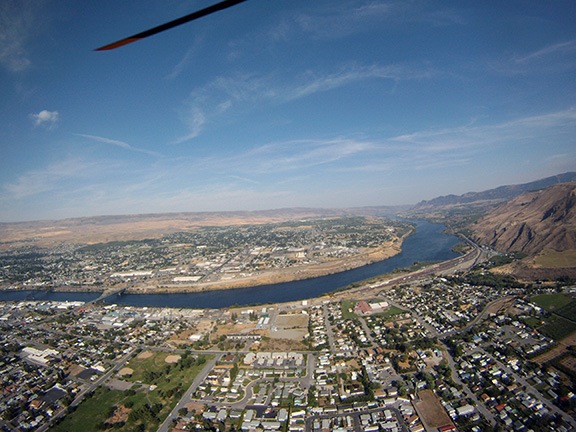
East Wenatchee Aerial

I should mention here that the skidcam ran until its battery died; I only shut it off briefly while I waited in Chelan and later in Coeur d’Alene. I have over 3,500 photos from that camera.

My route followed the Columbia River, flying mostly right over the main channel. The nosecam would have gotten some really rocking footage that probably wouldn’t have been too useable because of the high winds bouncing me around in the sky. But the stills would have looked good. Here’s a view from the cockpit cam shot not far past the Rocky Reach Dam:

Cockpit View of Columbia River

If you’ve got a sharp eye, you might notice something in the front passenger seat. That’s Penny the Tiny Dog’s bed. Penny slept for most of the flight — as she usually does in the helicopter. But every once in a while, she’d poke her head up and look around. Here’s another shot as we came over the ridge and began our descent to Lake Chelan:
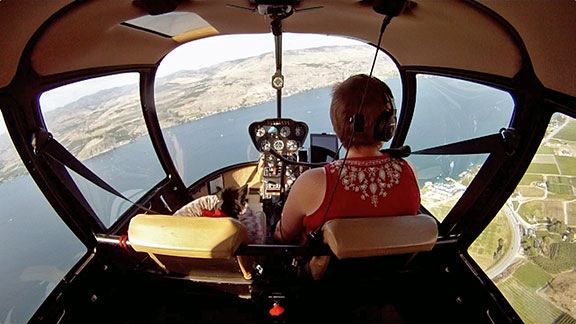
Flying with Penny

Normally, when I fly to Chelan Airport, I follow the river all the way. But I’d gotten a call from someone who wanted an engagement flight out to Tsillan Cellars Winery on the south shore of Lake Chelan. I wanted to scout the possible landing zones. I circled the winery once and decided that both offered landing zones would work. The one I’d use, however, was the one right at the end of the entry road, by the winery’s big sign. Showy and convenient and not too tight. Here’s a shot from the skidcam as I circled:
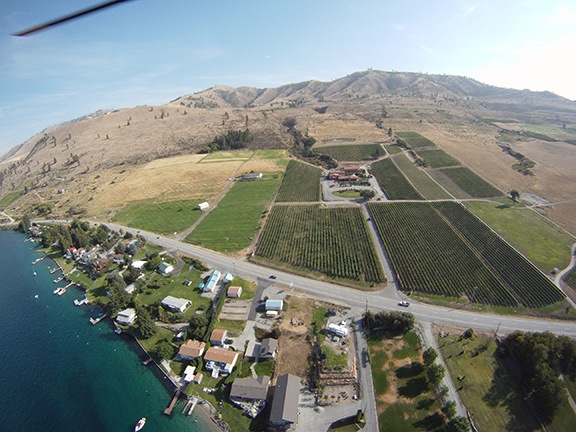
Tsillan Cellars Winery

From there, I continued on to the airport, flying over downtown Chelan along the way. I landed in the field near Jim’s helicopter and began the shutdown process. While I was waiting for the engine to cool, I put Penny on her leash and dropped her gently onto the ground. She wandered into the frame of the skidcam as Jim pulled up beside me.

Penny at Chelan

Jim topped off both of my fuel tanks with the fuel he had on his truck. There was no reason to drive all that fuel out to Coeur d’Alene later on. I fiddled with my cameras and got them running. We took off as a flight of two with Jim leading the way, heading almost due east.

Despite the fact that the airport is at least 500 feet over the river, we began climbing as soon as we departed. We had to clear the cliffs and climb up to the Waterville Plateau. I followed Jim, trying hard to keep my eyes on the red speck of his helicopter, concerned about catching up with him because of my helicopter’s slightly greater power. (More on that in a moment.) When we topped the cliff, he was easy to spot above the horizon; this nosecam still gives you an idea:

Climbing to Watervill Plateau

I was pleasantly surprised to find that although we had a tailwind, it wasn’t gusty and the flight was much smoother. The thought of spending an hour each way bouncing around the sky wasn’t appealing. But that wasn’t the case.

I soon learned that my Raven II helicopter is not faster than Jim’s Raven I. There are two possible reasons for this:

  • His helicopter is lighter, weighing in at less than 1450 empty. My ship’s empty weight is 1515. I assume he had full fuel (as I did) and we weigh about the same. Not sure how much gear he had on board with him, but I’m certain that his flight weight was lighter than mine. Although probably not much.
  • His chart for maximum manifold pressure allows him to pull at least an inch more power than I can in the same conditions. I have no idea why our charts are different.

In either case, he was able to get 5 to 10 knots more airspeed than me. It wasn’t long before his helicopter became a faint dot in the distance.

Meanwhile, the light was getting good and the combines were out harvesting the dry-farmed wheat up on the plateau. We paused enroute while I circled a field with two combines at work. This is where I really wish I’d set the camera for a shot every 2 seconds instead of 5. Although I got one so-so shot, I missed so many other possible shots:

Combine at Work

Afterward, I was ahead of Jim for a short time. My skidcam and then my nosecam caught him passing me:

Racing with Jim

Losing the Race with JIm

The landscape continued with rolling wheat fields, most of which were already harvested. It suddenly gave way to Banks Lake, a dammed coulee filled with water pumped up from the Columbia River at the Grand Coulee Dam. Here’s the last still clip from the nosecam — I’d mistakenly inserted a 2GB SD card instead of the usual 16GB SD card so I only got about 30 minutes of video. (Sheesh.) Jim told me, over the radio, that the rock formation in the lake is called Steamboat.

Banks Lake

Although my skidcam kept shooting, it had shifted somewhat and was no longer level — if indeed it ever was. It produced this slanted view of the lake as we were crossing the cliffs on the other side:

Banks Lake

Beyond that, my skidcam caught a few more images of combines out in the field. Here’s one corrected for the camera’s tilt:

Another Harvest Shot

After more relatively flat farmland, the landscape began to change. There were more and more trees and canyons mixed in with the farmland.

Farmland in the Hills

Soon we were flying along a bend in the Columbia River. Later, we were alongside the Spokane River.

Spokane River

By this time, Jim was so far ahead of me that I simply couldn’t see him. We finally determined, based on distance to KCOE, that he was four miles ahead of me. It wasn’t exactly a “flight of two helicopters” anymore.

A while later, we landed at Coeur d’Alene. Jim’s wife met us there. They exchanged hugs and he put his helicopter away in the hangar while Penny and I stretched our legs. Then he and I climbed back into my helicopter with Penny in the back seat and we took off on the flight home.

By this time, only the skidcam was still taking pictures. And because it was facing mostly into the sun, it didn’t get too many good shots. It’s a real shame because the light was really nice by then. Here’s a sample image shot somewhere over Washington at about 7:47 PM:

Return Flight

We chatted all the way back. When Iet him off at Chelan Airport, I had to shut down to take on more fuel. Then I took off back toward Wenatchee, where I was living at the time, and he drove off back toward Idaho.

My skidcam caught this image of Wenatchee as I crossed the Columbia River:
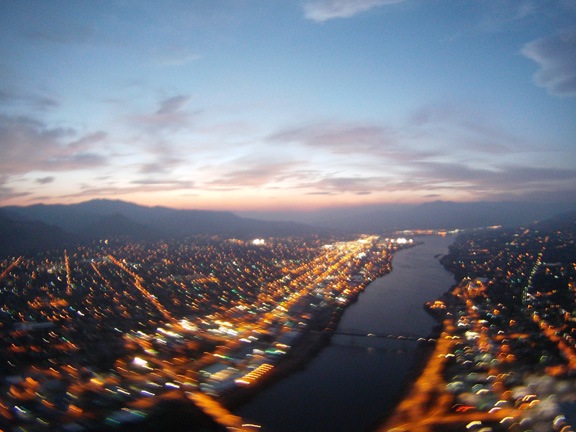
Night Over Wenatchee

I touched down in my parking spot with just my landing light to guide me.

Cherry Vodka, Revisited

More cherries, more cherry vodka.

This was a weird year for cherry growers. An overabundance of cherries near the end of the season caused the market to tank. Cherries that normally would have been picked for sale were left on the trees.

Including a lot of rainier cherries here at the orchard I’m working at.

I hate letting food go to waste. Especially amazingly delicious food. Like these slightly-past-prime-picking-time-super-sweet cherries. So I started picking in the evenings, taking home about 2 pounds a day.

There are only so many cherries a person can eat. I reached my limit.

Cherry VodkaSo I fell back on last year’s recipe for cherry vodka — or cherry liquor, as some people like to call it. So far, I’ve filled 4 pint jars and 2 other jars I’d been saving in the RV.

They look delicious. I’m very interested to see how they hold their color over the coming year. They’re best eaten — perhaps served over ice cream? — after at least 6 months in the jar. Last year’s cherries, which I blogged about here, were a mix of red and rainier cherries, but all the cherries in the jars turned dark red. They taste okay, but I probably should have added some sugar when I jarred them. This year’s are super-sweet and I don’t think sugar will be necessary.

By the way — I always use decent vodka. Most of these were made with Absolut, but I switched to my favorite, Ketel One, when I ran out.

R44 iPhone and iPad Power and Mount

What you need to get the job done — and how I did it.

One of the great things about the R44 is the DC power port located rather conveniently between the two front seats facing backwards. At first glance, it seems as if it would be the perfect accessory for charging any number of devices.

Well, it is — but not without jumping through a few hoops. The trouble is, on a Raven II, that port is connected to the 28v DC power system and puts out 24v to 28v of power. Plug the wrong kind of DC accessory into it and you can fry your device.

Seven Years of Struggle

Like most pilots, I can certainly use that power port to charge any number of devices: cameras, phones, and, most recently, an iPad. And since buying my helicopter more than seven years ago — has it really been that long? — I’ve tried numerous devices to make it work.

I should state right here that I’ve had passengers simply plug car chargers for their phones into that port. They did it without asking me — you know how passengers can be — and I never heard about any harm coming to those phones or the chargers. But not only does the label on the port assure me that it’s 28v, but a call to the Robinson factory confirmed it. I was not about to plug any 12v charger or power cable I owned into it without stepping down the power.

To that end, I purchased a little box that supposedly made any conversion I wanted. I dialed in 24v (which is apparently close enough to 28v to make everyone happy) to 12v, plugged in my devices, and it worked.

Until the day I was warming up the engine with two photographers on board and began to smell burning electronics. (I have a very good sense of smell. I once woke up in the middle of the night smelling smoke. In the morning, I learned that a building about a mile away had burned down overnight. But I digress.) I reached back and felt for the box. It was melting. I pulled the plug, glad that I was still on the ground, and later threw it away.

When I got my Moitek Mount, which has three Kenyon KS-8 gyros, I bought Kenyon’s 28v dual inverter to power two of them. (The third is powered by a battery pack.) To date, that’s the only device-specific power supply I’ve found that accepts 28v input.

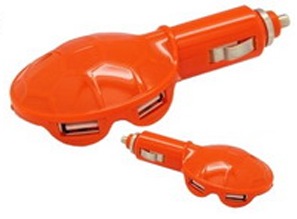
Bestek MR-C21ANext came “the turtle.” My friend Don recommended it to me and that’s what he called it. It’s actually a Bestek USB Charger, model C21A. It’s a DC to USB charger that has 4 USB ports. It accepts input of 10v to 30v and supposedly outputs up to 2.1 amps. By that time, that’s what I needed — I had an iPad 2 and was beginning to use it for Foreflight. As the manufacturer advised, however, you should only use one port when charging an iPad. What I discovered is that if I used the iPad in flight, even with just one USB device plugged in, I could not maintain a charge on the iPad. Although it said it was charging, the power was still trickling away. Yes, I was able to stretch the iPad’s use out to 12 hours on a very long cross-country flight, but that’s because I kept shutting it off when I didn’t need to consult it. And it irked me that I couldn’t charge my phone at the same time.

I should mention here that I tried a variety of other solutions for DC to USB. I must have more of these damn devices than anyone on the planet. The turtle worked best — but it didn’t work good enough to make me happy. The others mostly didn’t work at all.

When I bought a new iPad, the problem came to a head. The turtle couldn’t provide enough power to even indicate that the iPad was charging. On a recent day-long charter with several off-airport stops and long waits, my iPad went completely dead. Not acceptable.

Mediabridge to the Rescue!

With another very long cross-country flight ahead of me, I decided to stop screwing around and find a solution that worked flawlessly. So I began a search for a DC to USB charger that could charge both my iPad and my iPhone at the same time.

Mediabridge USB ChargerI found the solution on Amazon.com: the Mediabridge High Output Dual USB Car Charger for iPad and iPhone. [Sorry, but as of 30-August-20 this product is no longer listed on Amazon.] This device takes input from 12v to 24v and outputs a total of 3.1 amps: 1 amp on one USB port and 2.1 amps on the other USB port.

Long iPhone/iPad CablesI coupled that with a pair of KHOMO Extra Long USB Sync Cables for iPhone/iPad. These cables are 6 feet long. I needed the length to safely run the cables from the middle of the aircraft to the place I’d mounted my devices. More on that in a moment.

This afternoon, I went out to the helicopter, plugged everything in, and flicked the Master Battery switch. Sure enough, my iPhone and iPad both indicated that they were charging.

Total cost of this power solution: $12.99 + $9.99 = $22.98.

Cockpit Management

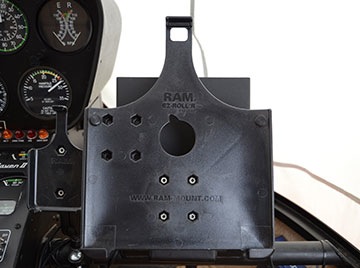
Empty Mounts
Here are the two RAM mounts, empty, mounted on the Robinson GPS bar. You can see the tray behind the iPad mount.

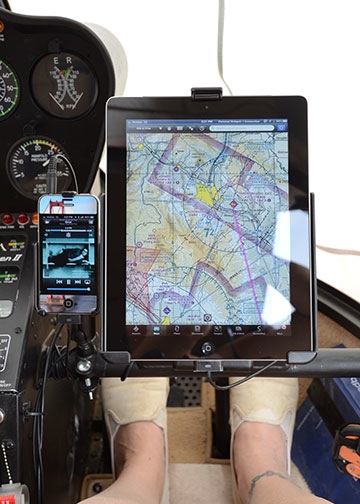
Mount with iPad & iPhone
Here are the mounts with the iPhone and iPad installed and turned on. No, the glare isn’t much of an issue in flight. (Overheating in direct sunlight is another story, though.) As you can see, the bar does not interfere with my use of the pedals. Remember, the bar is a Robinson component; not something I whipped up and installed myself.

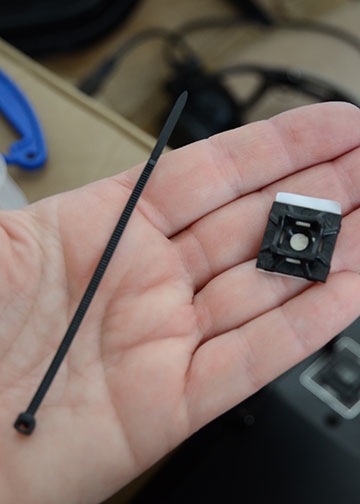
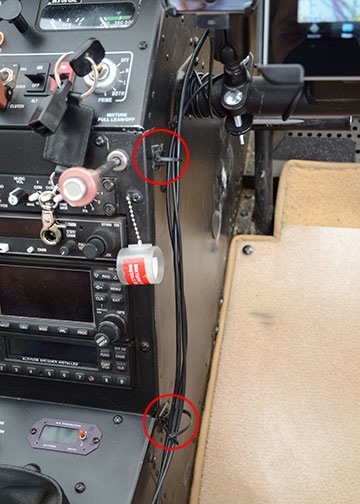
cable ties
Here are the wire tie pieces I use to keep the wires tidy.

Tidy Wires
I attached the wire ties to the side of the instrument panel with the adhesive pieces. I looped the ties wide enough to pass the end of a USB plug through.

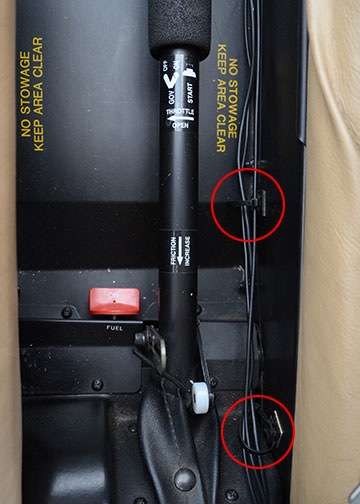
more tidy wires
I did the same along the side of the pilot seat. This keeps the wires from getting tangled in the collective, which would be a serious problem.

Of course, my solution isn’t limited to just the power accessories discussed above. I’m a strong believer in having a tidy cockpit — especially when flying solo or flying long distances. I already have mounts for my iPhone and iPad that keep them within reach without blocking my view of any instrument or what’s outside the cockpit bubble.

My solution has multiple components:

  • A customized version of the GPS mounting bar Robinson offers. Mine was installed by the folks at Helicopters Northwest at Boeing Field in Seattle. It includes the bar and a semi-useful tray that I clip duty sheets onto when I fly. (Before I got the iPad and Foreflight, I used it to display charts or lists of airport frequencies.)
  • A RAM mount for iPad with glare shield clamp. I clamp it to the base of the tray on the bar.
  • A RAM mount for iPhone with U-Bolt Rail mount. A friend of mine customized the U-Bolt mount to remove the U-Bolt and add a plate he made in his shop. A pair of straight bolts attaches it to the bar.
  • A number of adhesive wire tie holders with wire ties. I found these gems in a great little hardware store in Chelan, WA and bought a ton of them.

Let me take a moment to talk about RAM mounts. I love RAM mounts. It’s a component system, so you can mix and match parts. What works for you today might not work for you tomorrow in a different aircraft or with a different device. But RAM has you covered. You just get the pieces you need and use them with other pieces you already have. For example, I already had the custom U-bolt thing for another purpose; I just repurposed it with the iPhone mount. Ditto for the iPad mount; it came with a kneeboard. Mix and match. Well made stuff, too.

So if you think you need to enlighten me on how RAM mounts suck and how what you’re using is so much better, save it. I have a sizable investment in RAM equipment and will not switch now or anytime in the foreseeable future.

At the same time, I’m not saying that my solution, as outlined here, is “the best.” It’s the best (so far) for me. But it all hinges on the availability of that Robinson GPS bar. It’s not easy to get; for a long time, Robinson wouldn’t sell them. I’m not sure if they’re selling them now. But it’s a great add-on for any Robinson. Rock solid, bolts onto the frame, great platform for any equipment you need handy but out of the way.

I do, however recommend mounting your devices with sturdy but easily removable mounting components affixed to something that won’t vibrate like crazy, is within arm’s reach, and doesn’t block your view of anything.

I ran the wires — including an audio cable so I could listen to music in flight — through the loops I made in the wire ties and made sure they were tight. (I’m thinking of braiding them to keep them all together but haven’t decided if that’s a good idea yet.) I wrapped any excess around the bar over my feet. I can then plug in the devices on both ends.

It’s a temporary solution that is extremely effective in keeping everything neat without any modification to the aircraft.

Works for me.

Dog is My Co-Pilot

And here’s the picture to prove it.

Penny and I flew from our Wenatchee Heights base to Lake Chelan, WA (shown here) to Coeur d’Alene, ID and back yesterday to help a friend reposition his helicopter. Penny is now a seasoned helicopter pilot, having logged about 6 hours of cross-country flying. The sound and vibration doesn’t seem to bother her. She sleeps most of the trip, getting up for a look only when the helicopter drops out of cruise flight or lands.

This is a frame grab from my GoPro “cockpit cam,” which shot video for the entire flight from Wenatchee Heights to Chelan.

Dog Is My Co-Pilot

By request; a larger frame from the video.

Penny’s Bone Cache

Because dogs will be dogs.

When I got Penny the Tiny Dog I was determined to make sure that, despite her diminutive size — she currently weighs 4.6 pounds and might get up to 6.0 — she would be just like any other dog. In my book, that means making her walk (instead of being carried), making her jump into the truck (instead of being lifted), and being free to walk off-leash in safe environments (i.e., no danger of moving vehicles, predators, crowds, etc.).

Penny the Tiny Dog
Here’s Penny at dawn on Monday morning, standing at the edge of the cliff, watching the pickers come into the cherry orchard far below us.

As part of her training program, I let her run loose on the 2 or 3 acres of hillside property where my mobile mansion is currently parked. There’s no fence around the property, but she seems to understand her boundaries: the road on one side, the cliff face on the other, the steep slope to the house next door, and the boat parked halfway down the driveway on its trailer. I don’t let her loose when I’m not home — she’s too small and young for that — but I’m not always outdoors with her, supervising her closely. I’m confident — through a few weeks of observation — that she’ll be okay. And even if she doesn’t come right away when I call her, I can usually find her within a few minutes.

Rabbit Skull?Within her “territory” — which is actually a good term for it because she will bark to chase off neighboring dogs who come near — is a pile of bones. It’s the remains of a rabbit — or at least that’s my best guess based on a skull I snatched away from her when we first discovered it. Although once a good pile of bug-cleaned bones with very little fur or tissue (dried or otherwise), it’s since dwindled to what you see in the photo here:

Penny's Bone Cache

Leg Bone
 
Not So Lucky Rabbit's Foot

You see, since we discovered it about two weeks ago, Penny has been revisiting it on her own. She grabs a bone and brings it home with her. Sometimes she brings it into the RV — I took three leg bones away from her just this morning and found a not-so-lucky rabbit’s foot on the floor just the other day. Other times, when she wants to keep it to herself, she’ll take it under the RV — where she knows I can’t reach her — tune me out, and gnaw on her prize until she gets tired of me throwing rocks at her.

Now you might think this is gross — after all, my dog is regularly raiding a dead animal’s carcass and bringing pieces into my home. But there are no bugs or flesh or anything else that’s disgusting. The bones are… well, bone dry. I get them away from her, give her a treat in exchange, and toss them in the garbage. It sure beats the freshly killed, half-eaten mouse she brought home from the orchard the other day.

And the way I see it, eventually the bone cache will be emptied and she’ll stop bringing bones home.

Maybe then I can get her to work on the mouse that seems to have found its way into the RV and is eating Alex’s the Bird’s food every night.