Bees: Mid-August Update

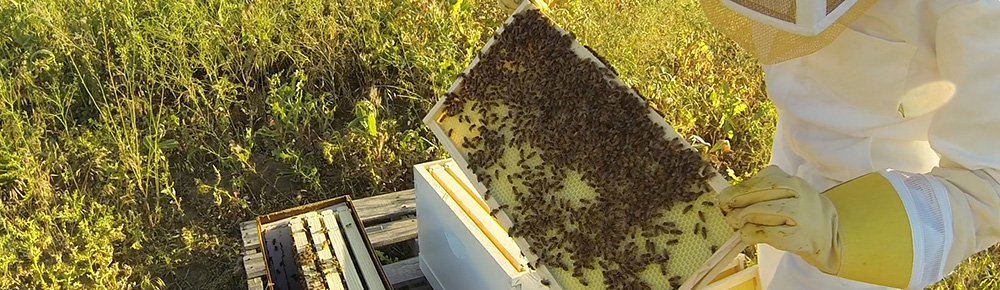
I thought I’d take a moment to bring readers up-to-date on my bees and their hives.

I started my beekeeping hobby in June 2013 and have been blogging about it periodically. If you’re interested in reading the other posts in this series, follow the Adventures in Beekeeping tag. Keep in mind that the most recent posts always appear first on this blog.

I haven’t blogged about my bees in almost a month. That’s because there hasn’t been anything terribly interesting happening with them. But that doesn’t mean there isn’t anything to report.

Hive Move

I have a total of three hives. Two of them were with me where I’m camped out along the side of Squilchuck Canyon in Wenatchee Heights. The third (which was really my first) was at a fellow beekeeper’s house in Wenatchee.

The one in Wenatchee was doing great. So great that they filled seven frames of a deep hive box with capped honey. I extracted honey from six of those frames in July and got a total of about 2-1/2 gallons of honey. I replaced that deep hive box with a medium box and 10 new frames for the bees to continue making honey.

I used the deep hive box that had been on that productive hive as a home for the new hive I’d created a few days before via a hive split. The bees had been living in a nuc box until I could get a deep hive body for them. I set them up in Wenatchee Heights beside the hive I’d created by catching a swarm earlier in the season. I divided the extracted frames and partially filled frames between those two hives, removing any empty frames I had. The bees, I knew, would clean the beeswax cells of those frames and start using them for brood or honey storage. At least that was the idea.

As I discovered on two subsequent hive inspections, however, the bees weren’t producing much honey at all. They cleaned out those sticky frames very quickly, but didn’t refill the cells. One look around the area made it pretty clear why: there simply weren’t enough flowering plants to give them the food source they needed. Even though I was feeding them regularly with a 1:1 sugar water solution, they just weren’t making a noticeable amount of honey.

My beekeeping friend, Jim, confirmed this when he and his wife came over for dinner one night. He suggested that I move the hives down to his place with my other one. He had lots of clover in his grass and there were plenty of gardens in the area. A much better source of food.

My Three Hives
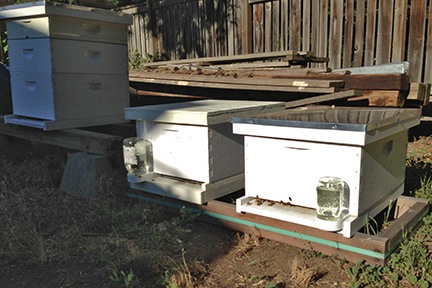
My beehives are currently in a friend’s backyard.

So one late July evening, after the bees had gone in for the night, I stuffed rags in the hive entrances to lock them in and used ratchet tie-down straps to secure the bottoms and tops to the two boxes. In the morning, I loaded them onto my pickup truck and drove them down to Jim’s place. I set up some scrap wood to form a platform and positioned the two hives side by side on it. Then I removed the rags, added sugar water to two feeders, and left them.

At this point, all three of my beehives are in Jim’s backyard in Wenatchee.

I have to admit that I’m a bit worried about how they’ll fare when I move them to my future home in Malaga. Although the property is full of wildflowers in the spring and early summer, in late summer it’s about the same as Wenatchee Heights. I suspect that I’ll be feeding my bees quite a bit until my gardens are established.

The Main Hive

I’ll always consider my first hive my “main hive” simply because it’s the healthiest and most active. But I noticed a definite decline in honey production since extracting honey in July and replacing brood frames in the bottom hive body with empty frames when I made my hive split.

Indeed, the bees have yet to produce any comb or store any honey in the medium box that’s now their second level. And it’s been about three weeks.

Yesterday I did an exhaustive hive inspection. Although I didn’t see the queen, I did see fresh brood. And I was very pleased to see that they had begun putting brood in the drone frame. I could kick myself — I should have brought along a fresh drone frame to replace it with. I’ll have to go back sometime this week to do that; the idea is to freeze the frames with drone brood in them as part of a varroa mite prevention strategy. Of course, the frame won’t fit into my RV’s freezer. But there is a freezer in my “landlord’s” garage; I’ll ask if I can store it there.

I removed the queen excluder and Ross Rounds box from that hive to store them for the winter. There’s no way they’ll fill the Ross Rounds before autumn comes. At this point, I doubt they’ll fill the medium frame.

The Hive Split Hive

I blogged about my risky hive split back in July. The way I did the split was admittedly haphazard. I pulled brood frames that included swarm cells out of my main hive and put them in a nuc box with all the bees that were on them. Then I moved them away from the main hive with hopes that a swarm cell would hatch into a queen and the hive would continue. I also hoped that the queen was not among the bees I moved.

I was certain I had failed. The hive was not very active and didn’t seem to be growing. It certainly wasn’t producing much (if any) honey, as I reported above. Every time I inspected it, I’d look hard for a queen or eggs in cells. I did see developing and capped brood but never saw anything fresher.

But in yesterday’s hive inspection, I did something I never did before: I wore my reading glasses. Yes, I’m of “that age” when glasses are necessary to bring tiny things into focus. And what’s tinier than a bee egg?

Surprise, surprise! Not only did I see freshly hatched eggs, but I also spotted a queen. My risky hive split had been a success!

Now if only they’d start storing honey for the winter.

The Swarm Hive

I thought the swarm hive might have stored enough honey for me to add a medium hive body with frames to it. I even brought the hive body with me and unboxed it prior to making my inspection. But the bees simply aren’t working hard enough. There are plenty of empty areas in the frames in their deep hive body. Adding another box on top might coax them into storing honey in the top box before they’d filled the bottom one. I needed to wait.

I also checked the drone frame I’d put on that box. They’re just starting to build out comb. So I’m not very sure how effective the drone frames are for mite control. It seems that the bees are slow to accept them.

Prepping for the Winter

I know it’s only August and the summer’s hottest days are barely behind us. But I do need to plan ahead for the winter. That means ensuring that the bees store up enough honey to feed themselves during the coldest months. This will be especially important since I plan to spend much of the winter traveling and won’t be around to feed them.

With luck, however, I’ll find a good, sheltered spot for them on my new property. That’s one of the chores I face in the months ahead.

Cherry Drying: My Sixth Season

The whole season in summary.

I’m just finished up my sixth season as a cherry drying pilot in North Central Washington’s Wenatchee area. I thought I’d take a moment to summarize how things went.

What Cherry Drying is All About

I’ve blogged about this extensively and you can quickly zip to other cherry drying related posts by following the cherry drying tag. In a nutshell, it’s like this:

Split Cherries
These Rainier cherries are split and cannot be sold. Cherry drying by helicopter can prevent this.

During the last three or so weeks before a cherry is harvested it is susceptible to damage by rain. Growers are most worried by splits, which can occur when water accumulates in the cherry’s stem cup and is absorbed through the skin. The cherries get too fat for their own skin and split. Other damage can include mildew and rotting.

Because of this, growers want to get the cherries as dry as possible after a rain. So they hire helicopter pilots to hover over the cherry trees after it rains. The downwash of the helicopter’s main rotor blades shakes the water off the leaves and cherries, allowing them to dry much quicker without absorbing so much water.

Keeping the cherries dry is vitally important for a successful crop — as this year so clearly demonstrated. During the relatively short cherry season, dozens of helicopters are on standby with pilots waiting to fly when it rains. And when the rains start falling, all hell breaks loose over the cherry trees.

The Flying M Air Team

One of the things I pride myself on is the ability to provide prompt service and quick dry times to my clients. I do this by never contracting to cover more than 100 acres per helicopter and by utilizing helicopters well-suited to cherry drying missions. Because of this 100 acres/helicopter policy, I need to contract with additional helicopter crews to help out during “crunch times.”

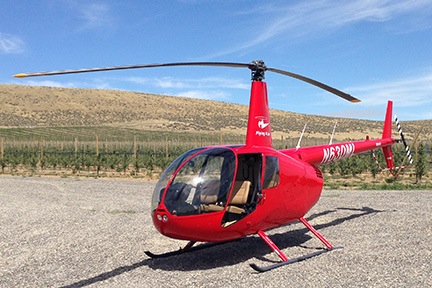
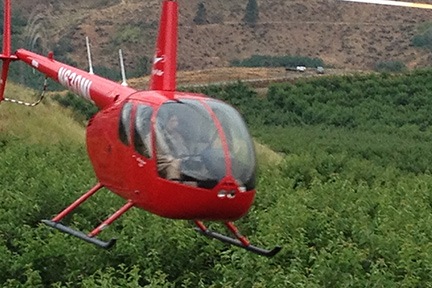
Robinson R44
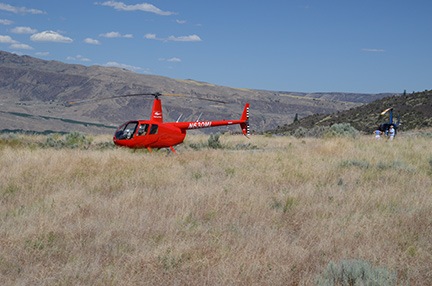
I’ve been providing cherry drying services in my Robinson R44 since 2008.

My Robinson R44 can thoroughly dry an average of 40 acres per hour. (Of course, actual drying capacity varies depending on tree size, row density, orchard obstacles and terrain, and the wetness of the trees. The more I dry, the better feel I have developed for all this.) That means that if it rained on all my clients at once and they all called at the same time, I could dry 100 acres in about 2-1/2 hours. That’s a long time, but still within requirements. Fortunately, it seldom rains everywhere at once and I’ve never had all my clients call at once.

Of course, I do contract for more than 100 acres at a time. That means I need help to get the jobs done promptly. This was the second year in a row that I had two other helicopter crews helping me complete my cherry drying contracts.

MTAS Hiller
The MTAS Hiller was on contract with Flying M Air for its second year.

Mike and Ron manned the MTAS Hiller for the second year in a row. For the first four weeks of their contract with me, they covered three orchards in Quincy, WA. For the fifth and final week, they provided backup coverage for orchards in East Wenatchee and Wenatchee Heights.

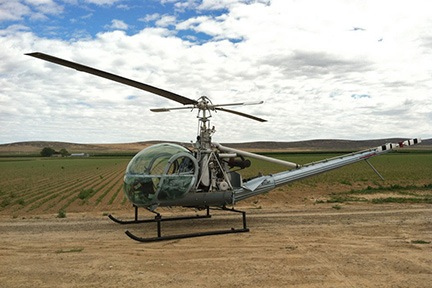
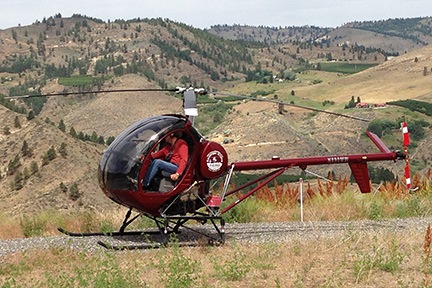
Canyon State Hughes 300
Woody at the controls of Canyon State’s Hughes 300.

Woody manned the Canyon State Hughes 300 for the first time. He was on contract with me for just 8 days during what I think of as a “super crunch” time when overlapping contracts made me responsible for about 250 acres of cherry trees. Although I prefer working with helicopters that have big two-bladed systems — such as the Robinson R44, Hiller, Bell 47, and JetRanger — this little Hughes got the job done using the Flying M Air technique of flying very low and very slow over the treetops. If Woody does come back next year, however, he’ll likely return in either a Hiller or R44.

If you’re a helicopter owner/operator with an R44 and at least 500 hours experience in helicopters (50 or more of which is in your R44), you might want to check the Help Wanted page at Flying M Air next spring. I’m always looking for good, reliable pilots with helicopters to help out.

Old Clients, New Orchards

This year, I contracted with all of last year’s clients except one. He decided to skip helicopter services. That was a loss of 55 acres. (Not sure how he did because I didn’t ask.)

Two of my clients added orchards to their contracts. One added three orchards totaling 61 acres. Another added one orchard that was 23 acres.

So I had a net gain of 31 acres. If I hadn’t lost that 55 acres, I would have had to hire on another helicopter without enough standby pay to cover it, so it’s kind of good that I lost it.

My contracted orchards stretched from George, WA to Monitor, WA. Most were in Quincy, Wenatchee Heights, and Malaga. The crunch time fell from June 20 through July 24, with super crunch falling in the middle of July.

I was based at Quincy for the first half of my season and then moved to Wenatchee Heights for the second half.

Busy, Busy!

This was our busiest season ever. My teammates and I flew a total of about 62 hours for the total of 16 weeks we were contracted (10 for me, 5 for MTAS, and 1 for Canyon State).

Now if you do the math, you’ll find that 62 ÷ 16 comes out to just about 3.9 hours per week. That’s not very much flying. But still, it was the most we’ve flown in a cherry season. My first two years I flew only 5 hours in 7 weeks (less than 1 hour per week average) and 5 hours in 10 weeks (about 1/2 hour per week average). There’s not a lot of flying in cherry drying work. It’s definitely not a time-building job.

Cherry Drying Action Photo
Here I am in action, hovering with my skids nearly in the trees.

The busiest time was what I refer to as the week from hell. It was the last week in June and I personally flew almost 30 hours in just 6 days. On several of those days I dried more than one orchard three or four times. I flew orchard after orchard, sometimes stopping only long enough to refuel and head back out.

I wasn’t happy about it.

Yes, I like to fly because I make money doing it. But no, I don’t like my clients to be put through the wringer by the weather, worrying and spending money on my services and still losing cherries because there’s simply no way to keep them dry when it rains all day long. So yes, I hope I never have another cherry season as busy as this one. My clients, for the most part, are too nice.

As for my competition, they were flying around like crazy people, too. I heard them all on the radio, playing follow the leader to guide unprepared pilots to the orchard blocks that needed drying. Some operators will contract for blocks as small as 2 and 3 acres, so their pilots often spend more time flying from orchard to orchard — without compensation — than actually drying. I’d rather take contracts for a small handful of big orchard blocks so I spend more time over the trees than in transit.

Early, Compressed Season

This was also the earliest season ever. My first contract started May 29; it usually starts the end of the first week in June. And my last contract ended by August 10; last year, it ran until August 25.

It was also a compressed season. Estimated start dates for mid to late season orchards, which were provided at the beginning of the season, creeped forward little by little, causing an uncomfortable overlap in scheduling — which is why I brought Woody’s company on board. That explains how my season started a week earlier than usual and ended two weeks earlier.

Late Season Rain

We also had an unusual amount of late season rain. Indeed, many growers don’t bother getting helicopter standby coverage because it so seldom rains in late July and August. But this year it did. Huge rainstorms hit on the evening of August 1, the morning of August 2, and the evening of August 4. I made five flights, covering my contracted orchard five times and another orchard three times (at my client’s request).

It was a good thing I did. My client reported that on the day of the last storm, I was one of only two helicopters flying in the area. While the packing plant reported minimal splits for his cherries, other orchards that did not have helicopter hover service reported up to 50% splits.

Maybe some lessons were learned? I guess we’ll see next year.

That’s It In a Nutshell

That’s pretty much how the season went for me.

It was my best season ever — but will it be as good next year? Or will we have a bad crop and lose contracts due to frost — as was the case in 2008? Or not have many rain events — as was the case in 2008 through 2010? Or will some upstart company come in and undercut operators like me by taking contracts for as many as 300 acres per helicopter at half the standby pay, crossing their fingers that it doesn’t rain and they’re not actually called to dry? That’s happened more than a few times in the past and those fly-by-night operators never seem to come back for a second season.

It’s all a gamble, a crap shoot. It’s why I don’t put all my eggs in one basket, why I save as much as I can for leaner days when the revenue just isn’t flowing.

But that’s just part of being a small helicopter operator. I love the challenge — especially when things work out just right.

Week One as a Landowner

Getting a lot done by myself.

Here's My SignAs I blogged last week, I finally purchased that 10-acre view lot in Malaga, WA that I’ve been wanting for over a year. And I wasted no time getting started on turning that piece of land into my next home.

Utilities

One of the great things about this lot is that it already has important utilities on it. It’s just a matter of getting them set up and turned on.

  • Water
    Water was the easiest of the utilities. I have “city water” meaning that the water is provided by Malaga Water District. No well or pump to share or maintain. A water pipe comes out of the ground and has a spigot handle on top. According to the water guy, the pipe is designed for cold weather use; the pipe drains when the water is turned off so winterization isn’t necessary. When my building is constructed, the plumber will tap into this pipe below ground and run the water line in a trench to the building. Until then, I can simply fasten a hose to the pipe.
    Getting the water turned on was easy. I made one call to tell them I wanted it turned on. They sent me a contract that I received the same day — such is the benefit of living in a small town where the utility guy drops off a stamped envelope at the post office and the postmaster puts it right in your post office box. I filled out the contract, put a deposit check in the envelope, and mailed it back. Two days later, they called to tell me the water was turned on.
  • Electricity
    Electricity is a bit more involved. Because there’s no building on the property, I need temporary service set up by an electrician. He then submits an application to the Chelan Public Utility District (PUD) and when they approve it, they turn on power. Later, when my building is constructed and wired, I’ll go through another process to get electricity turned on there.
    Fortunately, there’s already a transformer on my lot so it won’t cost a thing — at least not payable to the PUD — to turn on temporary power. It will, however, cost about $500 to have a temporary power post with plugs and circuit breakers installed and left on my lot for a year. The post is a rental; I could buy one if I needed it for a longer period of time. I’ll have it set up with 2 110v outlets, a 30 amp outlet, and a 50 amp outlet. That’ll make it easy to plug in just about anything, including power tools and my RV.
    So far, I’ve had one bid on the temporary power pole. I should get another bid on Sunday. Once I choose an electrician, the power should be turned on within a week.
  • Fiber

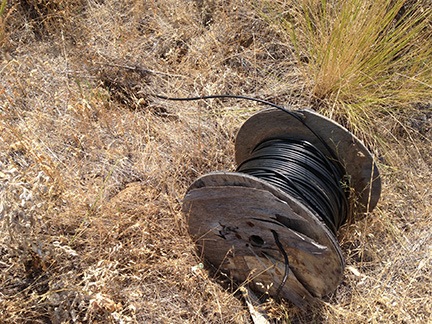
    Not Fiber Optic Cable
    I have enough phone cable to wire the entire neighborhood.

    Fiber is the tough one. Although I thought the cable coming out of the ground near my electric transformer box was fiber optic cable, it’s really telephone cable. Who wants that?
    Fortunately, fiber optic cable already runs down my road past my lot. And a conduit for fiber optic cable has already been put in place between the source on the road and a spot near my transformer. So all I need is for the Chelan PUD to run the cable down into the conduit and the local internet service provider, LocalTel, to set up service.
    The PUD guy who checked my transformer box told me that dropping the cable is an easy job. Unfortunately, there’s backlog and it could take several months for the drop to be done. I did what I could: I got myself on the list so I’d eventually get service.
    And the service is definitely worth waiting for! 100Mbps download and upload speeds. That’s 100 times the speed I had in Wickenburg and 20 times the speed I had in Phoenix.
    LocalTel also offers television service, which I may get. It depends on what kind of DVR they’ll make available. I don’t watch much television and I certainly won’t watch live television. Life’s too short to sit through commercials.

Septic System

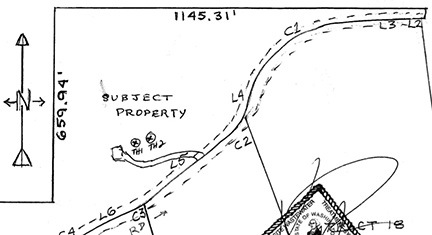
Septic System Plan
A good portion of the septic system design preparation work was already done.

The property’s previous owner had been preparing to build on the lot. That’s one of the reasons it has utilities as discussed above. They’d even gone so far as to begin work on a septic system. In fact, they’d already done a percolation test (or perk test) to test the suitability of the land for a septic system. That was good news for me. It meant that if I put my septic system in the same place the designer had tested for, I didn’t need to get another perk test. That would save me about $300 and at least a week.

Of course, I didn’t really want the septic system where the original owner wanted it. But I did want to save money on a perk test and I definitely wanted a gravity system. So I had the septic system designer over and we discussed it. In the end, I chose a location near where the original owner planned to put his septic system. No additional perk test would be needed. The designer could draw up plans and prepare the application for me in less than a week. Once I had the plans in hand, I could get bids. By the time the plans were approved by the county, I’d have the crew on site to dig. There was a distinct possibility the septic system would be installed by month-end.

The “Necessary” Building

Outhouse
My stepdad would call this the “necessary building.”

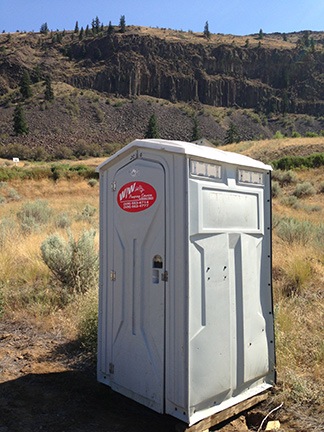
During the week, I also arranged for a portable toilet to be delivered to the lot. That took just a single phone call; a man with a gray plastic building showed up two hours later.

The toilet building was really a necessity. First of all, some builders require one to be onsite. And even if they didn’t, I don’t want workers pissing all over my property.

(A side note here. There’s a house under construction down the road from where I’m currently living. As I drove down into town one day, I witnessed a worker urinating on the house near the front door. Seriously? How can anyone have so little respect for someone else’s property?)

I needed the toilet there, too. Even though my visits to the property are usually only a few hours long, it’s nice to be able to take a leak if I need to. And if I move my RV to the lot before the septic system is done, I’ll need the building to reduce the load on my RV’s tank until it can be dumped.

Those building, by the way, aren’t gross if they have limited use and are kept clean by someone who actually cares. That’ll be me. The hose is nearby; I don’t expect that building to get or stay very dirty very long.

And in case you’re wondering, it will be serviced — i.e., pumped out — once a week. So it shouldn’t get very gross at all.

Name and Address Sign

Sign Before
You can barely see the previous owner’s name sign behind all these weeds.

Sign After
Here’s my sign after pulling most (but not all) of the weeds. The sage bushes in the foreground went, too.

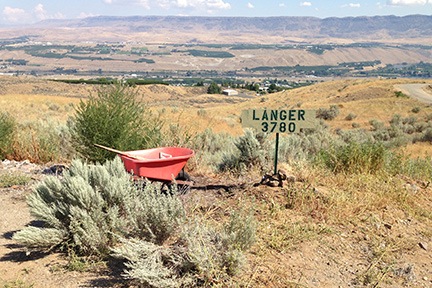
This week I also took care of putting a name and address number sign on the lot near the end of my driveway. The old sign, hand painted with the name “Young,” just wasn’t going to cut it. I wanted a nicer sign so I got a piece of scrap wood from the pile where I’m living, painted it with my landlord’s exterior house paint — a nice shade of sage green — and used spray paint with a stencil to add my last name and street number. The resulting sign looked pretty decent for something I cooked up myself.

I bought a t-post and a t-post driver and some screws with nuts and washers. I drilled holes in the wood (with my new drill), pounded the post into the ground, and ran the screws through the post to hang the sign.

Seeing the sign there made me very happy. It made my ownership of the lot more real to me. (It’ll also make it a lot easier for my wasband’s “investigator” to find the correct lot if he feels a need to “investigate” or take photos of my progress over the coming weeks and months.)

My War on Weeds

War on Weeds
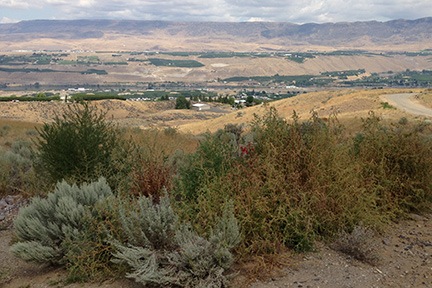
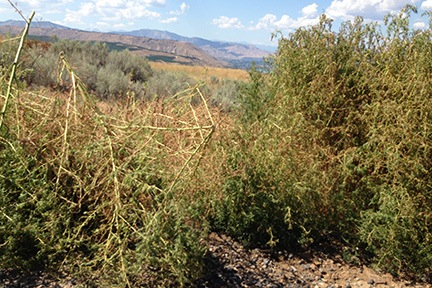
I attacked the kochi a with a weed whacker, a pruning saw, and a hedge trimmer. The wilted plants here show the effect of the weed killer.

The final bit of work I did this week was to begin my war on weeds.

An invasive weed was growing in a few places along my driveway and en masse along my road frontage. The weed, which is called Kochia (Kochia scoria), reminded me a lot of tumbleweed (Russian Thistle), which had pretty much taken over our Howard Mesa property’s prime building area when we failed to get it under control. With shallow roots, the bushy plant grew as tall as me in some places. Each plant would yield thousands of seeds which, fortunately, would only remain viable for a year. If the plant could be removed before it went to seed for a year or two, it would be gone.

Pruning SawI was able to pull the smaller plants out by the root. The slightly larger ones could be cut back with my weed whacker. But the larger ones were a real pain. The best way to get rid of them was with a pruning saw. It was hot, back-breaking work. I spent about 2 hours a day for three days in a row working at it. On the fourth day, I attacked them with a hedge trimmer I’d rented from Home Depot.

And I was winning.

I managed to clear them completely out of my driveway and make a dent in the ones along the roadside. I should mention here that the road association — my property is on a private road — sprayed the weeds along the road. By that fourth day, I could see that the spraying was taking effect. The weeds were beginning to die. Maybe, if I was lucky, they’d be killed by the weed poison and I wouldn’t have to deal with them.

Then, that afternoon, I sprained my foot. Doing more weed control was out of the question, at least for a few weeks. And I have to admit that that’s the only good thing about having a sprained foot — it gives me an excuse not to deal with those damn weeds.

But I know I’ll face them again in the future. And I’ll win.

Up Next

More of the same…and then some. Stay tuned.

Jeeping in the Wenatchee National Forest

Exploring my world.

One of the things I love about this area of Washington is the variety of landscape and terrain so close by. I’m surrounded by farmland, orchards, desert, rivers, steams, lakes, forests, and mountains. All of these things are within a 30 minute drive from my home — it just depends on which direction I drive.

Beehive Reservoir
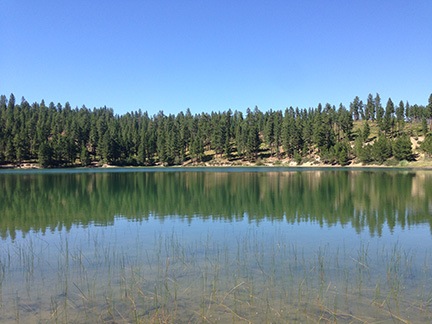
Behive Reservoir isn’t anything special, but it’s a short drive away, up in the mountains south of Wenatchee.

The other day, I briefly explored the area around Beehive Reservoir. I’d driven up there with the goal of checking it out as a possible kayaking destination. The lake I found was small and rather uninteresting. Penny and I walked around its one-mile circumference before continuing up the road. We found a far more interesting web of forest roads that I ached to explore. But without a decent map, I wasn’t comfortable going very far. I decided to return better prepared to explore.

I had a 3-hour window of time on Monday. Penny and I, joined by a friend, climbed into the Jeep and headed out. This time, I had a Wenatchee/Leavenworth trail map with me that clearly identified all the forest roads. We drove up to Beehive Reservoir and kept going.

Our intended destination was Cashmere, on the other side of the mountains. A road numbered 7100 wound through the mountains and a canyon to Cashmere. I’d been on part of the road two years before, picking it up from Number 2 Canyon Road in Wenatchee. It was a relatively easy drive in the Jeep; I figured this would be the same.

But Road 7100 was closed to motor vehicle traffic. They were making improvements somewhere along the way.

Mountain View
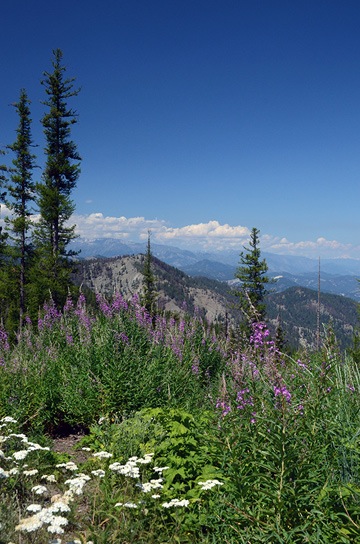
I couldn’t ask for a better day — or better views.

So we followed Road 9712, which went west and then mostly south and east. It climbed pretty steadily into tall pine forest, often skirting the edge of a steep cliff. Every turn offered magnificent views. Although I tried to follow our progress on the map, using turns and trailheads as landmarks, I soon lost track of exactly where we were. That wasn’t a big deal — we could always get back because we didn’t make any turns.

We passed a family of three on mountain bikes: mom, dad, and a girl who couldn’t have been much older than about eight. A strap tied dad’s bike to the kid’s. I guess the logic there was that if the kid went over a cliff, her bike would be saved because it was tied to dad’s. The kid, of course, wasn’t tied to the bike so she’d be lost. Maybe that was the idea. We didn’t see them later on the way back, but their car was still there. Maybe they all went over a cliff. It was not the kind of road suitable for a family outing on bikes. I wonder, sometimes, whether people know how to use their brains.

It was after we made a turn down a steep hill that I got the idea to turn on tracking on my iPhone. I use an app called GPS Track that can keep a breadcrumb trail of where I’ve been. It can also display my position (and track) on a map — if I have a 3G or LTE connection. Since I wasn’t sure whether the road we’d turned down would offer other turns, I turned tracking on. Even if I couldn’t see where we were on a map — which I couldn’t — I’d still be able to follow the track back, even after making a bunch of turns.

At the top of the World
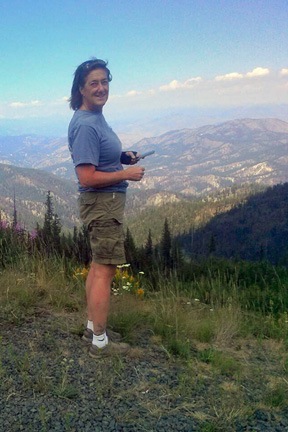
I used my phone to make a panoramic image; my friend used a phone to take a photo of me.

The road we were following descended steadily and then came to an abrupt end in a wide circle with a fire pit in the middle of it. A pickup truck was parked there, but there was no one in sight. We stopped the Jeep and got out to admire the view. We were at about 5,000 feet in elevation and the spot we were on offered a completely unobstructed view of the eastern side of the Cascade Mountains, still blanketed with snow. A variety of wildflowers grew in clumps along the edge of the cliff. It was beautiful and peaceful.

We got out of the Jeep to stretch our legs and take in the view. It was the kind of place that you find it hard to believe exists, a place you know you’re lucky to have stumbled into. I often find places like this when I go exploring in my Jeep. Maybe that’s one of the reasons I like doing it so much.

Panoramic View
Not a bad photo for a phone. (Click it to see a larger version.)

Burned Forest
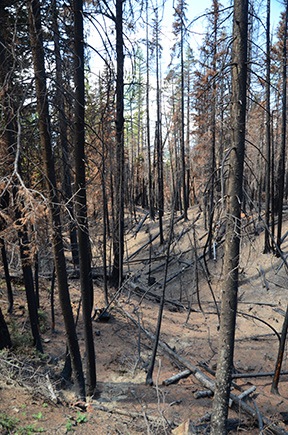
There was lots of evidence of last year’s fires.

We turned around and headed back up to the main road, then turned onto it and continued on our way. The road wound through more forest, up more hills, and over more loose patches of volcanic rock. In some places, the forest was burned out from the previous year’s fires.

The well-maintained road gave way to a narrower, less maintained track. I decided it might be a good idea to figure out where I was. I stopped the Jeep right in the middle of the road — after all, there was no one around — and pulled out my map. I lamented to my friend that I wished I could find a good GPS app for my phone that enabled me to download detailed topo maps so I wouldn’t need a cell signal to use them.

Motorcycle Guidance
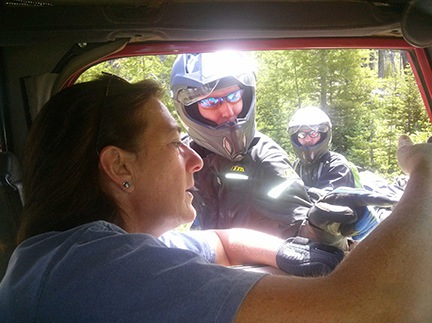
We ran into a pair of motorcyclists who helped us figure out where we were on my map and then recommended a great back road driving app.

I was rather absorbed in my map study when two motorcycles came into view in front of us. The riders were completely geared up and riding good bikes with camping gear fastened to them. I moved to the side to let them pass. They came up beside me and must have noticed I was looking at a map. They stopped and asked if we needed help.

I told them that we weren’t lost but we didn’t know exactly where we were. I know that sounds silly, but in my mind, “lost” means not knowing how to get where you need to go. I didn’t need to go anywhere in front of us and I knew how to get back, so I wasn’t lost. I just didn’t know exactly where I was. Makes sense, no?

One of the guys had a GPS and tried to point out on my map where he thought we were. I told them what I’d been telling my friend: that I wished I had an app that would download maps.

Gaia GPS,” one of the guys said immediately. “It’s $20 but worth every penny.”

They went on their way. I had a good LTE connection, so I downloaded Gaia GPS on the spot. (I figured that guys outfitted like that had to know what they were talking about.) I used it for the rest of the drive and even saved a track from it for the trip back from our farthest point.

Flower along Road
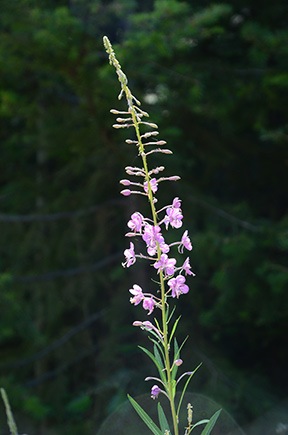
This flower caught my eye as we drove past; I stopped, got out, and took a photo. It’s nice not being rushed by an impatient companion when you’re out for a drive in the forest.

We continued on our way. Soon, however, I was watching the clock. I had a doctor’s appointment at 3:45 and needed to be home by about 3:00 to drop off my friend and make the trip down to Wenatchee. Not sure how long it would take to get back, I set a deadline of about 1:30 to return. It was about 1:00. That gave us just another 30 minutes to explore.

The road continued to wind through the forest, often with sheer cliffs on one side or the other. When we got a good look out to the southeast, I realized that we were on the far side of Mission Ridge, almost at the same altitude. The valley we looked out over was hazy from the smoke of the Colockup Tarps fire, which had started two days before.

I was looking forward to a particularly steep drop-off alongside a section of the road up ahead — that’s what the topo lines showed on the map, anyway — when I realized it was past 1:30. We had to head back. I’d have to make another trip to continue exploring. I marked a waypoint in Gaia GPS so I’d know where I left off and turned around.

Flowers and Burned Trees
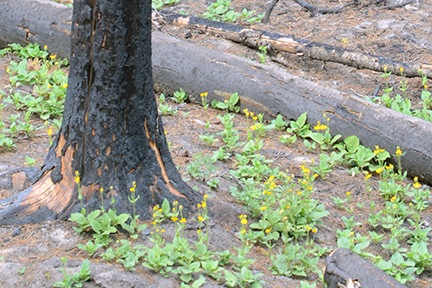
Less than a year after the fire that burned thousands of acres of this forest, flowers were blooming.

The trip back, of course, was much quicker. It always is. We stopped for a nature call and I got some mildly interesting photos of flowers blooming among the burned out trees in the area.

We were back at Beehive Reservoir before we knew it. And back on Squilchuck Road soon after that. In fact, we were back home well before 2:30. We could have stayed out longer after all.

It was a nice trip out — I say that all the time, probably because I enjoy exploring by Jeep so much. I’m looking forward to going out again, perhaps with a hearty picnic lunch, to follow that road to its end.

Buying the Land for My Next Home

It’s a done deal. I’m a land owner!

Back in the summer of 2011, I had a chat with a friend of mine from the east coast about my summer job. I told him him how much I liked the Wenatchee area of Washington where I was working. As he reminded me just the other day, he said to me “Looks like you found your next home.”

I didn’t think much of that idea then. After all, I was married and living in Arizona in a house that would soon be paid off. Although I wanted very badly to move — and even started looking for a new place to live as far back as 2005 — my husband was firmly entrenched in a 9 to 5 grind after bouncing from one dead-end job to another. His only two suggestions for a new place to live — Santa Fe or San Diego — would simply not work for me or my business. So in 2011 I was stuck there in Arizona, waiting for him to wake up and dig himself out of the rut he was living in.

But in the summer of 2012, things were different. First, my husband announced that he wanted a divorce. That got me thinking about a life without having to wait around for him to start living again. Next, I started doing a lot of winery tours, including a flight to a winery along the base of the cliffs in Malaga. The winery was on Cathedral Rock Road, a 2-1/2 mile stretch of winding gravel with 10- and 20-acre residential lots overlooking the Wenatchee Valley and Columbia River. What a nice place to build a hangar home, I thought.

I had a friend who owned land along that road and one day, on a whim, I called him to ask who his Realtor was. I told him I was interested in possibly buying a lot on that road.

“It’s funny you should call right now,” he replied. “My wife and I just decided the other day to sell our lot. Do you want to look at it?”

I did. He described which lot it was and I easily found it from the air. I landed there one day, shut down, and got out to walk around. It was amazing.

Two Helicopters
On July 5, 2012, I met my friend Don at the lot — we both flew in by helicopter. I wonder what the neighbors thought?

Over the following weeks, I brought other people to see it. My friend Pete. My friend Jim. My friends Don and Johnie. The day I met Don and Johnie there was the same day I flew in with the owners, Forrest and Sharon. We had two helicopters parked on the driveway. Turns out, Don had worked for Forrest’s dad when he was a kid. Small world, huh?

Forrest pointed out the boundaries of the 10-acre parcel. It sat on a shelf on the river (north) side of the road. A hill on the west side shielded it from the homesite on the next lot — which had also belonged to Forrest and Sharon. There were expansive views to the northwest to southeast — 270° — that included the city of Wenatchee, the river, the airport, and countless orchards. To the south were tall basalt cliffs. Although the land sloped down toward the river, at least 80% of it was completely buildable with a minimum amount of earthwork. Electricity, water, and even fiber-optic cable were already at the ideal homesite. Quiet and private, it was exactly the kind of place I like to live without being too far from town. And with friends living just down the road, it was a real win.

But it was the views that got me. I’ve always been a view person.

I knew before the middle of July that I had finally found the place I wanted to make my next home.

The Deal

The sellers told me what they’d planned to ask for the property and agreed to reduce that price for me since a Realtor wasn’t involved. I would, however, have to cover all the closing costs. I did some math and decided that the cost was reasonable and within my means. After all, my husband had told me he wanted a “fair and amicable divorce.” If we couldn’t patch things up when I got home in October — which I still had hopes we could do — I’d take my share of the value of our paid-for house in Wickenburg and apply it to my new home in Malaga.

Of course, this was before my husband got a lawyer and some very bad divorce advice. Before we began the year-long battle to settle. Someone’s idea of “fair” wasn’t very fair at all.

As far as the land deal was concerned, I wouldn’t be able to close until 2013 anyway. The sellers had sold another lot — the one next door — in 2012 and didn’t want two sales in the same year for tax purposes. Even though things on the divorce front looked bad, I figured that my husband would eventually get smart and take my very generous counter proposal.

I was wrong.

The Long Wait Begins

When Christmas came and went and my husband’s lawyer managed to postpone the court date from January to April, I realized I wouldn’t be closing as soon as I’d hoped. The sellers were very patient, though. We chatted once or twice on the phone during the winter. They weren’t in any kind of rush to close the deal.

In January, I flew out to Wenatchee for a week to see what the place was like during the winter months. I was a bit concerned about that big cliff on the south side of the property, knowing that the low sun angle and short winter days that far north could leave the land in complete shadows for days, weeks, or even months at a time. But in January, the lot did get some sunlight. There was snow on the ground that week but the road was passable — even in a rental car. I only got stuck twice and managed to unstick myself both times by myself. Driving up there in the winter would be fine in my Jeep or 4WD truck.

I got to experience the winter fog so many people had told me about. It hung over the river, right about the level of my lot. I went to visit a friend in Wenatchee Heights and got the pleasure of climbing above it, seeing the Wenatchee Valley as a white puffy blanket of clouds beneath the high hills.

I also talked to a builder and a septic system guy.

In late February I returned with a friend. I had to drive my truck up from Arizona to get my avgas fuel tank installed in the truck bed and move my RV down to California for a frost contract. My friend was very impressed with the land and shared my excitement about moving there.

Time moved on. There was a lot of talk on the news about property values recovering. I knew that property values in Washington were already healthier than those in Arizona. I worried that the owners would change their mind about selling or change the price. Several of my friends had already asked me if I had a contract to buy and I admitted I didn’t. I decided I needed to change that.

Fortunately, the sellers lived in Arizona in the winter, not far from my home in Wickenburg. In late March, I drove down to Sun City to meet with them, bringing along a standard real estate sales agreement I’d picked up in a stationery store in Wenatchee when I was last there. We filled out the form and I gave them a check for $5,000 in earnest money. The following week I opened escrow with Pioneer Title Company in Wenatchee. We’d agreed on a closing date on or before June 30, 2013. My birthday.

Financing Woes

Meanwhile, my divorce dragged on. My husband rejected every attempt I made to settle. He apparently thought he could get more if he let the judge decide.

The divorce put a stain on my finances. The legal fees drained my personal savings and began tapping into my business savings — the money I was setting aside for the helicopter’s costly overhaul. I had originally intended to pay cash for the land and finance the building, but now I didn’t even have enough cash for the land. I had to finance it.

And that was the challenge. Everyone told me I should get a construction loan, but no bank wanted to finance the land and building with the type of building I’d decided to build — a pole building with living space. Understand that my first priority was to get storage space for my helicopter, RV, and vehicles; I’d build temporary living quarters above the garage to live in until I could afford to build a “real” house. I did not want to live in my RV year-round. But banks wouldn’t finance that kind of building because they couldn’t get comps for it for appraisal purposes.

My New View
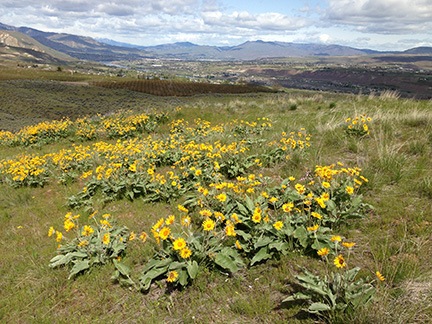
In April and May, my future home was covered with huge yellow flowers.

So I decided to finance the land and pay cash for the building. And I found a lender who would not only lend me the money on the land, but offer a great deal on that loan. You see, because of the size and location of the land, it qualified for farm credit. I could get a farm credit loan.

In May 2013 I finally applied for the loan. In the financial information section of the application, I listed all of my personal and business assets except my home — after all, my husband wanted it and would likely get it in the divorce. (I certainly didn’t want it.) Being completely debt-free, I look very good on paper. I was sure I’d get the loan.

But there was a snag: the lender said he could not process the loan until my divorce was finalized. I needed the divorce decree.

Once again, I found myself waiting for my husband.

The Bridge Loan

In late June, when I still didn’t have a divorce decree in hand, the owners agreed to push back the closing date to July 31. I had to cough up another $5,000 for the escrow deposit. That wasn’t a problem. I’d been working on cherry drying contracts since the end of May and had a good cash flow again.

But I was getting worried that the sellers would back out. The real estate agent who had sold the lot next door for them was nagging them about listing the lot they were selling to me. I knew that they’d be able to find another seller pretty quickly, perhaps for even more money.

Meanwhile, the lender had already told me that once they got the divorce decree and a preliminary loan approval, they still had to get an appraisal for the land. That could take three to six weeks. They refused to get the appraisal without preliminary approval, even though I offered to pay for the cost without any guarantee of the loan. The loan simply could not move forward without the decree and even when that piece of paper was produced, I could expect to wait up to two months for the loan to be finalized.

There was no way I could meet a July 31 closing deadline.

I racked my brain for options. As anyone who knows me can tell you, I’m a very resourceful person. But I was coming up empty.

Except for one option.

Early on, the sellers and I had talked about them carrying a loan on the land. I had done this with a condo I sold back in 2008 and it was one of the best deals I’d ever made. Monthly income at a good rate of return — surely two retirees would like that. Yes, they said. But their accountant advised them to not allow me to build on the land until it was paid for in full. Obviously not a workable solution for a long term loan.

But how about short term? Would they be willing to carry it until year-end? By that time I’d surely have the farm credit financing I wanted.

We spoke about it and I was frank about my concerns. They were frank about their Realtor wanting to list the land. They came up with terms I could live with. I requested that I be allowed to put a septic system on the property — the last component I needed to move my RV there — and they agreed. After all, it would increase the value of the property. We went to the title company agent and she drew up papers.

There was only one more requirement: that I get a life insurance policy for the amount of the loan naming the sellers beneficiaries. No problem, I thought.

I was wrong.

The insurance agent informed me that if I got a life insurance policy in the state of Washington I was required by law to list my husband as a beneficiary. While it was true that I could list him for just $1, I had absolutely no intention of listing him on any financial transaction I made. I was told that if I represented myself as an unmarried woman, I would be committing fraud and the policy would be invalid.

And that made me wonder about how the property would be titled if I closed before the divorce decree was filed with the court. As far as I was concerned, it had to be titled, right from the start, to me as an unmarried woman.

So I had to wait.

Closing

Meanwhile, the sellers came to the title company office and signed all the necessary papers to sell to me and set up the loan. I told the title company that I couldn’t get the insurance as quickly as I expected. (No lie there.)

Yesterday’s blog post goes into a bunch of detail about my wait for the divorce decree. It finally arrived on Tuesday, July 30, a day I now consider Freedom Day, the first day of my new life.

I spent most of Tuesday talking on the phone and exchanging email and texts. There were so many people who wanted to know the outcome, so many people I needed to talk to. It was a good day. I ran my phone battery down three times and got all kinds of good wishes from friends, family members, and even business associates.

But on Wednesday morning, I headed down to the insurance company to get that policy taken care of. It took 30 minutes and $70 to get what I needed. I decided to take it over to the title company, which was nearby, and drop it off.

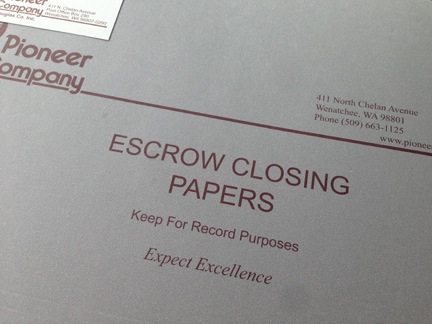
Closing Papers
I’d signed half the papers before I realized I was actually closing on the land deal.

The title company agent was full of congratulations for me. We went into her office where I handed over the insurance paperwork. She pulled out a file and had me start signing papers. I’d signed about four things when I realized something with a start: I was finally closing on the property I’d been trying to acquire for the past year, the property where I planned to build my new home and life.

I voiced this realization and she confirmed it. All she needed was a certified check for my downpayment and a voided check for the automatic loan payments. I handed over the voided check without hesitation, glad that I’d brought along my checkbook, tickled that it included my new physical address as well as my P.O. box mailing address.

Purchaser
It made me very happy to see this line on the closing papers.

Afterward, I went to the bank to get the certified check. I’d already transferred the necessary funds into my personal checking account, so it only took a few minutes. I then drove back to the title company and dropped off the check.

Done.

The deal was filed with the county on Thursday. I’m now the proud owner of 10 acres of view property in Malaga, WA.

Next up: getting a septic system installed, power turned on, water turned on, and bids for my building. You can bet I’ll be pretty darn busy over the next few months.