Picasa Library Photo Scam

Another one. Or two.

Another heads up on a phishing scam. This one comes in the form of an email message from “Picasa Library” or “Picasa Photo” that’s marked Urgent.

Pointing to the button in my email message window (see below) clearly shows that the link doesn’t go to Picasa (a photo sharing site) at all. It’s just another scam — another attempt to get you to go to a site and enter login information or download a virus.

Picasa Email Scam

It was pretty obvious to me that it was a scam, mostly because I don’t use Picasa and certainly don’t have 76 photos on the site. But if you do use Picasa? And had just uploaded a photo? You might be fooled.

Don’t be.

ADP Payroll Invoice Scam

Sloppy work, but I’m sure some people will fall for it.

Have you gotten an email message supposedly from payroll@adp.com (but really from someone else)? A brief email with the ADP logo and an invoice.zip file attachment?

Don’t open it.

Although I don’t think opening the message will cause any harm, the attachment is likely some sort of virus — or contains one when opened — and that can’t be a good thing.

Here’s what the message I got looks like. Note the From field and the typo in the bold, underlined text.

ADP Scam

I’ve said it before and I’ll say it again: Don’t open attachments you aren’t expecting, especially from organizations you don’t have some sort of email relationship with. Doing so is just plain stupid.

Coincidentally, I worked for ADP at their corporate headquarters back in the 1980s.

Snake Oil Supplements?

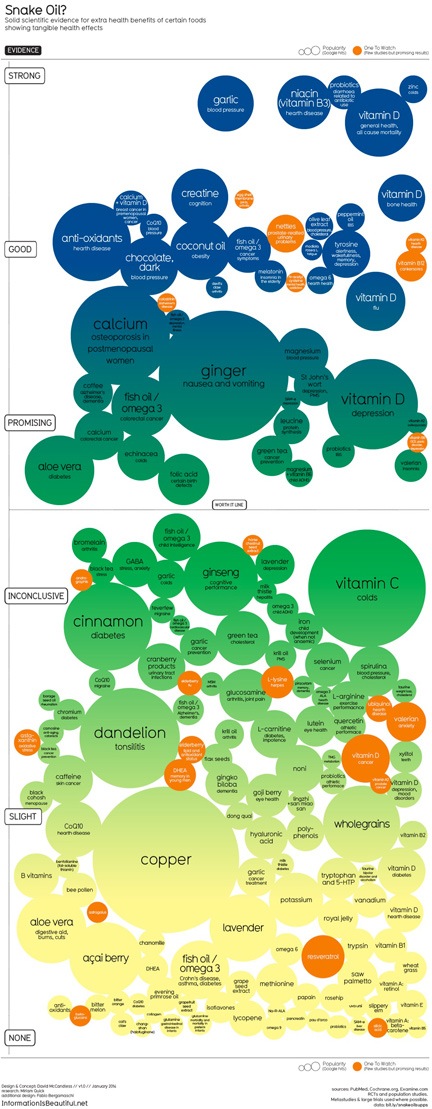
An amazing infographic about the tangible benefits of popular supplements based on scientific evidence.

Snake Oil Supplements?
This is a greatly reduced version of the static image dated January 2014. Don’t strain your eyes to study this — go here to see the full sized image.

Fellow author Tom Negrino shared a version of this infographic on Facebook the other day and I’ve found myself going back to it over and over to study the data it presents.

The presentation of the data is pretty straightforward. In each bubble is the name of a supplement and the condition the bubble represents. (If both aren’t listed in the static graphic, try the interactive version; point to a bubble to expand it.) The size of the bubble indicates the popularity (based on Google hits) for the supplement/condition combination. The location of the bubble determines the amount of scientific evidence to support the supplement’s effectiveness for the paired condition — the higher up in the image, the more evidence exists.

So, for example, fish oil/omega 3 appears several times on the chart. in the “Good” area, it’s paired with cancer symptoms, meaning that there is good evidence that it is effective against cancer symptoms. Near the “None” area, it’s paired with Crohn’s disease, asthma, and diabetes, meaning that there is no good evidence that it is effective against these conditions. You’ll find this particular supplement in other areas of the chart, too — I’ll let you explore those for yourself.

Why This Matters

Too many people are relying on supplements to help them with real health problems. They read something online or get advice from their “alternative medicine practitioner” with recommendations and they spend lots of money on pills and powders and liquids at health food stores, hoping to avoid real doctors and real medicine. They think they’re saving money and keeping “big pharma” from getting even bigger. But if they’re using supplements for conditions at the bottom of this infographic, they’re basically throwing their money away.

And that bothers me.

It’s nice to see the research presented in such a user friendly way. Best of all, as the main page for the latest version of this graphic says:

This visualisation generates itself from this Google Doc. So when new research comes out, we can quickly update the data and regenerate the image. (How cool is that??)

So we can expect to see this image modified as time goes on. In fact, you can see previous versions of it on the site if you poke around enough. (Tom, in fact, originally posted an older version that was embedded on another Website.)

Why You Should Care

Now I know some readers are going to push back against this data, possibly with anecdotes about how copper or acai berry or slippery elm helped you or your friend or your sister-in-law’s cousin overcome some ailment. You’re also going to say something like, “It can’t hurt to try, can it?”

You’re wasting your time with such an argument here. I don’t put supplements in my body for a specific problem without scientific evidence that it might actually work. I don’t throw away money on unproven remedies when proven remedies are available.

You probably shouldn’t either.

As for whether it can or can’t hurt to try, it certain can hurt. First, it can hurt your finances by causing you to waste money on something that probably won’t help you. Second, if you rely on ineffective remedies instead of getting real medical care and proven effective remedies, you run the risk of extending or complicating the condition. The What’s the Harm? website summarizes all kind of harm that came to people who relied on “alternative medicine” and supplements. (Alternative medicine is not medicine; if it was proven effective, it would be medicine. Think of aspirin.)

And if you want to explore a similar graphic about “superfoods,” be sure to check out this image.

And now pardon me while I add garlic to my shopping list…

Business and Politics Don’t Mix

Idiotic doctor loses a patient.

In defense of the Walmart Vision Center

Before you start beating on me about using Walmart for eye care, let me explain why I trust them.

In February 2012, when the stress levels due to marital frustration reached an all-time high, I experienced some “flashers” in one of my eyes. It scared me — mostly because it could indicate a detached retina — and I immediately sought an appointment with an eye care professional.

Wickenburg didn’t have a full-time optometrist and the quickest, closest exam I could get was at the Deer Valley Phoenix Walmart. I went, got an exam, got some feedback about my eyes, and was told I was okay.

I was so worried and so mistrusting of Walmart-quality care that I sought a second opinion. A week later — the soonest appointment I could get — I went to an eye surgeon near our Phoenix condo. He gave me the exact same exam and even pointed out the exact same weird issues with my left eye. The difference: his exam cost twice as much.

Oh, and Walmart will give me a contact lens prescription so I can get it filled online, saving hundreds of dollars.

On Wednesday, I went to the Walmart vision Center in Wenatchee for an eye exam.

While the receptionist checked my insurance to see if I was covered, the doctor got started with his exam. He was an older guy who was very gruff. Although he might have just got up on the wrong side of the bed that morning, I suspect he’s always that way. A cranky old man.

He got crankier when the receptionist came in with the insurance results. For some reason, they led me to believe at first that it wasn’t covered.

I said something like, “Well, I didn’t expect to be covered. I’ve never had eye exams covered.”

“You can thank your president for that,” the old doctor snapped.

I wasn’t going to let that go. I’m fed up with people bashing the president’s attempts to get all Americans affordable health care. Yeah, the rollout was a mess and the website sucked. (Although I had no problems with it here in Washington state; got insurance in less than an hour on my first try in November.) And I honestly don’t think the president purposely lied when he said we could keep existing coverage — I just think he spoke without knowing the facts. I’ll agree that was pretty dumb. But seriously: we needed something and no one else seemed interested in doing anything. This is better than nothing for the vast majority of people, whether they want to admit it or not.

“Actually, I’m very happy with my coverage,” I told him. “I just came from my FAA medical. For the first time ever, it was covered 100% as preventative care. I didn’t even have to pay toward the deducible.”

“Most people aren’t happy,” he said. His tone suggested that I was stupid for not following his herd. “Most people don’t like it at all.”

Most people?” I replied. “I don’t know about that. I know lots of people who are happy. I’m thrilled. My coverage is better than ever. And I know what it’s like to be uninsured because of a pre-existing condition.”

I was referring, of course, to the time my idiot wasband had made a late payment on the health insurance policy that covered both of us. It was COBRA because he was out of work (again) and he was paying with funds from our joint checking account. The payment was five days late and they cancelled us. Then they wouldn’t reinstate me because they said I had a heart condition — which I didn’t have — because a doctor had done heart tests the year before. I was without health insurance for about six months until I could get the issue resolved and it was the scariest six months of my life. A major illness could have bankrupted me at any time.

And that’s one of the thing that the Affordable Care Act will prevent: Bankruptcies caused by bad health. It’ll also keep Americans healthy by covering preventative care like routine physicals and tests.

He didn’t say anything more after that. Maybe he realized that I couldn’t be bullied. Maybe he thought that if he just shut up I’d forget what a jerk he is.

But I won’t forget. And I won’t be going back to him for my next eye exam.

And oh, by the way, I was covered. I don’t think he liked admitting that to me.

My advice: if you’re in business, keep your controversial political views to yourself.

The Rise (and Fall?) of Drones for Aerial Photography

I’m watching the developments closely for a few reasons.

I care about unmanned aerial vehicle or drone use, no matter what size it is. But I really care about drones flown by amateurs for photography.

The Death of a Revenue Stream

I first felt the sting of drone use for aerial photography when one of my best aerial photography clients began using a six-rotor, radio controlled quadrocopter to create some of their excellent 360° interactive panoramic images. Their setup even made international news when it photographed a protest in Moscow in 2012.

Bryce Canyon Pano
Our trip to Bryce Canyon was especially memorable because it was so freaking cold.

The drone seemed to be the perfect solution for one of our biggest problems: finding a cost-effective way to get an aircraft to some of the most remote locations in the world. In the past, I’d flown this client at Bryce Canyon in Utah, Lake Powell, Horseshoe Bend on the Colorado River in Arizona, San Juan River Goosenecks in Utah, and the San Juan and Colorado River Confluence in Utah. Drones theoretically also made it possible for them to get images at places helicopters couldn’t legally fly — such as within certain national parks and other restricted airspaces. I worked with one photographer on many of our flights; he was just as disappointed as I was about the drone use because it meant he wouldn’t be sent to these locations, either.

As I saw more and more images and video footage shot from drones, I thought I was seeing the writing on the wall. Why spend $500 or more per hour to fly with a helicopter pilot when you could spend less than $10,000 for a ready to fly quadrocopter designed for photography that you could use over and over anywhere in the world? Or much less for something more basic, like a Parrot AR.Drone or Phantom Quadcopter that you could attach a GoPro camera to? Theoretically, an investment of less than $1,000 would give you everything you needed to get the aerial photos or videos you need.

Of course, you have to be able to fly the damn things. But apparently, that isn’t much of a problem.

So I saw the very real possibility of a revenue stream — aerial photography flights — drying up because of the proliferation of drones carrying cameras.

Bigger Worries

But there was something else that worried me — something that worried me much more. As a helicopter pilot, I often fly at or below 500 feet AGL (above ground level). And contrary to popular belief among airplane pilots, there is no minimum altitude for helicopters. I fly where it’s safe to fly and try hard not to annoy people on the ground. Still, there’s a very real possibility that I could be flying in the same airspace as someone with one of these drones.

And that scares me.

Yeah, you say. Fly higher. But sometimes that’s not possible. Sometimes I need to fly closer to the ground. And besides, the FAA has given me permission — by issuing me a helicopter pilot certificate — to fly in this space. The same can’t be said for most drone operators.

Watch the video from the crashed drone.

These drones are not toys. They have the potential to be very dangerous. This became very apparent in October 2013 when a Quadcopter crashed in Manhattan after bouncing off a few buildings, landing only a few feet from a pedestrian.

Can you imagine what would have happened if this drone had struck someone on the ground? Or went through one of those office building windows? Or collided with a helicopter or small airplane?

Here’s what happened when a radio controlled helicopter struck the man controlling it in a Brooklyn, NY park in September 2013.

And the possibility of drones and aircraft colliding isn’t so remote. It almost happened near Denver in May 2012.

In December 2013, the PBS NewsHour did a story about this: “How will thousands of drones impact already crowded skies?” That story explores other issues, too, including computer-operated drones that can fly themselves and privacy.

The FAA Steps Up to the Plate

After dancing around the issue for a while, the FAA finally made a statement — and it’s one I’m very happy about.

It all started last week when the Spokesman-Review newspaper published a video shot from a “radio-controlled helicopter.” The aircraft that shot the video was clearly operating in close proximity to people on the ground — indeed, even right overhead. A self-proclaimed “troll” tweeted about it and the legality of “drone journalism” turned into a Twitter debate that was picked up by Poynter. The operator of the drone claimed such use was a “gray area” as far as the FAA was concerned. As covered in later articles on both Poynter and the PBS NewsHour, the FAA plainly stated that “drone journalism” is not allowed. According to the Poynter piece:

“There is no gray area,” said FAA spokesperson Les Dorr.

Hobbyists are allowed to use small, radio-controlled crafts under specific guidelines, but “if you’re using it for any sort of commercial purposes, including journalism, that’s not allowed,” he added.

Although I’m very happy about this development, I’m sure this isn’t the last word. I’m equally sure that drone photographers will find loopholes to avoid use being classified as “commercial” and that the practice of strapping cameras onto drones will continue into the future. Hopefully, however, drone operators will limit their use to more remote areas and keep them away from people and property on the ground.

It also proves to me that the FAA is finally paying attention to this issue. With luck, their attention will be enough to limit drone use for these purposes — at least until some sort of controls can be put in place to ensure safety.


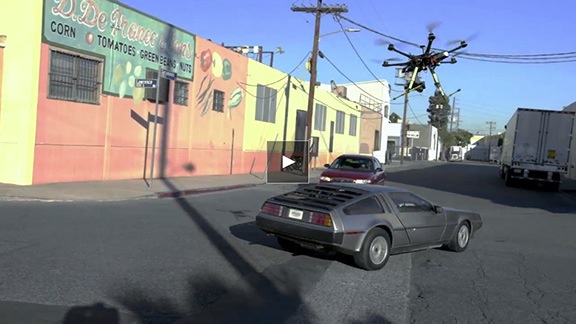
January 10, 2014 Update: Watched the latest video of Jerry Seinfeld’s Comedians in Cars Getting Coffee this morning. In the first 30 seconds of this video (after the commercial), you can see a UAV with a camera flying over the Delorean. Seconds later, it crashes. I’m thinking they didn’t do this on purpose — although Jerry masterfully works it into his script.

Screen Grab from Comedians in Cars Getting Coffee
This screen grab is from 1:11 in the Patton Oswalt episode of Comedians in Cars Getting Coffee. (Highly recommended show.)