
There’s no automatic in, no fast track to the dream jobs.
In this series:
– Part 1: Read this First
– Part 2: Save Up
– Part 3: Start Young
– Part 4: Choose a Reputable Flight School
– Part 5: Check Your Attitude at the Door
– Part 6: Study Hard
– Part 7: Stay Slim
– Part 8: Be Willing to Travel
– Part 9: Pay Your Dues
– Part 10: Network
– Part 11: Don’t Bite the Hand that Feeds You
more to come…
The thing that bothered me most about the Silver State debacle was the way the company misled potential students in their sales seminars. Radio commercials would lure people in by claims that anyone could become a helicopter pilot earning $80,000 a year. The combination of cool job and big paycheck was enough to get dreamers in the door. The seminar, which often included helicopters on stage and pilots strutting about in flight suits, visualized the dreams, making them tangible. With bank representatives standing by to guarantee financing, is there any wonder so many people signed on the dotted line?
The trouble is, although Silver State (and some other organizations) made it sound as if all you need is a commercial helicopter certificate to qualify for a high-paying dream job as a pilot, in reality, you need a lot more than that. All your certificate gets you is a chance to get your foot in the door. You’ll need to pay your dues to earn a good job as a pilot.
Paying Dues
When I say “pay dues,” I mean that metaphorically. You’re not actually paying money — you’ve already done enough of that to get your certificates, haven’t you?
I mean working in one or likely more less desirable jobs in order to build the experience you need to qualify for better jobs. Like a recent college graduate climbing the corporate ladder, you can’t expect to get the CEO job while the ink is still wet on your diploma. Instead, you start at the bottom and work your way up.
The goal of paying dues is to build experience. In the world of flying, experience has several components I can think of: time, skills, aircraft, and confidence.
Building Time
At its lowest level, experience can be quantified by stick time: total time, total helicopter time, and PIC time. The vast majority of non-entry level employers won’t even look at your resume unless you have at least 1,000 hours of PIC time; that number varies depending on the job market and availability of pilots.
Most pilots build time as flight instructors — which is why it’s so common to get a CFI rating as part of pilot training. So the first job you’re likely to have is as a CFI, sitting in the same kind of helicopter you probably trained in while someone sits beside you, learning to fly.
I can make a valid argument about why time built as a flight instructor isn’t worth as much as time built actually flying missions. In fact, I made this argument in a blog post I wrote back in 2009. Unfortunately, unless you have access to a helicopter and an opportunity to fly real-life missions, you’re not likely to build much of your early time that way.
The point is, flight time builds experience. No matter how that time was built, a pilot with 1,000 hours PIC has more experience than one with 300 hours. Be prepared to take any job you can get to start building that time.
Oh, and one more thing: if you’re interested in adding bulk time to your log book, don’t pay an organization for the privilege of doing so. There’s at least one company out there using low-time pilots to fly relatively dangerous missions. That company is not only getting the pilots to pay them $200/hour (or more) to fly but is also collecting money from clients for the missions being flown — a practice known as “double-dipping.” Legitimate employers don’t charge their pilots a fee to fly; they pay their pilots. They also don’t ignore manufacturers’ safety notices regarding qualifications for missions being flown.
Building Skills
You might think that building time leads to building skills. It does — but only to a certain point. Look at it this way: If you do the same thing over and over, you’ll likely get pretty good at it. But you won’t get very good at anything else.
Take, for example, a flight instructor job. You’ll get good at hovering and preventing student pilots from crashing while trying to hover. (I can still remember how good my CFI was at steading the helicopter when I was learning to hover.) You’ll get good at performing basic, advanced, and emergency maneuvers to private and commercial standards. You’ll get good at doing traffic patterns and planning the same cross country flights to the same handful of airports.
While there’s nothing wrong with those skills, there are a lot more skills that a commercial pilot needs in his bag of tricks. Landing direct to fuel at an unfamiliar airport, avoiding the flow of fixed wing traffic — in other words, stay out of the traffic pattern. Planning cross country flights over unfamiliar areas with multiple stops at unfamiliar airports. Landing off-airport someplace other than at the same handful off practice areas. Calculating weight and balance and performance for a wide range of flight profiles. Dealing with demanding passengers, unreasonable air traffic controllers, obnoxious airplane pilots. Making changes to a flight due to weather or other unforeseen circumstances. These are the kinds of skills you build by flying real missions.
And then there are the specialized skills. Landing in snow or on water. Conducting photo and video flights. High altitude operations. Sling loading, long line work. Fire suppression by bucket or snorkel/tank setup. Spraying crops, drying cherries, preventing frost damage. Search and rescue. Flying with night vision goggles. These are the skills that are hard to build because they’re part of jobs that require experience. But these are also the skills that lead to high-paying pilot jobs.
If you have an opportunity to get real training in one of these skill areas, it might be worthwhile to pay for it. For example, if a flight school offers a long-line course and you want to get into fire suppression work, having that course on your resume might help you get your foot in the door for a job that’ll get you the experience you need to move in that direction. But again, don’t get suckered into a “job” where you pay to sit beside someone who is “training” you while actual work is being done for clients. Instead, look for a course that combines ground school with flight time where you manipulate the controls beside a flight instructor. In other words, real training.
Learning Aircraft
Your stick time in different aircraft is also an important part of experience. You’ll likely start out in a small piston (reciprocating engine) helicopter, like a Robinson or Schweizer or Enstrom, but the real jobs — the ones that come with big paychecks — are usually in far more impressive aircraft.
They say that if you can fly an R22, you can fly any helicopter. I think that’s true — to a certain extent. Small helicopters with their limited control systems and squirrelly flight characteristics offer challenges you won’t find in larger helicopters. They also can offer opportunities to learn how to deal with limited performance in challenging conditions. But, at the same time, larger, more complex aircraft have their own challenges to learn through experience.
The biggest aircraft distinction is piston vs. turbine engine. That engine difference leads to two major concerns:
- Start-Up. If you screw up while starting a piston helicopter, it won’t start. If you screw up while starting a turbine helicopter, you could have a hot start that melts the turbine, leaving the helicopter disabled (or dangerous to fly).
- Power. If you pull too much power in a piston helicopter, you’ll likely get a low rotor warning. If you pull too much power (torque) in a turbine helicopter, you’ll over-torque and damage the transmission. (Either way, if this happens in flight you could have some serious problems.)
Beyond that, the only differences are in the systems you need to learn to understand how the helicopter works, do a preflight/postflight, and troubleshoot problems. Still, the differences are considerable.
Another example might be hydraulics. An R22 doesn’t have a hydraulic system, so there’s no worries about hydraulic failures. A larger aircraft does. But not all aircraft hydraulic systems are equal. I’ve been trained to deal with hydraulic failures in Robinson R44 and Bell 206L helicopters and can confirm that a lot of upper body strength is required to control the helicopter and land safely without hydraulics. I’ve also heard that even more strength — possibly more than I possess? — is required to deal with a hydraulics failure in a Eurocopter AS350 (AStar).
Obviously, the more aircraft you’ve flown, the more prepared you are to deal with issues that might come up in flight. For that reason, the more aircraft types a pilot has flown, the more marketable he is.
There are opportunities to pay to fly specific aircraft models. For example, there’s a guy in the Los Angeles area who does ENG work and will let you fly his turbine helicopter on assignment with him for a fee. And even I offer long cross-country flights twice a year to pilots interested in building 10-12 hours of R44 time over two days. Is this worth it? It depends on your need. If you just want to get familiar with an aircraft or you only need a few hours of flight time to qualify for something else, it might not be a bad idea. But if you need 50 or 100 or 500 hours of experience in an aircraft make and model, do you really want to pay for it? Wouldn’t it be better to take a less attractive job and get paid to fly that aircraft instead?
Building Confidence
I hesitated to include this because I don’t want readers to confuse confidence with over-confidence. There’s a fine line between them and being on the wrong side of that line can kill you.
Simply stated, the more you do anything, the more confident you should be that you can do it successfully.
Example. Do one autorotation. Do you feel confident you can do one perfectly every time you try? Probably not. Do 150 autorotations in a month. How do you feel about it now?
Of course, it’s not enough to perform a maneuver or task multiple times to feel confident about your ability. You have to perform it successfully. The higher the percentage of times you successfully perform a maneuver, the more confident you should become about being able to perform it successfully in the future. You can do 150 practice autorotations in a month and if more than half of them are bad — wrong airspeed, miss the spot, etc. — you shouldn’t be nearly as confident as if you nail it 90% of the time.
Off-airport landings is a good example from my own flying. I do a lot of off-airport landings — in fact, in the work I do each summer, I’d estimate that 95% of my landings are off-airport. Years ago, I was a nervous wreck when landing on anything that wasn’t paved and level. But now, after so many landings on all kinds of terrain and surfaces, I’m pretty confident in my ability to find and land on a suitable landing zone where I need one. But that doesn’t mean I’ll try to set it down anywhere. I still go for the smoothest, most level surface I can find. I set it down slowly and I fly it all the way down to the ground. If I don’t like the way it feels, I’ll pick it back up and move it — sometimes only a foot in one direction — until I feel good about where I’m parked. I’ve done this solo and with a ship full of passengers, front-heavy or side-heavy. I’m confident I can do it.
Over-confidence occurs when you think you can do something better than you actually can. Instead of putting real effort into it, instead of concentrating to complete the task with all of your attention, you become complacent and go through the motions without thinking. That’s when things go wrong and accidents happen.
Work Your Way Up
The better a job is, the more experience you need to get it. That’s why you’ll need to work at possibly low-paying, low-interest jobs before you can qualify for more interesting or lucrative ones.
This is normal in any industry or career path. You should not expect it to be different for a flying career.
A career conscious pilot will keep this in mind with every job he gets. I remember a fellow pilot at the Grand Canyon when I worked there in 2004. He told us, from day one, that his goal was to build 500 hours of turbine time in that job. While the goal was achievable, he put himself on the fast track to make it happen. If he was idle and another pilot wanted to give up a flight, he’d take it. If he had a day off and another pilot who was scheduled to work wanted the day off, he’d swap. As early as July, he’d built the 500 hours he wanted — most other guys were lucky to reach that milestone by the end of the season. He stuck around, of course — we were under contract for the full season — but was the first pilot to leave for a better job when we were released.
The point is, it’s not enough to just get a job and go through the motions. You need to use each job as a stepping stone for your ultimate goal. Look for jobs that’ll get you the experience you need; work hard to put yourself at the front of the pack to get that experience. Yes, you might wind up doing a job you hate or working in a place you’d rather not be. But the quicker you do it and get it over with, the quicker you can qualify for the job you really want in the place you want to be.
Next up: why the learning should never end.

 Damaged discs and idiotic customer service.
 I brought along my camera. I didn’t really expect to find anything of interest to photograph, but on nearing the top of the first big hill — after an elevation gain of about 800 feet in 1-1/2 miles — I caught sight of a lone pine tree on a hilltop off in the distance. It reminded me a bit of
  As I continued the hike — my friend had gone up ahead because I’m so damn slow when hiking uphill — I got a little artsy with some weeds along the trail. I liked the way the sun shined through them. Remember, the sun was up ahead of me. Again, from what I could tell, the image looked interesting in the screen at the back of the camera. I felt good — as if I were getting some interesting shots.
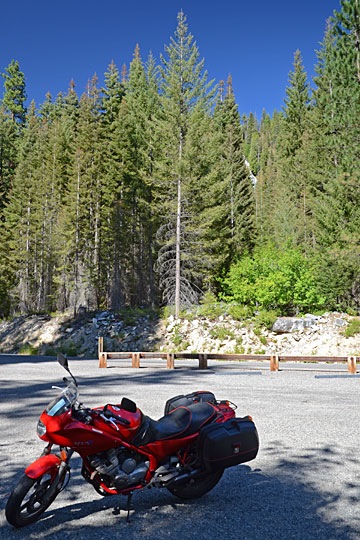 There were National Forest Campgrounds along the side of the river. I passed two before I reached the parking area and campground for Silver Falls. I parked and stripped off my gear, locking it up in my bike’s Givi saddlebags. Looking up, I saw the top of the falls — can you see it in the photo? It didn’t seem that far away.
 I immediately found myself in a deep, somewhat dark pine forest. As my eyes adjusted to the light, my nose picked up the scent of pine and moisture and my ears heard the sound of rushing water. I came upon the creek immediately — a healthy stream of water gushing over rocks between trees. For me — a desert dweller — it was a real treat.
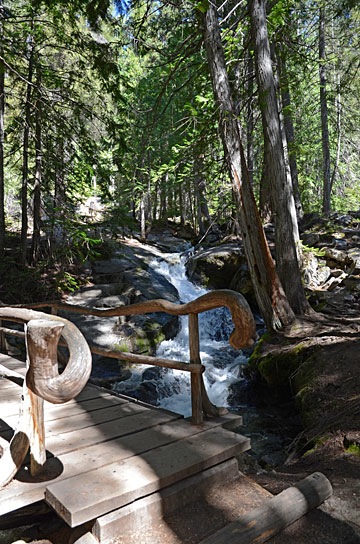 The path was well-maintained, with rustic protective barriers to prevent hikers from accidentally falling into the stream. The bridges were especially rustic looking, sometimes with curved logs making attractive rails. It was surprising to find something so attractively designed on a trail. I began to wonder how much of the trail dated back to the
 But I stuck with it and was rewarded with a switchback and another climb. A while later, I was back alongside the stream at yet another streamside bench, photographing some beautiful purple flowers just past the peak of bloom.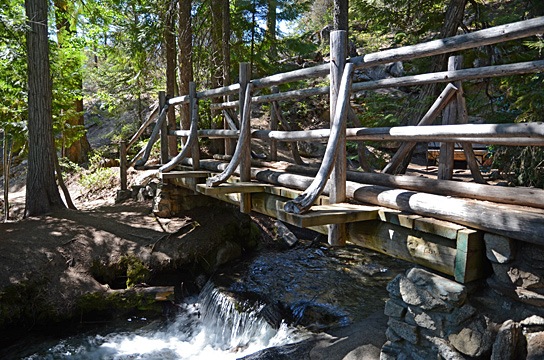
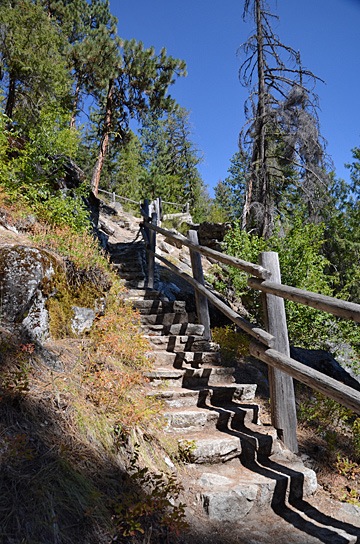 Then I started down the other side of the creek. At first, it was one long flight of stairs after another. Then the trail moved away from the falls in a series of relatively level paths with switchbacks. In some places, the trail emerged from the forest into the sun; not only could I feel the heat on my skin, but I could smell it. Then back into the trees for cooling shade and pine aromas.
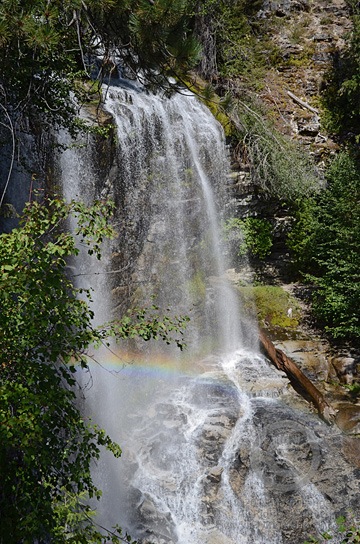 At one point, the trail came back to the falls just below where I’d walked along the ledge on the other side. The mist and sun worked together to produce a small rainbow. I did the best I could to capture the scene with my camera; I really do need to learn how to photograph waterfalls properly.