Back in the Saddle Yet Again

Reawakening my motorcycling skills.

This week, I jumped back into a hobby that had once been an integral part of my life: motorcycling.

A Little History

Years ago, when I was in my 20s, I came up with a personal list of skills I wanted to acquire during my lifetime. Although they didn’t have any particular order, the one I went after first was learning to ride a motorcycle.

I was 29 when I bought my first motorcycle. It was a 1978 400cc Honda Hawk — what we might call a “standard” bike with an upright seating position. It was black with red trim, and despite being 11 years old, it only had 941 miles on it. Its previous owner, also a woman, had died of cancer 9 years before and her husband had been unable to part with it. A motorcycle dealer, he’d kept it in mint condition and I was the lucky person to buy it. I don’t remember what it cost, but I do remember that it was a good deal. Wish I could find a photo of it.

Because I understood the importance of safety and I didn’t know anyone who rode, I signed up for a Motorcycle Safety Foundation course (highly recommended). Mike, who was not yet my husband, also signed up. His idea was that after taking the course, we’d both go riding on my motorcycle. I made it quite clear that my motorcycle was mine and if he wanted to ride, he needed to get his own. So he bought a very functional but tired looking BMW Boxer.

We met other motorcyclists at the safety course and it wasn’t long before we were riding weekly with a group. They were, as you might expect, mostly male and all right around our age or a bit younger. Women, when they came along, were usually passengers. The bikes were mostly sport bikes — crotch rockets, as some people call them — and the group rode fast on twisty roads, mostly in Harriman State Park north of our New Jersey home. It was challenging to build the skills to keep up with them.

1992 Yamaha Seca IIWe went to Americade with the group one year and that’s where I got a chance to test ride what would be my next motorcycle: a 600 cc Yamaha Seca II. The Honda was a nice bike and it had helped me build and refine basic skills, but I was ready for something more sporty. Almost a year passed before I took the plunge in 1992. Right next door to the Yamaha dealer in Paramus, NJ was a BMW car dealer that just happened to have the previous year’s model BMW K65S (I think), still new, in an electric blue color. Mike bought it. A few days later, we rolled up to an upstate New York campground on a pair of brand new bikes, shocking the hell out of the members of our riding club that were also on the trip.

We did a lot of riding in those days. One of my favorite vacations was the trip we took from the New York metro area down through Washington DC and onto Skyline Drive and the Blue Ridge parkway. It was a motorcycle camping trip and folks in the campgrounds we stayed at couldn’t believe how much gear we were able to pack on those bikes. We came all the way down the Blue Ridge Parkway to Tennessee, with a great ride through Deal’s Gap, then headed over to the coast and came up the barrier islands, following the wake of a hurricane that had battered Hatteras. Mike didn’t tell his mom that we were doing the trip on motorcycles — she thought we were driving. During one call to her while on the trip, I heard him assure her that I was doing just as much of the driving as he was.

Time went on. We did another camping trip with the club, this time up to New York’s Finger Lakes area. Riding through farmland at speeds I don’t want to admit, I found the top end of the Yamaha’s power curve. I instantly fell out of love with the bike.

1996 Ducati 900 SS/CRIt wasn’t long before I bought my next bike, a 1996 Ducati 900 SS/CR. Now here was a bike with testosterone. I recall trying to find the top end one day on a piece of long, straight desert road. I got to 130 mph when I decided that I didn’t really need to find the top end. Needless to say, I had no trouble keeping up with the group.

Things change. We moved to Arizona where the riding wasn’t quite as good. We got horses, which were more interesting to ride. Later, I learned to fly helicopters — another one of the skills I had on my list. I bought my first helicopter. Which do you think is more fun to take out for a spin? The motorcycles gathered dust in my hangar.

Fast Forward to Today

I’m up in Washington State for the fourth summer in a row, working a series of cherry drying contracts. With me are my helicopter, Mike’s pickup, and my very large fifth wheel trailer, the “mobile mansion.” The pickup is my only means of ground transportation.

Last year, I almost bought a Honda scooter. This year, I looked at them again and realized that a 30 MPH top speed would not be much use for serious transportation. I even looked at motorcycles with the thought of getting a dual purpose bike I could take off-road a bit. But when a reality check reminded me that I’d be turning 50 this year, I decided against such a purchase.

I wished I had one of the motorcycles I already owned, which were languishing in my hangar 1,200 miles away.

I called Dave, who runs a motorcycle shop in Wickenburg. I asked him if he knew of a company that could ship one of my bikes up to me. He not only knew a company that could do it, but they could do it for about half of what I thought it would cost. I told him to fetch the Yamaha from my hangar, do what he needed to to get it running, and ship it out to me.

The Yamaha ArrivesIt arrived on Thursday, on a specially designed dolly in a 18-wheeler filled with motorcycles. I took possession about half a mile down the road from my temporary home, at a closed-down weigh station. I’d asked Mike to put on the Givi hard luggage I’d bought for it; the helmet and my old denim riding jacket were stowed inside. Once I remembered how to start it — I knew there was a primer switch somewhere but couldn’t remember where at first — I was good to go.

That first half mile ride was the first time I’d been on a motorcycle in over two years.

Motor Skills Return

Yesterday, after a long, hot day of doing helicopter rides at a local winery, I climbed on, put on my helmet, and rode the 5-1/2 miles into Quincy for dinner at my favorite Mexican restaurant. I admit I was nervous at first — what if I screwed up and killed myself? The speed limit on the road between my RV and town has a 60 mph speed limit. It didn’t take me long to get it up to speed, though.

But what really surprised me is the way my hands and feet seemed to go into auto-pilot mode. My right hand and foot automatically moved to the brake lever and pedal to apply just the right amount of pressure for braking. My left hand and foot automatically moved to the clutch lever and gearshift to change gears smoothly. Balance comes naturally, even in the gravel parking lot at the RV park.

I’d been hoping that the skills would return. I’m thrilled that they have, but admit I’m very surprised that they have returned so quickly. I guess that’s what experience is all about.

Back in the Saddle

Today I’m planning my first big ride — a 70-mile trek from Quincy to Chelan, WA. I’m toying with the idea of mounting my GoPro for the ride — I’ll be riding along the beautiful Columbia River most of the way — but don’t need even more video footage I can’t really use. So I’ll likely just take it easy and enjoy the ride.

It’ll sure be nice making the trip in something other than a 3/4 ton pickup.
Murdoch Drags the Wall Street Journal Down to His Level

Such a sad, sad sight to see.

Defending News Corp against criticism of its illegal phone hacking and police bribing activities, Rupert Murdoch’s Wall Street Journal published an opinion piece that included this classic line:

Do our media brethren really want to invite Congress and prosecutors to regulate how journalists gather the news?

I am deeply offended by this piece on several levels.

  • Murdoch has built a fortune with yellow journalism. By buying up and controlling so many media outlets, he has brought journalism standards down worldwide. Not convinced? Roger Ebert explains the impact Murdoch had on the Chicago Sun-Times during his ownership.
  • Murdoch has insulted the intelligence of half the American public and conned the other half with his so-called “fair and balanced” news network, Fox News. The network not only promotes tasteless and sensationalist news stories, but it clearly promotes Murdoch’s conservative viewpoint, often with misstatements, half truths, and quotes taken out of context.
  • In the opinion piece from which the above quote was taken, Murdoch seems to suggest that his company’s news gathering techniques are protected under the First Amendment. In other words free speech allows journalists to collect news by whatever means are available to them. The legality of their actions simply doesn’t matter. Of course, Murdoch is also free to define “news” any way he sees fit.

In my opinion, there is no single news organization that has done more harm to America than Fox News. It oozes hate and mistrust, it pits Americans against each other and their elected political leaders. It makes news out of scandal — except this one, of course — and ignores or misrepresents the real issues that Americans need to know about.

Murdoch is responsible for this.

Fortunately, those Americans who haven’t been sucked into the half-truths spewed by FOX News have other sources of information: NPR, PBS, the New York Times, the Wall Street Journal. Well, scratch that last one.

The above-referenced opinion piece is the first example — at least the first I’ve seen — of where the Wall Street Journal is being used as a Murdoch disinformation tool. Not only has the Journal’s business reporting suffered, but it’s now becoming Fox-ified.

In the Journal piece, the unnamed author says this about its competing media outlets:

The Schadenfreude is so thick you can’t cut it with a chainsaw.

Why shouldn’t it be? News Corp has done more damage to the news industry than any other organization. I’ll be the first to admit that I’m enjoying the schadenfreude, too.

Want another point of view on this Journal opinion piece? Read what Felix Salmon says on Reuters.

Drying Cherries

Up close and personal with a whole lot of trees — and fruit.

One of the things that has been keeping me very busy — at least lately — this summer is my work as a cherry drying pilot.

What It’s All About

In brief: During the last three or so weeks that cherries are on the trees, if they get wet, they can become damaged — usually splitting or developing mold. Growers who don’t want to lose their crop hire helicopter pilots to stand by during cherry season. After a rain, they call us out to hover over trees. The downwash from our rotor blades shakes the branches, thus shaking off accumulated water.

There’s a lot more I can say about this, but I don’t think it’s necessary. As I mentioned here, the work can be dangerous and requires good flying skills. (There was an accident in an orchard just the other day that was likely caused by a failure to respect density altitude in a heavy helicopter. Both occupants survived uninjured; the helicopter didn’t.) It’s not for low-time pilots. And it’s a crappy way to build time — I was here 6 weeks before I was called out to fly at all and, now seven weeks in, I’ve only flown about 9 hours.

Oh, and did I mention how incredibly tedious the work is?

Some Snapshots

Anyway, yesterday I was called out twice to dry. There was a 15-acre orchard that I had to dry twice and a 40-acre orchard that I dried just once. Add that acreage together and you get 70 acres of cherry trees.

For my second call out, I mounted my GoPro “nosecam” on the helicopter. I actually have video from that viewpoint of both orchards I dried on that call. It’s not very exciting stuff. As I type this, I’m debating on whether to throw a few minutes’ worth into a video to share. I wouldn’t want to put anyone to sleep.

I did, however, pull out a few still images as photos to share here.

Cherry Drying
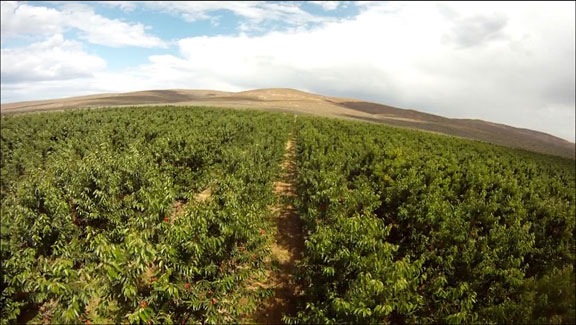
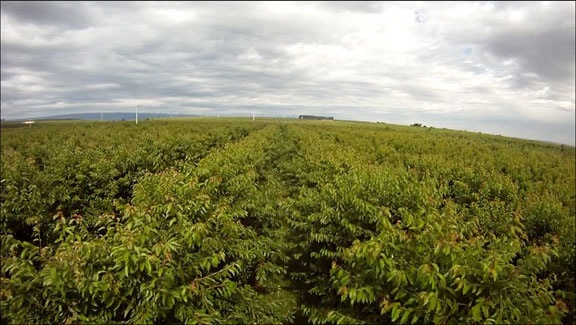
This is a typical view down an aisle of cherry trees. I fly very low.

Orchard and Rain
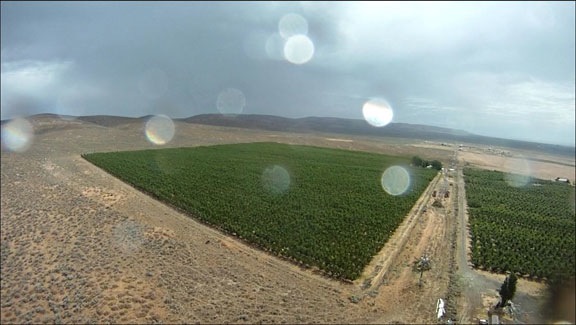
Here’s a shot as I approached the 40-acre orchard block. You’re looking at hundreds, if not thousands, of trees. It was still raining lightly as I flew up. I took the opportunity to land near the orchard and pull my door off. When the sun comes out, it gets very hot in the cockpit — especially when you’re wearing a Nomex flight suit and helmet.

Cherry Drying
Here’s another drying shot. These trees are younger than the ones in the smaller orchard and were heavy with fruit, which you may be able to see in this shot. The sun was out for much of this dry, so time was of the essence.

Serious Business

Cherry drying is serious business. My client is paying me good money to sit around and wait for the rain. When the rain comes, it’s my job to quickly and effectively dry his trees. If I fail to do my job, my client can lose his entire crop. That could be hundreds of thousands of dollars worth of fruit, the difference between a profitable year and a year living on credit.

It’s a huge responsibility that I take very seriously.

The next time you eat fresh US-grown cherries, think about the folks in the production chain that put those cherries on your plate. I might be one of them.

Blog for Your Readers, Not for Yourself

It simply isn’t fair to expect your blog’s visitors to jump through hoops to see your content or share their comments.

Yesterday, I followed a link to a Web site I often visit and read a blog post I wanted to comment on. I filled in the form and was faced with a series of options, all of which would eventually require me to set up an account with the blogger’s current choice of comment platform: Livefyre. I didn’t want an account on yet another commenting platform, so I simply didn’t leave a comment.

I should note a few things here. It was this same blog and blogger that was using Disqus, another commenting platform, a few years back. I wanted to comment and set up a Disqus account. Since then, Disqus has become relatively popular and I use the account a few times a week.

(It wasn’t always like that. I distinctly remember the hassle that followed my Disqus account setup when the system kept sending me email messages every time someone else commented on a post I’d commented on. It took a lot of digging to figure out how to turn off that feature — which I’d never turned on. As for Livefyre, it seemed impossible to post a comment yesterday without giving Livefyre permission to post on my behalf on Twitter or Facebook or use my e-mail address for some other purpose I didn’t want but had no choice but to authorize.)

Of course, I still don’t understand why a blogger doesn’t simply use the commenting feature that’s part of a WordPress installation. That’s what I use here. It’s pretty straightforward: enter your name, e-mail address, website (optional), and comment. If the comment passes muster with my spam prevention software, it’s held for moderation by me. If I approve it, it appears. If I don’t, it’s trashed. I could, of course, require each and every commenter to open an account on this blog, but I really don’t think it’s necessary to make them take that extra step. It’s bad enough that they may have to wait for their comment to appear.

And that brings up the topic of this post: requiring blog readers to do something special just for you so they can see or interact with your blog’s content. I’m talking about requiring an account on an obscure commenting system just because you like it. Or inserting content that depends on a specific plugin or Web browser to view. Or requiring someone to create an account or log in just to read a post. (Don’t get me started on paywalls.)

It’s just not right.

Face it: there are tens of thousands of blogs out there and, if you’re an average blogger, half of them are going to be better than yours. Why would you make your blog readers do something special just to read/reply to your blog? Do you really think it’s fair to have them jump through hoops just for you?

I don’t.

If you’re a serious blogger with content you want to share with the biggest possible audience, stop putting up roadblocks or hurdles for readers. Make content easy to find and read. And yes, that does mean not splitting posts into multiple parts, forcing readers to click through multiple pages to read one post. It also means not littering your blog with obnoxious and distracting ads that make it difficult to find content among blinking, flashing, or animated trash. And content that requires plugins to see is likely to be seen only by the few people who have those plugins or are willing to install them.

If you want feedback from blog readers in the form of comments that can start valuable conversations and build a blog community, stop making it difficult for them to post a comment. Not everyone is happy about setting up accounts all over the Web — especially accounts with third party services that might use contact information for their own purposes.

So who do you blog for? Yourself? Or your readers? Look at your blog from their perspective. Is your content worth the bother of jumping through the hoops you’ve set up for readers?

If there’s any question, maybe it’s time to rethink your priorities. It just might help get your blog a bigger audience and the kind of reader interaction that sets good blogs apart from the rest of the pack.

Phoenix Dust Storm Time-Lapse

Excellent footage of a desert phenomenon.

No, this isn’t one of mine. But it offers two excellent views of a larger-than-usual dust storm bearing down on Phoenix, AZ.

These storms are nasty. Although they can occur a few times during early “monsoon” season, they’re not usually as big as this one.

[Edit Note: The original title of this post referred to this as a “sandstorm,” although it was properly identified as a “dust storm” within the post. I’ve since fixed the title.]