Outdoor Photography: It’s All about Timing

What a difference two days and one hour makes.

Although I was very pleased with the “Desert Still Life” life photo I shot the other day, I wasn’t 100% happy with it. It seemed to me that when viewed at 100%, the photo was grainy. I decided to head back out to the same spot at roughly the same time of day to shoot it again.

I couldn’t do it the next day, however, so it was two days later when I pointed the Jeep down that ATV road, pulled out onto the ridge, and followed the dirt road there to the same site. When I arrived, it was a full hour later in the day than the previous shoot.

This is an amazing example of how important timing is in photography. These two photos show roughly the same image, but with a mere 49 hours of time between them. The one on the left is my original image; the one on the right is the later image.

Good Shot Bad Shot

Now I know what you’re going to say. The exposure is off on the second shot. It is. I exposed for the cactus flowers, which were in the shade — remember, it’s one hour later. And although I probably could have fixed this shot up a bit in Photoshop, I didn’t bother. Frankly, when I saw the condition of the flowers, I didn’t try very hard to get a good shot. I just tried for the same angle. The only reason I made the photo on the right at all was to show it in this blog post as an example of how things change from day to day.

The biggest change was in the flowers themselves. Those bright magenta blooms had mostly closed up. I don’t think this had much to do with the time of day. I just think that they were 2 days past their peak. I’d just happened to arrive on point to make the first shot when they were at their peak.

The point of this post is to clearly demonstrate that outdoor photography is all about timing. You need to get there at the right time of day when your subject matter is at its peak. If this means multiple trips to the same spot, so be it. If you’re serious, you’ll do it. You’ll go out every single morning or afternoon during the wildflower season, toting your camera and your tripod along with you just for the possibility of making the one photo that will make all the work worthwhile.

Think photography is easy? Think again.

DocStoc Sells Your Personal Documents

Your privacy is obviously not their concern.

This morning, when going through the Google Alerts set up for my name — one of the tools I use to track down copyright infringement — I found a link on a company called DocStoc. The link was to a copy of my resume, created back in 2004, that included a variety of personal information about me, including my name; my city, state, and zip; my old e-mail address at my domain name; and my job history up to that point. The document was listed as “public domain,” but a Download link required you to have an account with DocStoc to download the document.

Needless to say, I was outraged.

I e-mailed the company and filled out a DMCA takedown notice on their site. I also demanded to know who had uploaded the document so I could take legal action against him/her.

If you have any sort of Internet or Web presence, I highly recommend that you go to DocStoc, perform a search on your name, and use their online DMCA Notification form to get whatever personal documents that are found removed.

Do not support this organization by buying documents that could be stolen from their sources.

Tax Time = Torture Time

How did we let it get like this?

Yesterday, I did my own taxes for the first time in four years.

Understand this: I have a BBA degree in accounting. Having that degree always convinced me that I should do my own taxes. After all, if an accountant can’t do her own taxes, who can?

But back in 2005, my taxes were extremely complex. I sold a rental property and bought a helicopter. There were capital gains and losses and all kinds of weird things. Even though I’d been using TurboTax (and MacInTax) to do my taxes for the previous eight or so years — and doing it manually before that — I didn’t feel up to the task. So I handed it off to my husband’s tax preparer and let him deal with it. I’ve been doing that ever since.

TurboTaxBut after last year’s debacle with a new tax preparer who charged me more than $500, I decided to take matters into my own hands again. I bought TurboTax Home & Business. Yesterday, I sat down in front of my computer to do my taxes and my husband’s.

My husband’s taxes were the warm-up exercise. His taxes should be relatively simple, right? After all, he has an employer and gets a W-2 form. He didn’t buy or sell stocks, he doesn’t operate a business. He didn’t purchase or sell any property during the year. Yet even with the software, it took me two hours to prepare his Federal and State return. And when it was done, he didn’t like the answer and said he’d probably take it to a tax preparer anyway.

As we muddled through the process, however, I realized that my husband knows nothing about tax preparation. He didn’t know what any of the forms were and whether he’d filed them in the past. I’m not talking about those weird forms that only tax geeks know about. I’m talking about common schedules like A and C. He was clueless. For his whole life — and he’s in his 50s now, folks — he’d put his trust in a tax preparer, from his dad to local accountants to Hewett-Jackson. Whatever they told him was golden. He write a check or get a refund and be satisfied. After all, he didn’t have to deal with the bullshit of putting together a tax return.

After “completing” Mike’s return, I sat down to do mine. It took 4-1/2 hours. With a computer and software. And it isn’t as if I had to wade through a pile of papers to get the numbers to input. I use Quicken for my personal and business accounting. It does all the math for me. (It can also export to TurboTax, but I admit that I don’t trust them together for that.)

When I was finished, I saw the final numbers. I have to pay — I nearly always do because I’m too stupid to pay estimated taxes like I should — but the numbers weren’t quite as bad as I expected. (Of course, I had no clue what I’d made last year until I actually sat down to do my tax return.) But what’s mind-boggling to me is the forms TurboTax spit out. Here’s this year’s list:

  • Form 1040-ES Payment Voucher. There are four of these for my estimated payments, which I’m really going to try to send in this year.
  • Form 1040-V Payment Voucher. That’s the one I’m supposed to send in with my big check.
  • Form 1040Form 1040 US Individual Income Tax Return. Yes, it’s the long form. I can’t remember the last time I filed a short form. I may have been a teenager.
  • Schedule A Itemized Deductions. I’ve also been filing this one for years, although I’ve never been able to deduct medical expenses. I suppose I should be glad.
  • Schedule B Interest and Ordinary Dividends. I have a variety of investments that are not tax deferred.
  • Schedule C Profit or Loss from Business. I file two of these: one for my writing and publishing business and one for my helicopter charter business.
  • Schedule D Capital Gains and Losses. I sold some stock at a loss.
  • Schedule E Supplemental Income and Loss. This is for a rental property I own and my royalties on copyrights.
  • Form 8889 Health Savings Accounts. This is one way to deduct medical expenses. Save for them in a special kind of account and deduct your savings, then pay your medical bills with that account.
  • Form 8829 Expenses for Business Use of Your Home. I have an entire room in my home that’s dedicated to the mess I call my office.
  • Form 4562 Depreciation and Amortization. This is for my helicopter and other assets used by Flying M Air.
  • Form 8582 Passive Activity Loss Limitations. Apparently, I can’t deduct the tiny loss on my rental property because I don’t dedicate my life to keeping it occupied. Whatever.
  • Arizona Form 140 Resident Personal Income Tax Return. Arizona needs a piece of my pie, too.
  • Arizona Schedule A Itemized Deduction Adjustments. At least I can deduct my medical expenses in Arizona.

I should be clear here: it didn’t take me 4-1/2 hours to fill in these forms. It took me 4-1/2 hours to enter the raw data that TurboTax needed to fill in the forms. TurboTax did the job in seconds, completing just the forms it thinks I need and spitting them out of my printer as if they’d been typed by hand.

Frankly, I don’t think it’s humanly possible to prepare a tax return like mine by hand anymore.

And that’s my point. There are rules upon rules upon rules to the U.S. tax law. I remember studying taxes back in the early 1980s — it was a nightmare then. It’s even worse now. How frustrating is it to enter line after line of financial details on a worksheet or form just to discover that it won’t impact your taxes because it didn’t total more than 2% of line 38? Or perform a convoluted calculation just to see what percentage is taxable or deductible? Or answer questions regarding child care, home expenses, foreign transactions — the list goes on and on. Four and a half hours worth of questions and answers.

In this stack of paper I’m sending the IRS this week, there must be over 500 different numbers. What do they all mean? Do they really matter?

There’s an entire industry built on the annual torture of U.S. Citizens required to complete tax returns. I bought tax software to make filing my own return possible. It cost me $80 (discounted). Other people pay $50 or more to tax preparers to do the job for them. Hell, I paid $550 to get my taxes prepared last year! (That’s more than some people pay in taxes!)

And why? Because the tax laws are so complex and confusing that people with basic math skills simply can’t do it on their own.

Hello? IRS? Are you listening? Whatever happened to the Paperwork Reduction Act?

Flight Planning Realities

It’s more than just drawing a straight line.

Every week I get at least one weird helicopter flight request. Yesterday’s was for a flight from Scottsdale to Four Corners and back.

Four Corners

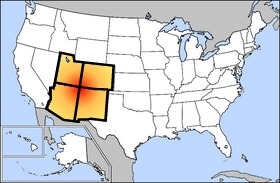
Four Corners, on a map. (Wikipedia image.)

When I say Four Corners, I’m talking about the place on the map where Arizona, Colorado, Utah, and New Mexico meet. In drawing their rather arbitrary state lines years ago, the mapmakers created this manmade point of interest: the only place in the United State where four state boundaries meet at one point. There’s a monument there that supposedly marks the exact point where the states meet. Tourists like to drive in and get down on all fours for photos with one limb in each state.

These days, the monument is managed by the Navajo Nation, which has land on three of the four states. The Colorado section is on Ute Indian land. I’m pretty sure there’s a fee to get in, but I could be wrong. I’ve driven past the point and flown over it, but have never stopped there.

So the passengers wanted to land at Four Corners, which is on Navajo land. That means I need permission from the Navajo Nation to land there. That’s the first hurdle the booking agent has to jump. (I won’t get permits for my passengers; I’ve wasted enough time trying for flights that didn’t happen.)

The booking agent evidently uses some kind of flight planning tool to estimate flight time. He estimated 2-1/2 hours each way. But the booking agent didn’t take into account the realities of endurance, refueling locations, weather, and FAA reserve fuel requirements.

I used SkyVector — highly recommended! — to come up with a basic flight plan — something I could use to estimate the cost of the flight. Its built-in aeronautical charts make it easy to identify places to stop for fuel if needed.

I learned that a direct flight from Scottsdale to Four Corners would take approximately 2-1/2 hours — just as he’d estimated. But this didn’t take into consideration the possibility of headwinds and my aircraft’s endurance. I roughly estimate 3 hours endurance on full tanks of fuel. But could I fill the tanks? I had no idea what the passengers weighed yet. And with my 20 minutes of required reserve fuel, planning a direct flight was not a good idea.

But what made it a really bad idea is that there is no fuel available between Winslow, AZ and Four Corners — a distance of 143 NM or 1-1/2 hour of flight time. Indeed, the closest fuel to Four Corners is 42 NM to the east — not on our way back — at Farmington.

My Flight Plan

SkyVector makes preliminary flight planning very quick and easy.

That meant I needed to plan three fuel stops: Winslow (INW) on the way up and Farmington (FMN) plus Winslow (INW) or Payson (PAN) on the way back. The resulting flight path is a narrow triangle totaling 549 NM and at least 5-1/2 hours of flight time. To be on the safe side, I’d estimate 6 hours.

This is what kills me about some of these booking agents. This particular one is based in Atlanta, GA. I can pretty much guarantee he’s never spent any time in an aircraft over the Navajo Reservation — which is where at least half this flight would be conducted. He has no concept of the vast distances and empty terrain a route like this would cover. He — and likely his passengers — can’t conceive of the utter boredom of six hours flying over this area. Sure, there are scenic parts, but not six hours worth. They’d be paying me close to $3,000 for this one-day adventure.

And all for what? A photo opportunity at a manmade “monument” in the middle of nowhere? Heck, look at it on GoogleMaps! There’s nothing there or anywhere near it!

Yet the booking agent will sell it to them if he can. And I’ll provide the service if it’s paid for.

I think the booking agent could do them a better service by selling them a Sedona tour or a trip up to the Grand Canyon. Or even Lake Powell, for Pete’s sake! Closer, cheaper to visit, and far more interesting.

Of course the weird requests of uninformed passengers or booking agents isn’t really my point.

My point is this: There’s a lot more to flight planning than simply measuring the distance between two points. The preliminary flight plan I cooked up here is just the first part of a lengthy planning process I have to go through if I get this job.

I have to admit that I find it a bit annoying when a booking agent oversimplifies the requirements of a flight — especially if he fails to inform his clients about what they’re getting into. In this case, it’s a long and expensive flight over the high desert of Arizona with very little of interest to see along the way.

Autorotation is Not a Low Rotor RPM Emergency Procedure

Especially when you’re two miles out at sea.

Picture this: An R22 helicopter without floats operating two miles off the coast of Miami, FL. On board is the CFI-rated pilot with 600 790 hours of total flight time and the private pilot rated “passenger” with 115 hours total flight time. They’re operating at about 40 knots 100 feet above the waves on an aerial photo mission, photographing boats. The wind in Miami, 13 miles away, is from 120 at 13 knots and it’s 26°C with a dew point of 21°C, resulting in a balmy 74% humidity.

The pilot had just completed a 180° turn to the south when the low rotor RPM horn sounds.

The pilot adjusts the throttle to compensate — in other words, we should assume that he adds throttle. The horn stops blaring, but 3 seconds later, it does it again.

So what does the pilot do? Despite the fact that the helicopter does not have floats, he enters an autorotation. The helicopter crash-lands in the ocean, the occupants escape, and the helicopter sinks. The pilots are rescued 10 minutes later by a privately owned boat. The helicopter is left unrecovered (so far) in 150-250 feet of seawater.

What We Don’t Know

There are a few things we don’t know that could explain the reason for the low rotor RPM horn:

  • How much did the pilots and their equipment weight? An R22 Beta (not Beta II) is a very small helicopter. Although they had burned off 45 minutes of fuel, there is a possibility that they were still heavy for the flight conditions.
  • Which direction did they turn? A turn that would have put them into a tailwind situation — especially at low speed — could rob them of airspeed. If airspeed dropped below ETL, the helicopter would have to work harder to stay in the air.
  • What speed were they operating at? Without the benefit of forward airspeed and effective translational lift, the helicopter would have to work harder to stay in the air. If the speed was close to zero, the aircraft might have gotten into a settling with power situation. The natural (but incorrect) reaction of increasing the collective to arrest the rate of descent could have triggered a low rotor RPM warning if available power was exceeded.
  • Were the engine and its components functioning properly? If the engine or magnetos were not performing to specifications, the resulting reduction of engine power could cause a low rotor RPM horn. We have to assume the engine was still running because the NTSB report didn’t mention an engine failure.

But regardless of the reason for the low rotor RPM horn, it’s the pilot’s decision to perform an autorotation to into the ocean that needs to be questioned.

The Robinson Low Rotor Horn

In a Robinson helicopter, the rotor RPM green arc is 101% to 104%. (Please don’t ask why; I don’t know. Yes, it is weird.) The low rotor RPM warning system is designed to alert the pilot at 97% RPM. (See it in action for yourself here.) This is a very early warning. The idea is that if rotor RPM is deteriorating, once it gets past a certain point, it could could become unrecoverable very quickly. The earlier the pilot is warned, the better off he is.

At the Robinson factory safety course — and, one might assume, at many flight schools that train in Robinsons — pilots are taught that a Robinson can generally fly at an RPM of 80% plus 1% per 1000 feet of density altitude. Given the temperature, dew point, altitude, and altimeter setting (30.01), the density altitude was 1,612 feet. That means that the helicopter should have been capable of flight when operating at only 82% RPM.

I need to stress here that this is a general rule of thumb. Do not attempt to fly around at low rotor RPM to test this. While it’s true that my flight instructor at the Robinson safety course had me fly for a few minutes in the Long Beach, CA area at 90% RPM with the horn blaring just to prove that flight was possible, RPM is not something we play with in non-training situations. The formula is simple: RPM = life.

Low Rotor RPM Emergency Procedures

The Robinson R22 Pilot’s Operating Handbook is quite specific on what to do in the event of a low rotor RPM warning. On page 3-10, in the red-tabbed “Emergency Procedures” section, it states:

A horn and an illuminated caution light indicates that rotor RPM may be below safe limits. To restore RPM, immediately roll throttle on, lower collective and, in forward flight, apply aft cyclic.

The NTSB report indicates that the pilot initially “adjusted the throttle to compensate for the [low rotor RPM warning] condition” and was immediately rewarded with recovery. But that was followed by the horn sounding again only 3 seconds later.

It had to be scary for the pilot. After all, he’s only 100 feet above the water and he’s supposed to react by lowering the collective. But the emergency procedure and repetitive training doesn’t tell us to enter an autorotation, which would be a full-down reduction of the collective. The reduction of the collective, coordinated with the rolling on of the throttle, should be slight — perhaps an inch or so. This reduces drag on the blades while the increased throttle provides power to increase their RPM.

What Was the RPM?

One of the things we don’t know is what the RPM was when the pilot decided to enter autorotation. If it had deteriorated to the point where autorotation and cyclic flare were the only tools to recover RPM, his decision was probably a good one. Better to hit the water relatively softly than from 100 feet up, falling like a brick.

If RPM had deteriorated to that point that quickly, however, it’s important to recover the aircraft to learn why. Other than a complete engine failure — which was not mentioned in the report — it’s hard to imagine what would cause RPM to drop enough to warrant such a drastic recovery action.

Who Was Flying?

There may be more to this than what meets the eye.

The helicopter was operated by Helicopter Academy, a flight school with locations across the U.S. The school’s Web site clearly advertises it as a low-cost training company:

$250 PER HOUR R22 HELICOPTER TRAINING TIME BARGAIN and we are the ONLY company in the world that can guarantee you a job.  We operate a fleet of helicopters and like other schools our insurance requires 300 hours helicopter time and an instructor’s rating to fly for us. We train you to work for us and offer a job to all graduates, including transfer student and instructors who can’t get jobs elsewhere.

Helicopter Academy’s other business is BoatPix, which uses helicopters to photograph boats and then sells the photos to the boat owners and others. It’s widely known that BoatPix pilots pay BoatPix (or Helicopter Academy) for the time they fly aerial photo missions. The company’s Web site alludes to this:

…you pay for the first 100 hours at $250/hr, the second 100 hours at $200/hr and the third 100 hours at $150/hr….It’s  $25,000 for the first 100 hours where you’ll do mostly training, $20,000 for hours 100  through 200 where we’ll introduce you to our photo contract which will subsidize your flying and $15,000 for hours 200 through 300 where you’ll do almost exclusively photo and will learn this skill that is valuable to our photo contract and making you a valuable pilot to us.

I added the emphasis in the above quote. It begs the question: who was actually flying this aircraft? The NTSB report suggests that it was the 600791-hour CFI. But was that really the case? Was the 115-hour private pilot paying $200/hour to be “introduced” to the photo contract — as a pilot — while the 600791-hour CFI took the photos?

High Risk Operations

In March 1999, Robinson Helicopter issued Safety Notice SN-34. The latest version of this Safety Notice is dated April 2009. Titled “Aerial Survey and Photo Flights – Very High Risk,” it starts out saying:

There is a misconception that aerial survey and photo flights can be flown safely by low time pilots. Not true. There have been numerous fatal accidents during aerial survey and photo flights, including several involving Robinson helicopters.

It goes on to list some of the possible dangers of low time pilots conducting aerial photo flights. It also makes some recommendations for minimum requirements for aerial photo/survey pilots, including a minimum of 500 hours pilot-in-command. BoatPix is one of the operations that has chosen to ignore this recommendation.

My question to helicopter pilot wannabes out there: Are you that desperate to become a pilot that you’re willing to trade your safety for flight time?

Pilot Experience and Decision-Making

What it all comes down to is whether the pilot made the correct decision for the situation he found himself in. I’m not convinced that entering autorotation over the ocean on hearing a low rotor RPM warning horn is the correct decision.

True, both pilots walked (or perhaps I should say, swam) away. But if the rotor RPM could have been brought back into the green while in flight — something a well-trained or experienced pilot could have accomplished if there wasn’t a mechanical problem — the watery autorotation and the resulting loss of the aircraft could have been avoided.

Hopefully, the Probable Cause report for this accident will shed some light on what really happened. Until then, it certainly gives pilots some food for thought.

November 1, 2011 Update: The Probable Cause report doesn’t add much to what’s reported here other than to clarify airspeed and PIC experience. The official Probable Cause is “A loss of main rotor rpm for undetermined reasons.”

Update, March 17, 2012: Just found another accident report with someone else using autorotation as a cure for low rotor RPM. He crashed, too.