Jack the [Desert] Dog

Not exactly a “dog park” dog.

Wickenburg just put in a dog park. If you’re not familiar with the concept, it’s basically a fenced-in area where people can let their dogs run around. It’s especially nice for folks who live in apartments or trailers or don’t have fenced-in yards. Wickenburg’s dog park isn’t anything special — at least not yet. I hope they plant some trees and do some cross-fencing to spruce it up a bit. Right now, it’s just a big area adjacent to the airport that’s surrounded by chain link fence. There are two leaf-less trees, two cheap park benches, and a bunch of molded plastic patio chairs.

But it’s better than nothing and I’m glad whoever put it in did so.

Throughout the day, folks gather there with their dogs, letting them run around together. The dogs bark, the owners shout. The dogs play, the owners socialize. It’s a relatively pleasant scene. Since the dog park is right on the other side of the fence from my Wickenburg hangar, I see its dynamics each time I’m at the airport.

My dog, however, will never set foot inside the dog park. You see, Jack’s a desert dog. He — like my neighbors’ dogs — roams freely on our property on the outskirts of town. On a nice day, we open the back door and let him out. He chases rabbits and squirrels and, when it gets a bit warmer, lizards. We have 2-1/2 acres of property, but he occasionally wanders off to visit with my neighbors, too. Their dog comes to see us once in a while, so it all evens out.

Jack goes lots of places with us. When I head out to the airport or store in town, he rides in the back of my Jeep or pickup truck. He likes to bark when he’s in the back of the truck, as if to yell out “Look at me!” It’s actually pretty annoying and I have to break him of the habit again soon. (Stopping the truck suddenly and throwing a cup of water on him usually does the trick.) When he rides in the Jeep, he likes to sit in my seat while I’m in the store. I don’t have the back windows on the Jeep and he’s fallen out twice. Once was when I was parked at the supermarket. An announcement over the loud speaker said, “Will the owner of a black and white dog please come to the courtesy counter.” I went out to the parking lot to find him circling the Jeep excitedly. He was very glad to see me. A woman standing nearby said, “Is this your dog and Jeep? He’s been trying to get into it. I was going to let him in, but I wasn’t sure if it was his.” I opened the door and he jumped in. We all had a good laugh. He hasn’t fallen out since.

Jack the DogJack also goes hiking with us out in the desert. He’s well behaved on the trail and never bothers other hikers. He’s a bit of a nuisance when we go out to take photos, as we did the other day. He always seems to get into the shot. But now that he’s older — he turned nine this year — he’s starting to slow down and spends a lot more time just relaxing in the scant shade of a tree while we bend over wildflowers and lie prone to shoot up at cacti. It could also be his thick winter coat — which I’ll soon be vacuuming up off my floors and carpets — that keeps him too hot in the springtime to run around.

In answer to a commonly asked question, yes, Jack has flown in the helicopter. He’s been flying with me three times now. I think he considers the helicopter just another vehicle. The last time we flew together, he was very well behaved alone in the back seat.

Jack’s a good dog — the best I’ve had so far. Although he tends to get excited easily and seems to live to be petted, he’s smart and listens — unless, of course, he’s chasing a rabbit. We may spoil him by making him a part of our lives, but we don’t pamper him and don’t allow him to misbehave, especially when there are other people around. In other words, we don’t allow him to give people a reason to complain about him. If more people disciplined and trained their dogs properly, we wouldn’t need so many “No Dogs” signs and leash laws.

And we probably wouldn’t need dog parks, either.

Off-the-Grid Camping in the New RV

Working out the kinks.

One of the improvements I made on my old RV was to add a solar panel to the roof. It was connected to a battery charger which, in turn, was connected to the camper’s batteries. When the sun was out — which is during most daylight hours here in Arizona — the batteries were charged. This made the camper extremely useful for off-the-grid camping. My husband and I did a lot of that last year on our way back from Washington to Arizona. We never ran low on power, which was a good thing because we didn’t have a generator.

There are a few things that won’t work in an RV without a connection to A/C power:

  • A/C power outlets. This means you can’t plug in and use any device with a standard plug.
  • Certain light fixtures. Some lights are A/C while some are D/C. A/C fixtures won’t work without an A/C connection.
  • Microwave. Even if it’s standard equipment on an RV, it’s plugged into an A/C outlet.
  • Air Conditioning. It’s A/C and it sucks a ton of power when it is plugged in and running. That means that even if you have a generator, you need a pretty powerful one to run the A/C when you’re not hooked up to campground or city power.

There are a few things that will run on propane or battery (D/C) power if you’re camping off-the-grid:

  • Refrigerator. Setting the refrigerator on “Auto” tells it to look for A/C power first; if that’s not available, it uses propane from the onboard tanks (assuming the valves have been opened).
  • Stove/Oven. Obviously, they’re propane. It would be dumb to put an electric stove in an RV.
  • Water pump. If you’re not connected to a pressurized water line, a D/C pump activates when you run the water to pump the water from the onboard fresh water tanks.
  • D/C devices. Some RVs include D/C outlets — think of power ports or cigarette lighters on a car. My old RV had one and I added a second; my new RV had three and I added a fourth. These are handy for charging cell phones or plugging in low wattage inverters to plug in low wattage A/C devices like laptops.

Other appliances use D/C power all the time, but if you’re plugged in, your battery is being charged all the time, so it’s no big deal. The heater, stereo, and certain light fixtures are good examples.

As you can see, RVs are pretty much designed to be self-sufficient when you’re off-the-grid. There’s a limit, of course, to how long you can live in an RV without a hookup, though. The solar power (or a generator) helps take care of electrical needs. Eventually, however, you’ll run out of water or fill up your black water sewer tank. There are ways to get around these issues — for example, minimize toilet use by using public toilets whenever possible, carry extra water in external tanks, etc. — so two people can easily live in a well-equipped RV off-the-grid for several weeks if they need to.

Oddly, however, most RV owners do not live in the RV off-the-grid. Instead, many of them tend to pull their RVs from one parking lot-like RV park to the next, cram them into narrow spaces between other RVs, hook up power, water, and sewer lines, and retreat inside their luxury boxes to watch television.

I’m not like most RV owners.

Before trading in the old camper, I pulled the 135-watt solar panel off the roof. This past week, I had it installed, with a new battery charger and controller, on the roof of my new RV.

This weekend, my husband and I are out in the desert about 25 miles west of our Wickenburg home, testing the trailer’s off-the-grid setup. I’m out in Aguila, at a private “resort” where my clients are testing some wireless networking equipment. The test requires me to fly their equipment around in the helicopter to see how well it works with ground-based mobile and stationary equipment. There’s more to it than that, but for the sake of my client’s privacy, that’s really all I’m willing to say.

At Robson'sThe job has a lot of down time — time when I’m just waiting around for them to be ready to fly. It made sense to bring the RV out here for the weekend. It gives Mike and I a chance to get away and relax away from home and we can bring along Jack the Dog and Alex the Bird. And, of course, we can test the off-the-grid setup of the RV close enough to home so that if there’s a serious problem, we’re not suffering. So the RV is currently parked about 100 yards from the helicopter’s landing zone out in the desert.
We’ve discovered a few things:

  • When the refrigerator works off propane, it makes a noise that sounds like a fan running inside it. We’re not sure if it should be doing that. It seems to work fine and the fan noise does stop when the refrigerator reaches the correct temperature. But my last two RVs had silent refrigerators, so we’re a bit concerned.
  • The fresh water in the tanks smells like shit. I do mean that literally. We’re not drinking it, but we are washing with it. It’s making the RV stink a bit on the inside, so we have a lot of windows open to keep the air cleared out. This is our fault. We should have flushed out the system before using it. We’ll do that after this trip and likely run at least one tankful of clean water through it, too.
  • The new solar setup works great. It had the batteries fully charged before 10 AM. While it was doing that, we were using the lights, stereo, cell phone chargers (all D/C) and a 300-watt A/C inverter to charge my MacBook Pro and some aviation radios.
  • The 2000-watt Honda generator I bought so I could run A/C devices if I wanted to works great. It’s easy to start and can be very quiet. We gave it a good test on Saturday night when we ran it to see if we could watch a DVD (Up) on the 32-inch (or thereabouts) flat screen TV the RV came with. It ran hard when we first started it — likely to recharge the batteries we’d run down a bit after sunset while giving us A/C power — then settled down to a lower, quieter power setting. I don’t think I’d run it in the future just to watch TV, though.

Everything else works exactly as expected.

At this point, I consider this second test a success. It proves to me that the new RV can be at least as comfortable — more so, of course — than the old one when camping off-the-grid. Even though I didn’t get the solar power system I wanted, I think my less expensive solution — one solar panel to charge the batteries and a portable generator for more power when needed — will work fine.

One thing’s for sure: having a portable house along on these weekend long gigs is very nice indeed — even if I’m not plugged in.

One Gig, One Dozen Off-Airport Landing Zones

Testing my skills out in the desert.

For the sake of my clients’ privacy, I won’t go into too many details about where I flew or why I flew there. But I will say this: it was the most challenging day of flying I had in a long time.

LZ1
LZ2
LZ 3
LZ 4
LZ 5
LZ 6
LZ 8

No, I wasn’t chasing desert racers or boats on Lake Havasu. And I wasn’t flying around a bunch of photographers who don’t speak much English. I was flying miners around their claims in the desert mountains.

Their claims spanned a mountainous area at least 80 square miles in size. My job was to show them the sites from the air and, if they wanted to land and there was a suitable landing zone, land so they could check things out on the ground. Of course, all this was going on 100+ nautical miles from my Wickenburg base at about 500 to 1500 feet elevation on an 85°F day. And since I had three passenger seats, each flight had three passengers.

Fortunately, there were no fatties. (Well, maybe one.)

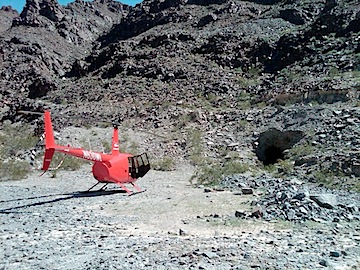
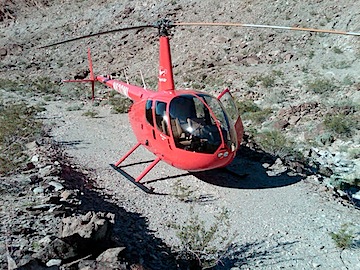
I started collecting photos of the landing zones but gave up after the seventh one. I tried to send each photo to TwitPic as I took them, but I didn’t have cell phone service for most of the day. In fact, my BlackBerry’s battery nearly drained just searching for a signal all day. The doors are open on the helicopter in most of the photos because it was so damn sunny and hot. I left the doors wide open each time we stopped just to keep air flowing through the helicopter. Otherwise, we would have been baked.

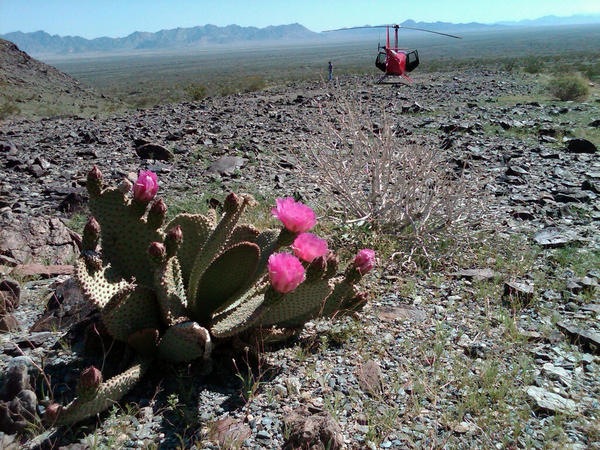
I wish I’d brought a better camera with me. These photos are all from my BlackBerry. The one with the cactus flower is supposed to be artistic. I can pull off that kind of shot much better with my Nikon and a wide angle lens.

The landing zones ranged from smooth, almost level clearings to old dirt mining roads. Some spots were wide open; others were relatively tight. Some spots were definitely slopes. I hate slope landings. I mean I really hate slope landings. The fact that I did about 10 of them yesterday says a lot about what I’m willing to do for money. No, none of the slopes were too dangerous. I just prefer more level ground. And, near the end of the day when I was really tired and probably a bit dehydrated, I was having a lot of trouble making those damn slope landings. At one place we stopped, I tried four different spots before I found one I liked.

Some of the landing zones were quite close to the mine features my clients wanted to explore. Others weren’t. At two sites, my clients had quite a climb to get where they wanted. They didn’t seem to mind — which was nice of them. Some folks expect fancy one-skid landings on mountain sides — which they won’t get from me. These folks were my kind of people — “safety first,” the leader told me at the start of the day.

The weather was as close to perfect as you can get — if you don’t mind mid-March desert heat. Perfectly clear blue skies, with just enough of a breeze to keep us cool without making for sloppy low-speed flying.

My helicopter performed like a champ — despite the heat. The density altitude was about 4,000 feet for most of the day. I started the day with about 3/4 tanks of fuel, fully expecting to need at least one refueling stop. But since we shut down at nearly every landing zone, I didn’t burn much fuel.

The first round of flights started at 9 AM and went until about 2 PM. We took an hour for lunch. I was glad they brought enough for me, since we ate it right out in the desert where they’d left their trucks. (No restaurant for miles.) Then I made another round of flights, finishing up at about 5:15 PM.

Of course, I didn’t have enough fuel to get home and, when I reached the nearest airport, it was closed. So I had to call out for the fuel guy and pay an extra $25 to get my main tank topped off.

I got back to Wickenburg about 20 minutes after sunset. It was dark when I left my hangar and made my way home.

I slept very well.

More on Fan Mail

I’m actually starting to like it.

Way back in May 2006, I wrote a blog post about Fan Mail. In it, I voiced my embarrassment about getting it from readers.

201003160814.jpgThings seem different lately, and I’m not sure why. I’ve begun getting fan mail from readers of my articles in Aircraft Owner Online (AOO), an online magazine for aircraft owners (duh). The articles are mostly recycled and refreshed blog posts and, to date, are all at least five years old. The folks at AOO do a great job of laying out my text with the high resolution photos I provide, making a slick presentation of my work. (They do the same for the rest of the magazine, of course.) I enjoy preparing and submitting the pieces, mostly because it gives me an excuse to dig back into my archives and relive the flying experiences I’ve written about. The AOO editors barely touch my prose, so I don’t have any reason to complain about heavy-handed editing. It’s a truly positive experience all around.

But what’s most rewarding to me (beyond payment for my work) is the fan mail my monthly “Adventure Flight” column articles have garnered. I’ve been writing for the magazine since November 2009 and, to date, have received at least four e-mailed “fan mail” letters. The most recent came just this morning:

Just a quick note to tell you how entertaining your articles have been in Aircraft Owner online Magazine. You have a very descriptive way of writing that makes one feel (and wish) that they were there flying with you. My wife is from Nogales, Arizona and has a sister in Scottsdale presently. I looked over the map of the various places that you mentioned in your latest article and felt like I had made the flight with you. Keep up the great articles and from one pilot (SEL) to another, I wish the best to you in your various endeavors.

I just felt you should know how much your writing is appreciated.

I didn’t expect any note from a reader to make me feel as good as this one did. In the past, much of my “fan mail” has been glowing praise about my achievements in general, most of which included some kind of envy or “I wish I could do that” statement. That kind of stuff embarrasses me and makes me feel bad for the writer. Most of us have the power to achieve what we want, if only we set our minds to it and do what’s necessary to make it happen.

But a note like this is so different. It complements me on my writing skills rather than on the volume of my published work. (Isn’t acknowledgement of quality better than acknowledgement of quantity?) It let’s me know that I’ve made an impact in someone’s life — even if it’s just a small impact. After all, the note writer read my article about flying with my friend Jim and took the time to dig out a map to follow my progress. The places we flew on that trip aren’t easy to find on a map, but this reader succeeded. And it prompted him to take the time to track down my contact info and send me a very nice note.

A note that pretty much made my day.

So despite what I wrote four years ago, I think I might actually like getting fan mail.

Another Scammer Looking for Free Content

Business opportunity? Is that what you call it?

A few weeks ago, I received the following e-mail message from someone I didn’t know, with the subject line: “I like your work- Business Opportunity”:

Hi Maria,

My name is [redacted] and I got your contact info from Lynda.com and really like your work especially your blogging content.

I am involved in a start up company that is wanting to change the way entrepreneurs use and get content. We are composing information/articles in a platform for marketing, legal and financing and we are looking for great business content to provide our entrepreneurs. We are looking at several options to pay authors for their content.

One of the reasons I emailed you was because I really like your work and I wanted to engage you in your level of expertise and wondered if you would be willing to answer some brief questions about your work. If you are interested in learning more about this opportunity please email me at [redacted]@gmail.com or call me at [redacted].

Looking forward to hearing from you,

[redacted]

http://www.linkedin.com/in/[redacted]

A few things struck me about this:

  • Apparently the folks at Lynda.com had given this person my contact info. That meant this initial contact had an element of networking to it instead of being just a “cold call” e-mail. (More on this in a moment.)
  • This could be a lead on another good publishing opportunity. As print publishing declines and the beginner-to-intermediate user base I write for shrivels, I’m always looking for new opportunities to write or create content for paying markets.
  • There was no mention of a company name or a Web site name. The person contacted me from a Gmail account. That raised a red flag.

But heck, it was worth a shot. I e-mailed back:

What do you need to know?

Maria

The Questionnaire

The response came quickly:

Maria,

Thanks for the quick reply!

I have prepared these questions for you. If you would rather I called please let me know when you are available or if you would rather feel free to respond to these questions via email.

I know your time is very important so please feel free to be as vague or detailed as you want on the questions. I really appreciate your feedback and I hope when we launch, you will be apart of our expert authors. Any feedback you have regarding these topic would be great. We hope to be able to provide additional revenue streams for authors by breaking down content.

1. Would you be willing to resubmit your articles/book content in a 5 step format or less? And would this be doable for you?

2. What kind of opportunities are out there for you in regards to getting your work out?

3. Who are you currently partnered with right now?

4. How do you typically get your content published?

5. Is this your full time job?

6. What outlets do you seek to get your work published or do they come to you?

7. What products do you have? Do you have any content in any other format? Audio? Video?

8. How do you typically get paid?Is it a flat fee? Would you be interested in getting paid pay per click?

9. Would you be interested in getting an identity in our community and would it be useful for to you have a website on our site that allowed you to sell your work, that could connect to your Facebook and additional products? It would also have a fan reading for you too.

Thank you for your help in advance Maria!

[redacted]

By this time, the red flag was flying high. The questions proved that she knew little or nothing about me or what she was doing. After all, questions 3, 4, 5, and 7 could be answered by a visit to my Bio page. Question 1 clearly indicated that she had no knowledge of copyright and non-compete clauses that appear in standard book and other publishing contracts. Questions 2 and 6 certainly shouldn’t matter to her if she’s really offering me an opportunity. Question 8 told me she was going to try to pay me per click — which is something I’m not interested in, especially from a “startup.” And Question 9 told me (1) she had no idea that I already had two very well-trafficked Web sites, (2) that my publishers sold my work, leaving me to actually create content, (3) that she would attempt to tie me to a Web site her organization operated, and (4) that she’d likely try to sell me products.

But I played along to see where I could take it and whether I could get her to dig herself in any deeper:

I’m a freelance writer and have been since 1990. I’ve written 70+ books and hundreds of articles for dozens of legitimate print publishers (think McGraw-Hill, Macmillan, Random House, and Peachpit Press). My Mac OS X books for Peachpit have been bestsellers since 1999. I also produce audio and video — you’ve seen the video on Lynda.com; I’m working on another title for another publisher now.

You can get all this information and more about me on my Bio page: https://aneclecticmind.com/bio/
You can see a list of all my published work using links on my site, https://aneclecticmind.com/

I don’t have a “full time job.” That’s one of the benefits of being freelance.

I’m definitely NOT interested in getting an “identity” in any “community.” I have an identity and certainly don’t need another one. I’m not the least bit interested in being tied to another Web site. My publishers are doing a pretty good job of selling my work, so I don’t see the need to use another Web site to sell it, too.

If you’re looking for a low-cost content creator, don’t look at me. I get paid very well for my work.

That said, let’s cut to the chase. What did you have in mind?

And maybe you can tell me who YOU are and why you are contacting me through a Gmail account. Doesn’t your company have e-mail?

Maria

As you might imagine, I didn’t get a response.

I contacted the folks at Lynda.com to see if they knew anything about this person. I forwarded them the initial e-mail. They all confirmed what I had begun to suspect: they hadn’t given this person my contact information at all.

So I sent [redacted] a final e-mail message:

It turns out that no one at Lynda.com gave you my contact info. I’ve warned them about you and what appears to me to be some sort of scam. Don’t contact me again.

What Writers Should Take Away from This

There’s a lesson here for writers, including bloggers and other content creators.

There are many “startups” out there in desperate need of fresh content. They’ll make all kinds of promises to get you to submit content to them. They’ll promise ad revenue from the pages on which your content appears, they’ll promise you payment per click on your content, they’ll promise to give you an “identity” and make it easy for your “fans” to find you. They’ll flatter you and tell you they love your work — without even knowing what your work is. Meanwhile, you’ll be required to upload and format your content on their site. You’ll be required to moderate or respond to comments on your content — perhaps even give technical support or answer other questions. Your “business partner” will also likely keep all rights to your work and republish it elsewhere without paying you a dime.

But you think it’s a good idea — they’ve hinted at thousands of hits a day! — so you give it a try. Your work appears on a slick-looking Web site that’s just jam-packed with advertising. But you soon discover that the majority of people visiting the site are the suckers like you — and their clicks don’t count. Your work appears among the drivel spewed out by other writers trying to cash in on a “business opportunity.” You’ve lost the rights to republish your work elsewhere and you’re not making enough to buy lunch once a month.

You think I’m making this up? I’m not. I was suckered in by one of these about five years ago. Sadly, I didn’t blog about it so I can’t remember the name of the company. But I did blog about eZineArticles.com, which is probably the biggest ripoff out there for serious writers. (Publish with them and you never know where your work will end up; mine appeared on porn sites.)

What do they get? Advertising revenue. Or maybe they repackage and sell your content to someone else.

My advice is to avoid any operation like this — even if you’re just starting out. It’s rare that any relationship like this can benefit your career.

A legitimate publisher will pay you for the content you create. Up front, before or at publication. They will accept First Rights or reprint rights or negotiate with you for rights — they won’t take all rights unless they’re paying big bucks for them. Although they might offer bonuses based on content popularity (hits), the revenue will not be completely tied into that. And, for Pete’s sake, they won’t compensate you based solely on clicks or ad revenue.